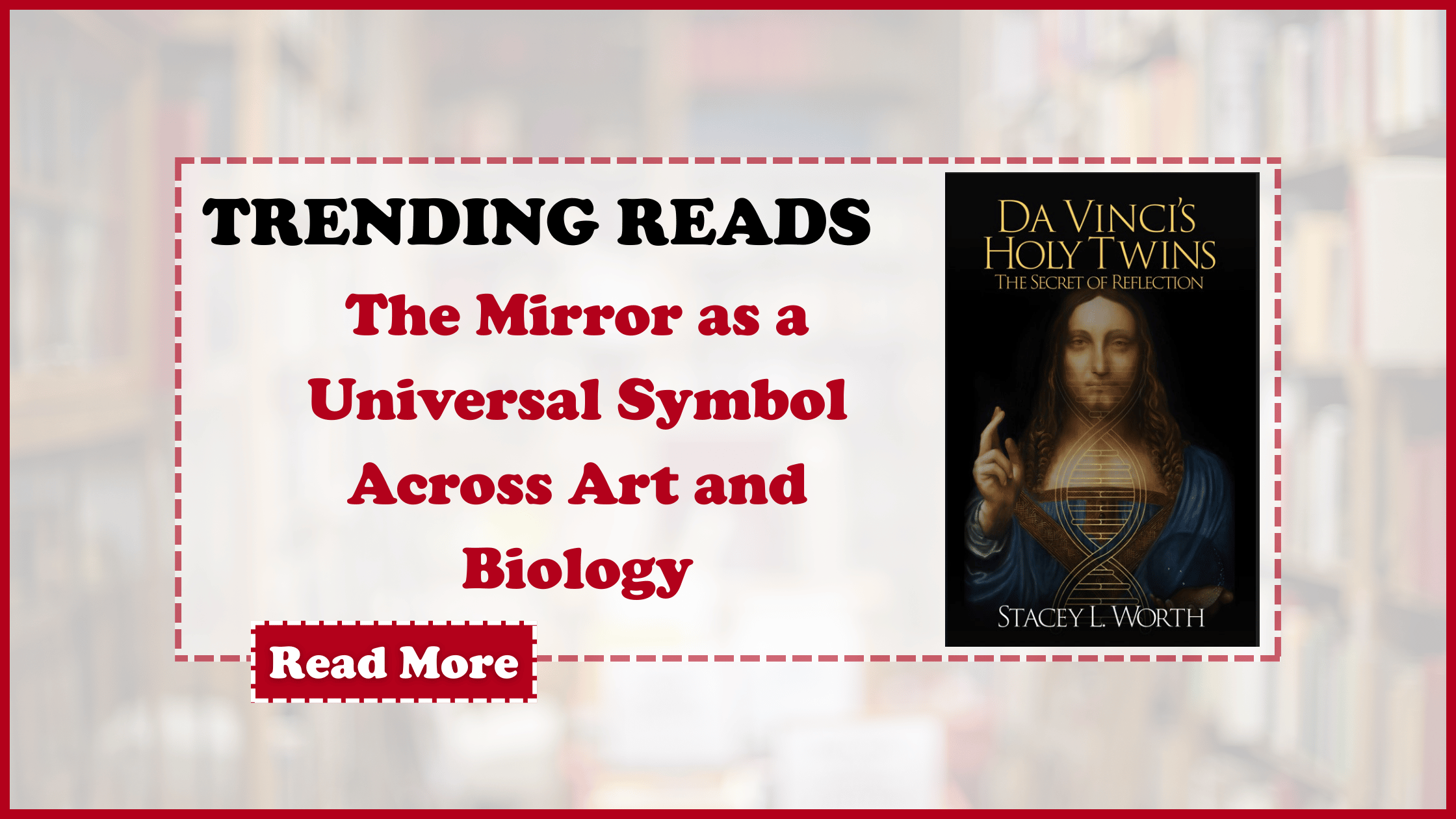
The mirror as a universal symbol across art and biology reveals how awareness recognizes itself through reflection rather than instruction. A mirror does not create truth. It reveals what already exists. Across cultures, disciplines, and time, the mirror has represented consciousness awakening to itself, identity forming through recognition, and life understanding itself through relationship. In Da Vinci’s Holy Twins: The Secret of Reflection by Stacey L. Worth, the mirror is not merely symbolic. It is a functional principle that operates within art, the human body, and the structure of consciousness itself.
In art, the mirror has long been used to challenge perception. It reverses orientation, disrupts certainty, and asks the viewer to question what is being seen and who is doing the seeing. Leonardo da Vinci understood this deeply. His use of mirrored imagery, dual faces, and symmetrical forms invites reflection rather than interpretation. According to Worth, these artistic choices were intentional signals that truth emerges when perception turns inward. The mirror becomes a threshold where surface identity dissolves and deeper awareness begins.
Biology mirrors this process in remarkable ways. Life develops through reflection and replication. DNA itself is structured as a mirrored double helix, carrying information through complementary pairing rather than dominance of one strand over the other. Neurons respond to mirroring behavior. The nervous system learns through reflection, observing, imitating, and resonating. Memory is reinforced not only through repetition, but through relational feedback between body and environment. The mirror in biology is not metaphorical. It is structural.
Stacey L. Worth connects these biological realities to consciousness. Awareness does not arise in isolation. It emerges through interaction. The self becomes known through reflection, between inner sensation and outer experience, between stimulus and response. When reflection is disrupted, consciousness fragments. When it is restored, coherence returns. This is why reflection plays such a powerful role in healing, learning, and identity formation.
The mirror also functions as a regulator. It restores balance by revealing excess, absence, or distortion. In art, a mirrored image exposes asymmetry that might otherwise go unnoticed. In the body, feedback loops operate as mirrors that maintain equilibrium. Hormonal systems, neural pathways, and cellular processes rely on constant reflection to remain aligned. When these mirrors fail, imbalance occurs. When they function properly, the system self corrects.
In Da Vinci’s Holy Twins: The Secret of Reflection, the mirror is presented as the meeting place of masculine and feminine currents. These currents reflect one another, creating unity through difference rather than separation. Leonardo’s work preserves this balance visually, while biology expresses it functionally. Consciousness emerges not from one force overpowering another, but from their mutual recognition.
The mirror is also central to remembering. It does not force recall. It invites recognition. When memory is fragmented through trauma or silence, reflection allows awareness to return gradually. A familiar image, a repeated pattern, or a symmetrical form can awaken knowing without demanding explanation. This is why art can heal and why the body responds to rhythm, touch, and resonance. Reflection reaches places logic cannot.
Ultimately, the mirror as a universal symbol reveals that consciousness is relational by nature. It knows itself by seeing itself. Da Vinci’s Holy Twins: The Secret of Reflection by Stacey L. Worth presents the mirror not as illusion, but as a doorway. Through art and biology, it shows that awareness does not advance by accumulation. It awakens through reflection, recognition, and the quiet moment when life sees itself clearly and remembers.