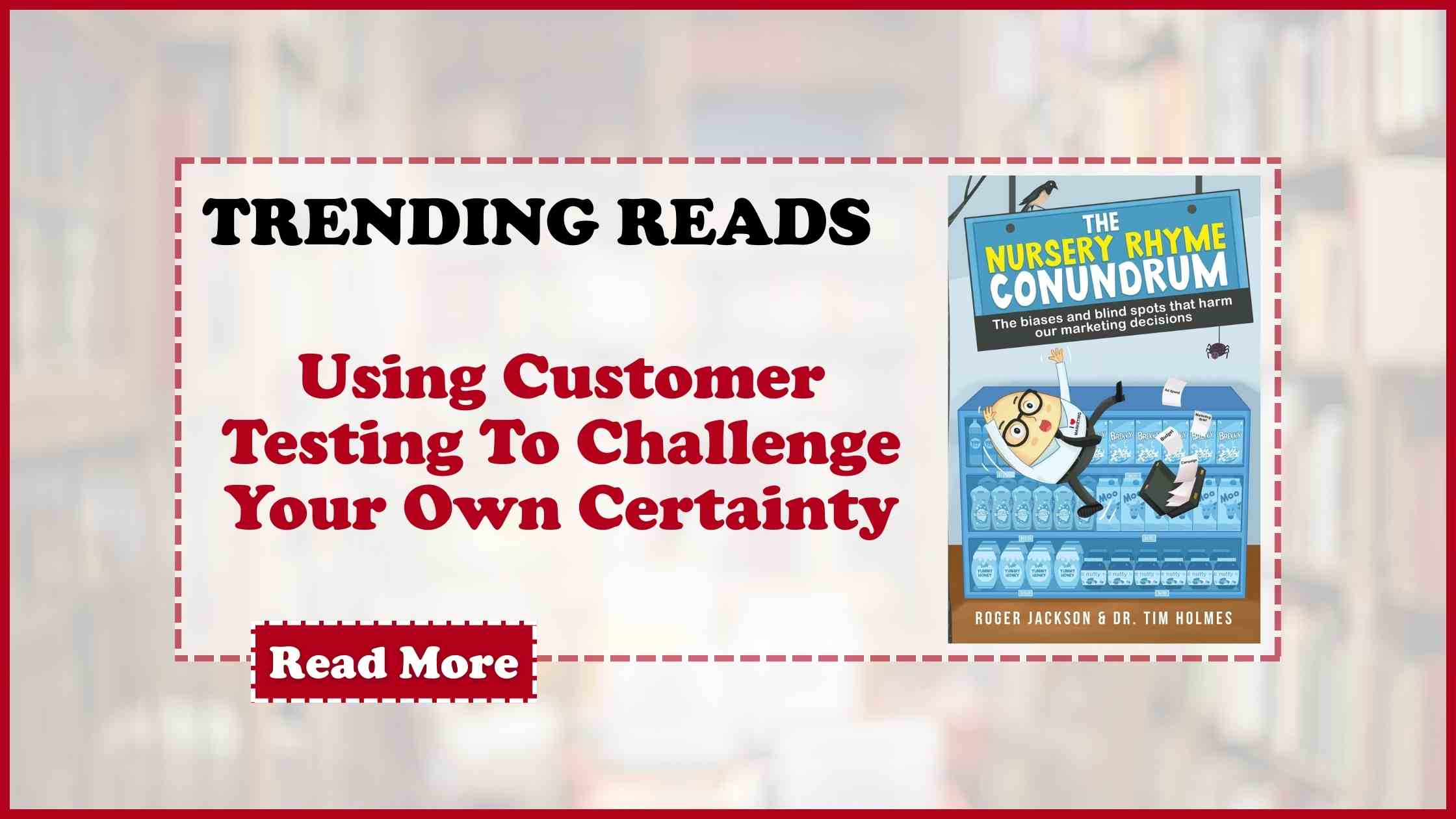
Most marketers feel confident in their work until the moment it meets real customers. That is when assumptions are exposed, and certainty begins to crumble. While this can feel uncomfortable, it is one of the most valuable steps in building effective communication. The book The Nursery Rhyme Conundrum by Roger Jackson and Dr. Tim Holmes explains why even experienced professionals can overlook their own blind spots and why customer testing is essential for clarity, accuracy, and stronger, more informed creative decisions.
Why Even Experts Miss What Customers See
Dr Tim Holmes’s research shows that people interpret information far more simply and quickly than marketers imagine. Creative teams spend weeks or months working on an idea, which builds deep familiarity. This familiarity creates overconfidence. Once you understand the strategy, message, and intent behind a concept, it becomes difficult to imagine how it appears to someone seeing it for the first time.
From where blind spots develop. A headline that feels sharp in the meeting room may feel flat to a customer. A visual that seems obvious to the team may fail to communicate the right meaning. Testing reveals these gaps, not to embarrass creators, but to help them see what their minds automatically fill in.
The Value of Early Testing
One of the biggest misconceptions is that testing slows down the process. In reality, early testing saves time. A brief round with a small group of customers or neutral viewers can help identify confusion before significant resources are invested in production or media. It also gives teams confidence that the message is landing as intended.
For example, a financial services company may create a campaign to explain the benefits of a new product. Internally, everyone understands the product. When tested with customers, the central message might be unclear or overshadowed by jargon. Catching this early prevents wasted investment and allows the team to refine the message while the changes are still easy to make.
The Power of Post-Campaign Learning
Testing should not stop once a campaign is live. Post campaign reviews help teams understand what worked and what did not. It builds long-term learning and supports better decisions in future projects. The book highlights how reviewing real customer responses, rather than relying on internal opinions, strengthens creative judgment.
For instance, a brand may discover that customers recall the visual but not the primary message. Or they may find that customers did not understand the offer at all. These insights create practical guidance for future work and reduce the risk of repeating mistakes.
Making Testing Part of Everyday Practice
The frameworks in The Nursery Rhyme Conundrum encourage teams to make testing routine and straightforward. It does not require large budgets or complex research setups. A small panel of customers, a quick online test, or even informal conversations can reveal powerful insights. The goal is not to chase perfection but to build a habit of verifying assumptions.
Teams should also learn to embrace feedback rather than fear it. When the red pen appears, it is not a sign of failure. It is a sign of improvement. More transparent communication leads to better results, and better results come from understanding how real people respond.
For marketers who want to build smarter habits and strengthen their decision-making, The Nursery Rhyme Conundrum by Roger Jackson and Dr. Tim Holmes offers practical tools that connect neuroscience, creativity, and everyday customer testing.
Grab your copies from Amazon: https://www.amazon.com/dp/1970749032/.
Here is the full podcast where the author dives deeper into the message of the book:
Spotify link:https://open.spotify.com/episode/2LwnCYYPNYOEOIZ51UEuVr?si=yC2xIf0QQja18gztiBw0_w