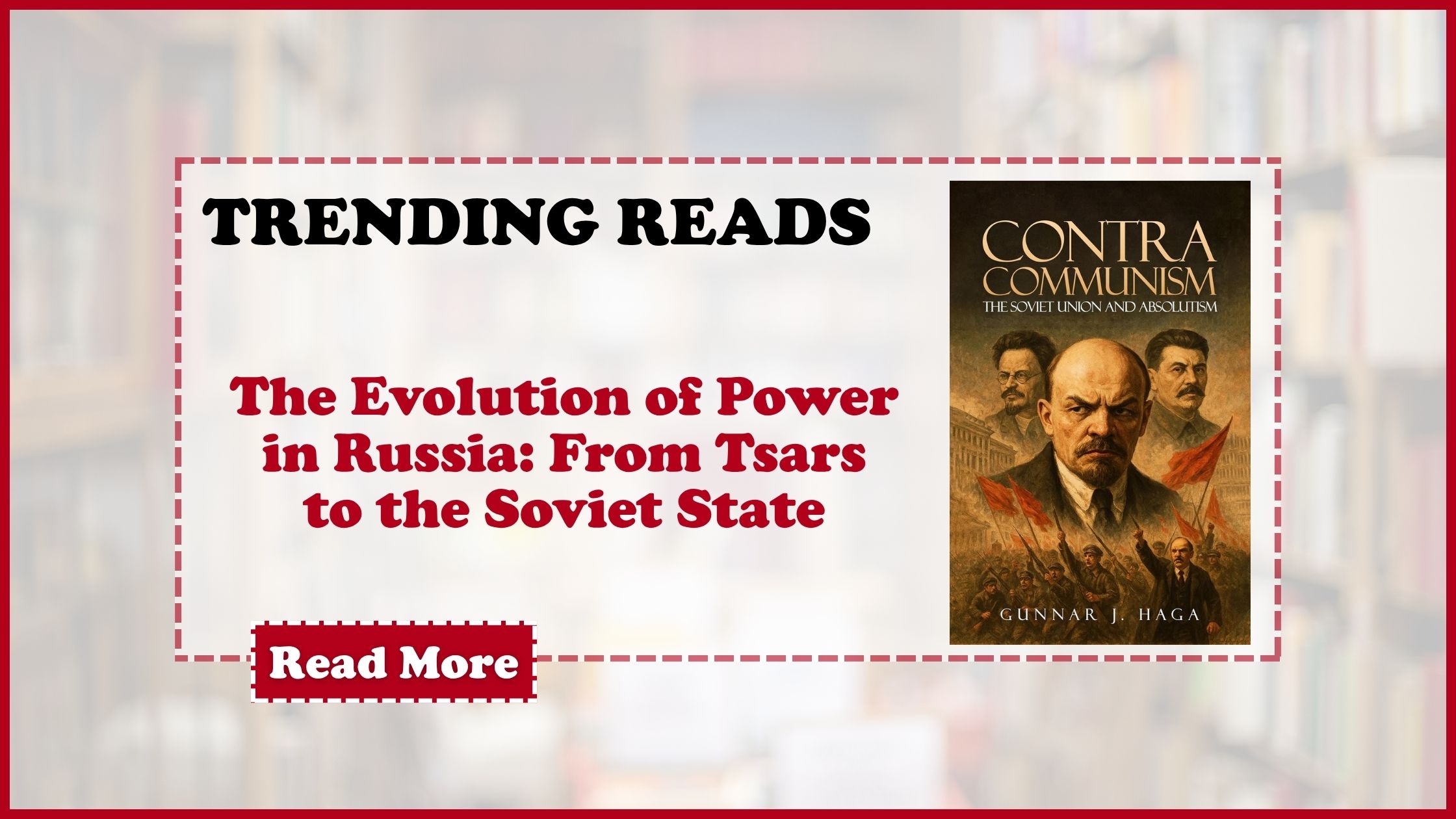
The story of modern Russia is often told as a dramatic sequence of revolutions, ideologies and sudden breaks with the past. From the fall of the tsars to the rise of the Soviet Union, it is commonly framed as a transition from monarchy to communism, from old-world autocracy to a radical new social order. But in Contra Communism: The Soviet Union and Absolutism, author Gunnar J. Haga challenges this familiar interpretation and предлагает a different lens through which to understand Russia’s political evolution: not as a shift from tsarism to communism, but as a transformation in the structure of centralized power that ultimately resulted in what he calls totalitarian absolutism.
At the center of Haga’s argument is the idea that Russia’s political development cannot be understood simply through ideological labels. Instead, it must be examined as a long historical process shaped by institutional continuity, delayed modernization and structural constraints. Unlike Western Europe, where feudalism gradually evolved into decentralized political competition and later into democratic systems, Russia followed a more centralized and uneven trajectory. Power remained concentrated in the hands of ruling elites for far longer and social transformation occurred without the same gradual diffusion of authority seen in Western states.
Under the tsars, Russia operated through a system often described as autocratic, but Haga emphasizes that this characterization alone is insufficient. Tsarist power coexisted with entrenched social hierarchies and regional structures that limited full state penetration into every aspect of life. While the tsar held ultimate authority, governance was still mediated through traditional elites and fragmented administrative realities. This produced a system that was centralized in principle but not yet fully unified in practice.
The collapse of this structure in the early twentieth century did not immediately result in a stable alternative. Instead, Russia entered a period of profound instability and competing political possibilities. The February Revolution of 1917, in Haga’s interpretation, represents a crucial but often misunderstood moment in this transition. Rather than being the beginning of Soviet communism, it marked the breakdown of imperial authority and the emergence of a political opening in which multiple futures were possible, including the development of a more pluralistic and potentially democratic system.
However, this open historical moment was short-lived. The October seizure of power fundamentally altered the direction of Russian development. According to Haga, the Bolshevik consolidation of authority did not continue the democratic potential unleashed in February but instead replaced it with a highly centralized one-party system. This shift marked a decisive break in the evolution of power, not toward communism as traditionally understood, but toward a new configuration of state dominance.
From this point onward, power in Russia underwent a profound transformation. The Soviet state expanded its reach far beyond the limits of traditional governance. Economic production, political expression, cultural life and even ideological thought became subject to centralized control. Haga describes this system not as the realization of a stateless or classless society, but as the emergence of totalitarian absolutism, a form of governance in which the state absorbs nearly all autonomous spheres of society.
In this framework, the Soviet Union is not the endpoint of a Marxist progression toward communism, but rather a distinct historical formation that replaced one centralized system with another. The tsarist order, with its imperial hierarchy and inherited privilege, gave way to a modern bureaucratic elite organized around the party structure. While the symbols and language changed, the underlying concentration of power intensified rather than diminished.
Haga’s analysis also raises important questions about how political systems are labeled and understood. The widespread identification of the Soviet Union as a communist state has shaped global perceptions of both Russia and communism itself. Yet if the Soviet system did not meet the theoretical conditions of communism, such as the absence of class hierarchy and the dissolution of centralized state control, then the label itself becomes historically misleading. What has often been called communism may instead represent a different kind of state formation entirely.
This reinterpretation does not simply revise one historical episode; it reshapes the entire narrative of Russia’s modern evolution. Rather than viewing 1917 as a clean ideological break, Contra Communism presents it as part of a longer continuum in which the form of power changed, but its concentration deepened. The result is a reexamination of how revolutions function, not only as moments of ideological change, but as turning points in the structure of authority itself.
By tracing Russia’s journey from tsarist rule to the Soviet state, Gunnar J. Haga invites readers to reconsider the assumptions that underpin conventional historical accounts. The evolution of power in Russia, as presented in Contra Communism: The Soviet Union and Absolutism, is not a story of the simple replacement of monarchy giving way to communism but a complex transformation in which centralized authority persisted in new and more expansive forms.
Ultimately, the book challenges readers to rethink what changed in Russia and what remained fundamentally continuous. In doing so, it offers a provocative reinterpretation of modern history, suggesting that to truly understand the Soviet Union, we must first understand the deeper structures of power that shaped Russia long before the revolution ever began.