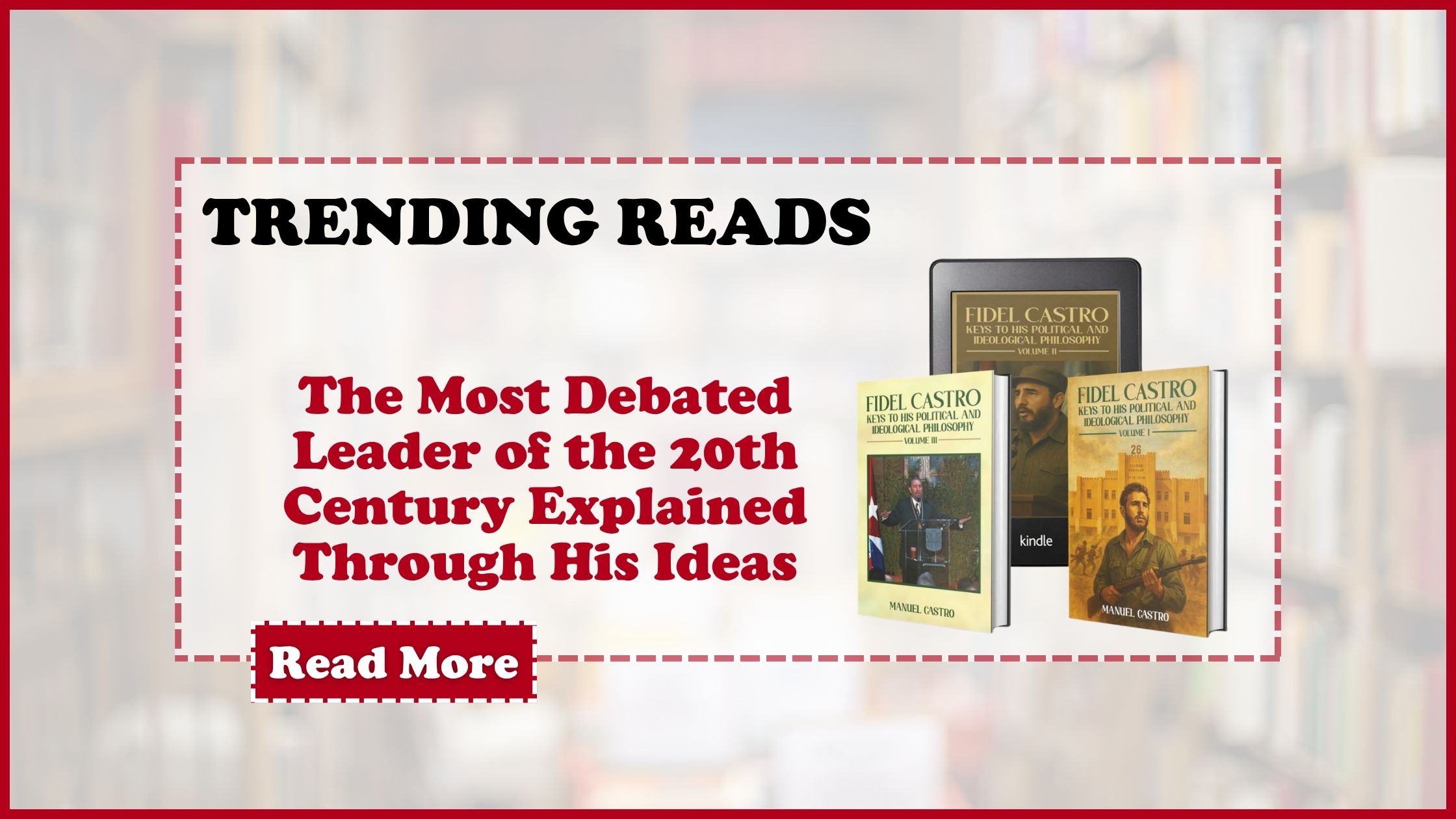
Few figures in modern history have sparked as much debate, admiration and criticism as Fidel Castro. For decades, he has been portrayed through sharply divided lenses, seen by some as a symbol of resistance and by others as a controversial ruler. But if you strip away the headlines, the soundbites and the political noise, one truth becomes clear: you cannot fully understand Castro without understanding his ideas. That’s where Fidel Castro: Keys to His Political and Ideological Philosophy (Volumes I–III) by Manuel A. Castro steps in, offering a powerful and detailed exploration of the thinking behind one of the 20th century’s most discussed leaders.
This trilogy does something most books don’t: it shifts the focus from events to ideology. Instead of retelling familiar historical moments, it asks deeper questions. What principles guided Castro’s decisions? How did he view power, justice and society? And how did those ideas shape not only a revolution, but an entire national identity? By answering these questions, the books move beyond simplified narratives and invite readers into a more nuanced understanding.
At the heart of the series is a distinctive framework often described as a “philosophy of variables.” Rather than presenting a single, rigid doctrine, the books break down Castro’s thinking into hundreds of interconnected concepts. These include themes like sovereignty, social equality, economic independence, education, media influence and global power relations. Each concept acts as a building block, helping readers see how complex ideas come together to form a cohesive worldview. It is a structure that mirrors the complexity of real-world politics, making the trilogy not just informative but intellectually engaging.
One of the most fascinating insights the books offer is Castro’s approach to power. In his philosophy, power is not merely about authority or control; it is about influence. It is about shaping how people think, what they believe and how they act. This is why communication plays such a central role throughout the trilogy. Castro’s speeches were not just political statements; they were strategic tools designed to educate, mobilize and unify. Long before the digital age transformed how ideas spread, he understood that narrative is one of the most powerful forces in shaping reality.
The trilogy also places Castro’s ideas within a broader global context, which is essential for understanding why he remains such a debated figure. His philosophy engaged directly with issues like inequality, imperialism and development topics that continue to dominate international discussions today. By exploring these themes, the books show how his ideas resonated far beyond Cuba, influencing conversations and movements around the world. Whether readers agree with his views or challenge them, engaging with these ideas offers valuable insight into the forces that shape global politics.
What makes this series particularly compelling is its ability to encourage critical thinking. It doesn’t tell readers what to believe. Instead, it provides the tools to analyze, question and interpret. This approach is especially important when dealing with a figure as polarizing as Castro. Understanding his philosophy doesn’t mean endorsing it; it means recognizing its impact and its role in shaping history. In a time when complex issues are often reduced to simple narratives, this kind of depth is both refreshing and necessary.
For anyone interested in leadership, political theory or modern history, Fidel Castro: Keys to His Political and Ideological Philosophy (Volumes I–III) offers a unique and valuable perspective. It transforms a widely debated figure into a subject of thoughtful exploration, revealing the ideas that fueled his actions and sustained his influence over time.
If you are ready to move beyond headlines and engage with the deeper forces behind one of the most talked-about leaders of the 20th century, this trilogy provides the insight you have been looking for.