Few debates in modern American history remain as emotionally charged and politically controversial as this one: Would John F. Kennedy have withdrawn from Vietnam if he had lived?
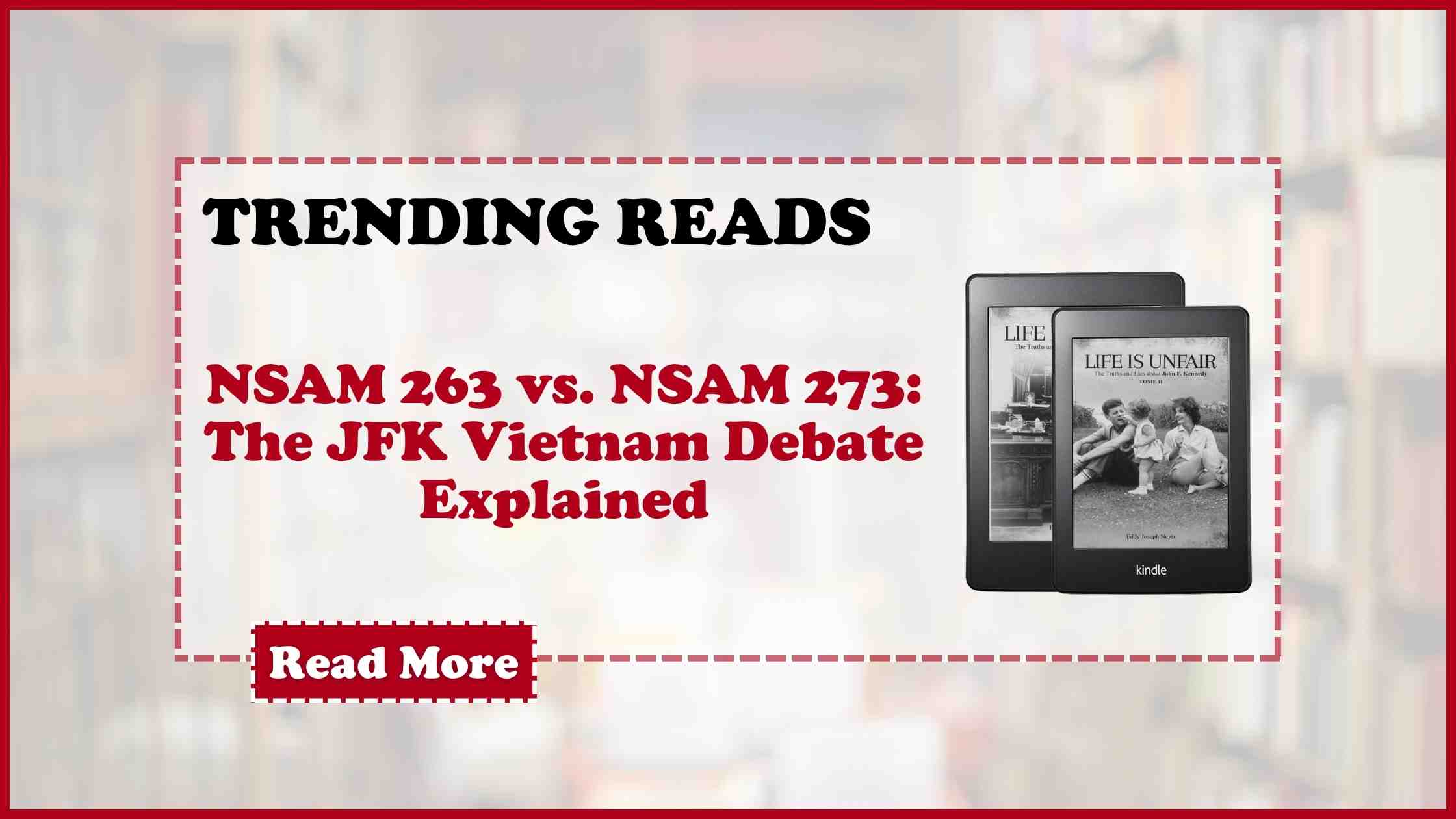
This question is explored in depth in LIFE IS UNFAIR: The Truths and Lies about John F. Kennedy by Eddy Joseph Neyts, a two-volume historical study that examines the myths, contradictions and political realities surrounding the Kennedy presidency. Among the book’s most compelling sections is its detailed investigation into the Vietnam War controversy and the clash between two critical presidential directives: NSAM 263 and NSAM 273.
To many historians, these memorandums represent two completely different directions for American foreign policy in Vietnam. One appears to point toward withdrawal. The other signals escalation.
More than sixty years later, the debate continues.
What Was NSAM 263?
NSAM stands for National Security Action Memorandum, an official directive issued by the White House.
On October 11, 1963, President Kennedy approved NSAM 263, following recommendations from Secretary of Defense Robert McNamara and General Maxwell Taylor after their mission to South Vietnam.
The memorandum included a highly significant statement: the withdrawal of 1,000 American military personnel by the end of 1963. It also suggested that the broader objective was to transfer increasing military responsibility to the South Vietnamese government.
In LIFE IS UNFAIR, Eddy Joseph Neyts carefully analyzes Kennedy’s statements, military discussions and internal disagreements within the administration surrounding this decision. The book argues that Kennedy showed increasing skepticism toward expanding American involvement in Southeast Asia and understood the dangers of sending combat troops into a complicated civil conflict.
Kennedy repeatedly emphasized that the war ultimately had to be won or lost by the South Vietnamese themselves. That cautious philosophy became central to interpreting NSAM 263 as an early withdrawal strategy.
The Turning Point of November 1963
Everything changed on November 22, 1963, when Kennedy was assassinated in Dallas.
Only four days later, newly sworn-in President Lyndon B. Johnson approved NSAM 273.
At first glance, the memorandum did not appear to reverse Kennedy’s policies in any dramatic way. However, historians have long focused on subtle but important differences in tone and direction.
NSAM 273 authorized planning for expanded operations against North Vietnam and reflected a more aggressive posture. Over time, that shift would contribute to the massive American escalation that followed under Johnson’s administration.
By 1965, the United States had introduced large-scale combat troops into Vietnam. What began as an advisory mission evolved into a devastating military conflict involving hundreds of thousands of American soldiers.
In Neyts’ research, NSAM 273 represents one of the most important transition points in Cold War history.
The Historians Remain Divided
The debate surrounding NSAM 263 and NSAM 273 continues to divide historians into competing camps.
One group believes Kennedy had already decided against “Americanizing” the war. They point to NSAM 263, Kennedy’s private remarks and his resistance to military pressure as evidence that he intended a gradual withdrawal after the 1964 election.
Others argue that Kennedy remained committed to preventing a communist victory in Vietnam and would likely have escalated the conflict if circumstances worsened. They note that the number of American military advisers increased significantly during his presidency and caution against interpreting the withdrawal of 1,000 personnel as proof of a full exit strategy.
LIFE IS UNFAIR does not reduce the issue to simplistic answers. Instead, the books explore the complexity of Kennedy’s leadership during the Cold War, his balancing act between anti-communist pressure, military advice, political realities and growing concerns about a potentially unwinnable war.
Why This Debate Still Matters
The controversy surrounding NSAM 263 and NSAM 273 is not simply about old government memorandums. It is about understanding leadership, political courage and the consequences of decisions made during moments of global tension.
More importantly, it reflects the enduring mystery surrounding Kennedy himself: was he evolving into a more restrained foreign-policy leader by late 1963 or would Cold War pressures eventually have forced him down the same path as Johnson?
No historian can answer that question with complete certainty.
Yet the debate continues because these two memorandums symbolize two possible futures for America in Vietnam, one cautious and limited, the other leading toward one of the most divisive wars in modern history.
That is precisely why LIFE IS UNFAIR: The Truths and Lies about John F. Kennedy continues to resonate with readers today: it challenges myths, confronts historical contradictions and invites readers to reconsider one of the most debated presidencies in American history.
Amazon Book Link : https://www.amazon.com/dp/1915424542/