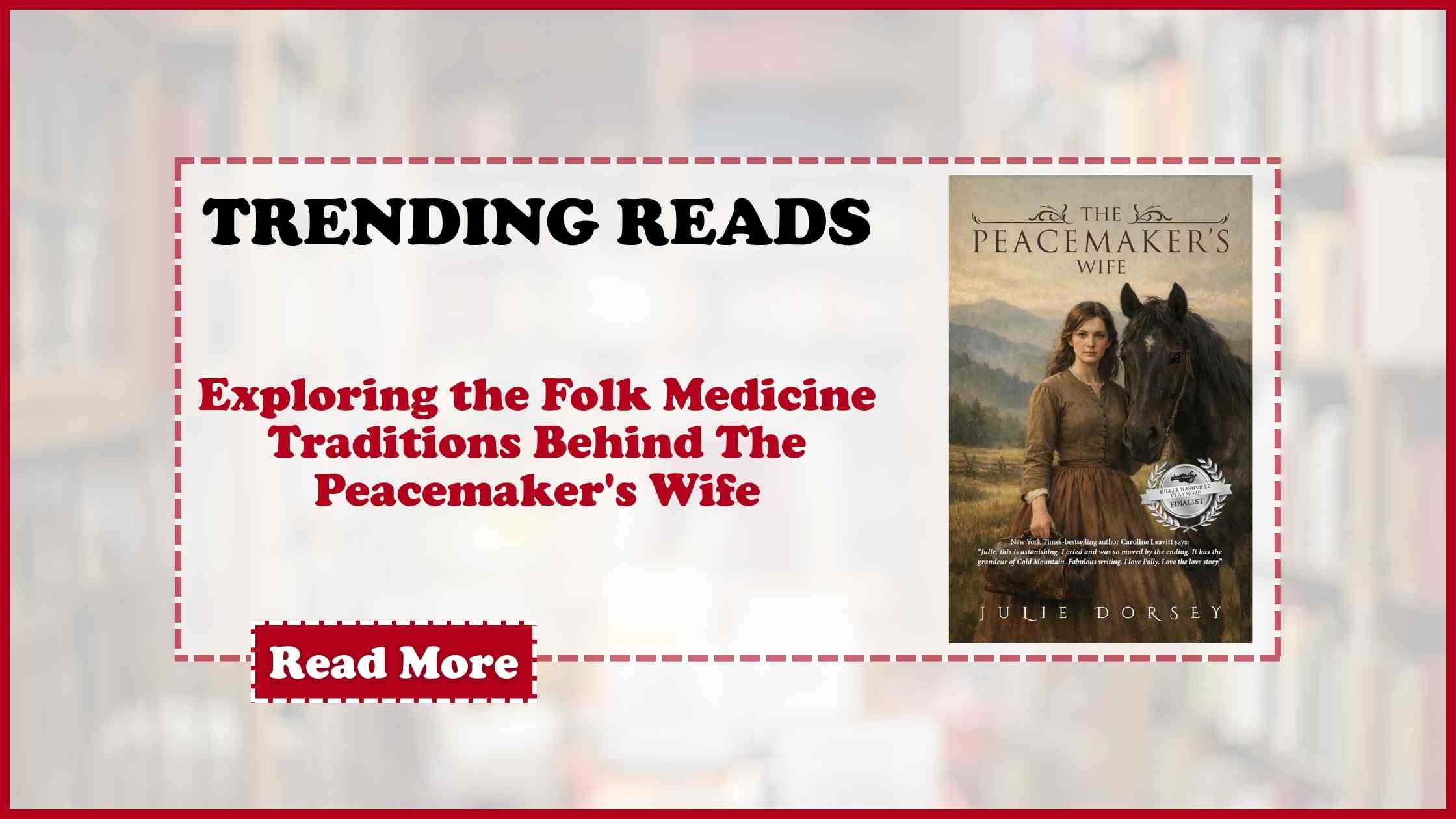
In The Peacemaker’s Wife by Julie Dorsey, healing is more than a skill. It is a calling, a legacy and a form of survival. Set in the Blue Ridge Mountains of North Carolina in 1857, the novel brings readers into a world where doctors are scarce, formal medical training is largely unavailable to women and communities depend on the wisdom of midwives, herb women and mountain healers.
At the heart of this world is Polly Justice, a young woman determined to learn the healing arts despite the limits placed upon her. Her desire to become a midwife and healer is shaped by guilt, compassion and a fierce need to prevent suffering wherever she can. For Polly, folk medicine is not superstition or simple tradition. It is knowledge earned through observation, experience and the careful guidance of women who came before her.
One of the most important figures in Polly’s journey is Nan Clark, the experienced granny woman of Blue Ridge. Nan understands herbs, roots, remedies, birth, sickness, pain and the delicate balance between life and death. Through Nan, Polly begins to learn what mountain women have long known: healing often begins with the land itself.
The folk medicine traditions in The Peacemaker’s Wife are deeply connected to place. The Blue Ridge Mountains are not just a backdrop. They are a living source of medicine. Sassafras, ginseng, goldenseal, spicebush, sweet birch and other plants appear as part of a practical healing tradition passed from one generation to the next. These remedies reflect a time when women relied on what they could gather, dry, mix, steep, bind and apply with their own hands.
Dorsey also shows that folk medicine required courage. A healer had to enter homes filled with pain, blood, fear and grief. She had to tend burns, fevers, childbirth, broken bones, stomach troubles, wounds and emotional suffering. She often worked without payment, recognition or certainty. Yet her presence could bring comfort when no one else knew what to do.
The novel respects the complexity of this tradition. Folk medicine is shown as both practical and spiritual, shaped by Christian faith, inherited remedies, mountain customs and old beliefs. Some characters trust herbs and prayers. Others fear spells, charms or anything that feels too close to magic. This tension adds richness to the story and reflects the complicated role healers often played in rural communities.
For Polly, learning folk medicine also becomes a path toward identity. In a society that expects her to obey, serve and remain quiet, healing gives her purpose. It allows her to claim knowledge, responsibility and authority. Each remedy she studies and each patient she tends brings her closer to becoming the woman she is meant to be.
The Peacemaker’s Wife makes folk medicine feel immediate and human. It reminds readers that before hospitals were nearby and before women were widely accepted as medical professionals, communities survived because of women like Nan and Polly. They carried wisdom in notebooks, memory, hands and hearts.
Through this powerful thread, Julie Dorsey gives readers more than historical detail. She offers a tribute to the women who healed in silence, served without praise and helped shape the hidden history of Appalachian life.
Grab your copy: https://www.amazon.com/dp/B0GHKW5LCV/