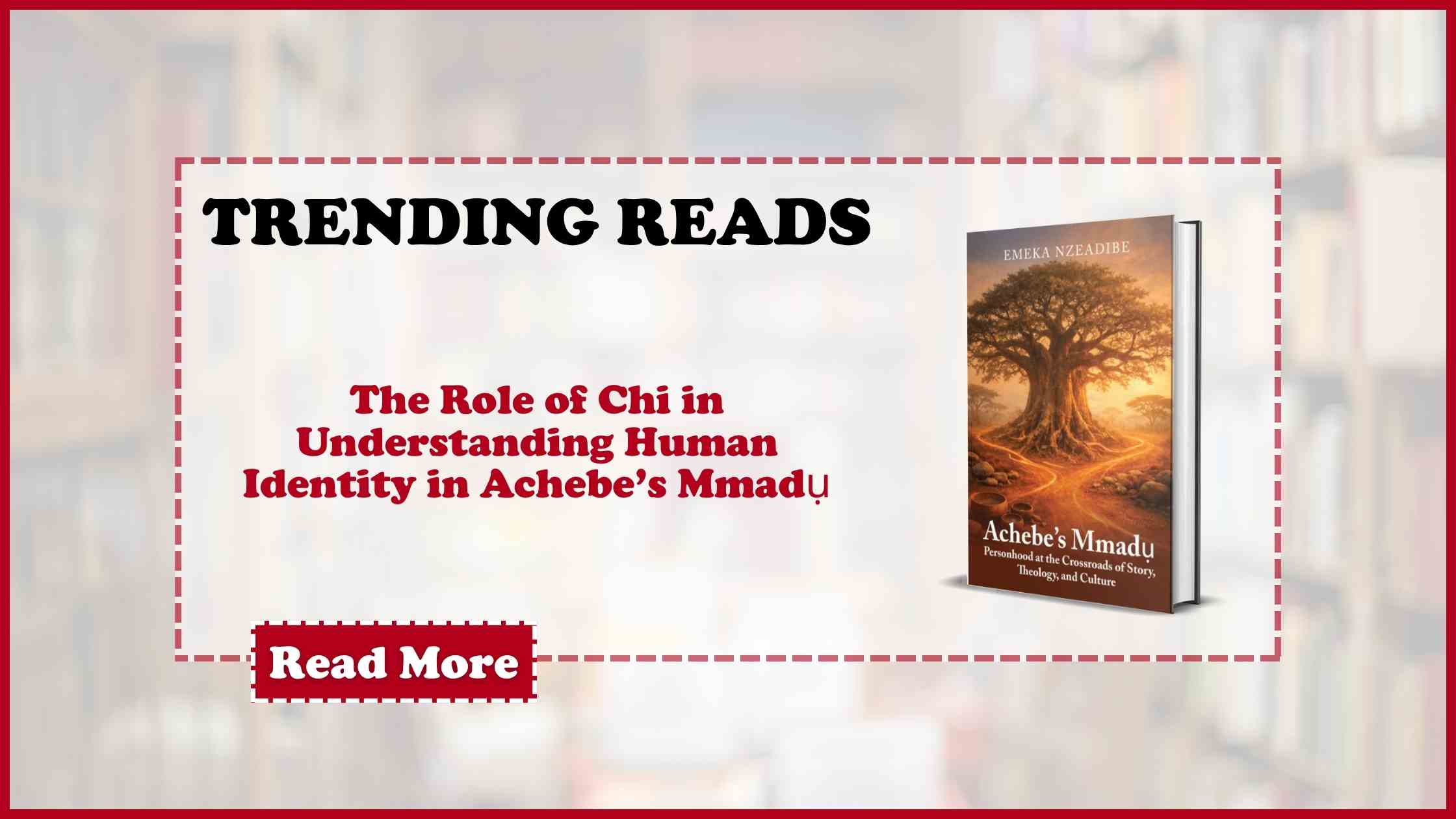
In Achebe’s Mmadụ: Personhood at the Crossroads of Story, Theology, and Culture, Emeka Nzeadibe explores one of the most important ideas in Chinua Achebe’s Igbo world: Chi. Through this concept, the book opens a deeper way of understanding human identity, destiny, agency, and spiritual belonging.
Chi is often understood as a person’s spiritual companion, inner destiny, or personal guiding presence. In Achebe’s world, it helps explain why every human being is unique, yet never detached from the wider community and the sacred order of life. Nzeadibe shows that to understand Mmadụ, the human person, one must also understand Chi, because identity is shaped by the relationship between human effort, divine presence, moral responsibility, and communal recognition.
This makes Achebe’s Mmadụ especially valuable for readers who want to move beyond simple definitions of personhood. The book does not present identity as something fixed or private. Instead, identity is shown as a living process. A person becomes known through choices, actions, relationships, struggles, and the mysterious guidance of Chi. Human life is therefore never empty or accidental. It carries direction, meaning, and spiritual depth.
Nzeadibe’s reading of Achebe brings this idea to life through characters such as Okonkwo and Ezeulu. Their stories reveal the tension between personal will and spiritual responsibility. Okonkwo tries to shape his life through strength, ambition, and fear of weakness, yet his struggle also shows the limits of self made success when it is separated from balance and moral awareness. Ezeulu, too, embodies the difficult relationship between authority, sacred duty, pride, and destiny. Through these figures, Nzeadibe shows that Chi does not erase human freedom. Rather, it places freedom within a larger moral and spiritual horizon.
One of the strongest contributions of Achebe’s Mmadụ is its ability to connect Igbo thought with broader theological questions. Nzeadibe places Chi and Mmadụ in conversation with the Christian understanding of the human person as bearing divine worth. This does not reduce Igbo wisdom to Christian categories. Instead, it allows both traditions to speak with depth about dignity, responsibility, and the mystery of being human.
For modern readers, the idea of Chi offers a refreshing challenge. In a world that often defines identity by success, status, appearance, or individual desire, Achebe’s Mmadụ reminds us that human identity is deeper than public achievement. A person is shaped by inner calling, moral choices, spiritual awareness, and relationships with others.
Emeka Nzeadibe’s Achebe’s Mmadụ is an important book for readers interested in Chinua Achebe, African literature, Igbo cosmology, theology, philosophy, and human dignity. It shows that Chi is not a minor cultural idea, but a profound key to understanding the human person. Through Chi, Nzeadibe reveals Achebe’s world as a place where identity is personal, communal, spiritual, and deeply meaningful.
Get your copy today! https://www.amazon.com/dp/B0GZFB5P25/