Directing a large group of children can quickly become about entrances, costumes, forgotten lines, noise, and keeping everyone in the right place. Yet a successful children’s production should accomplish more than getting through the performance.
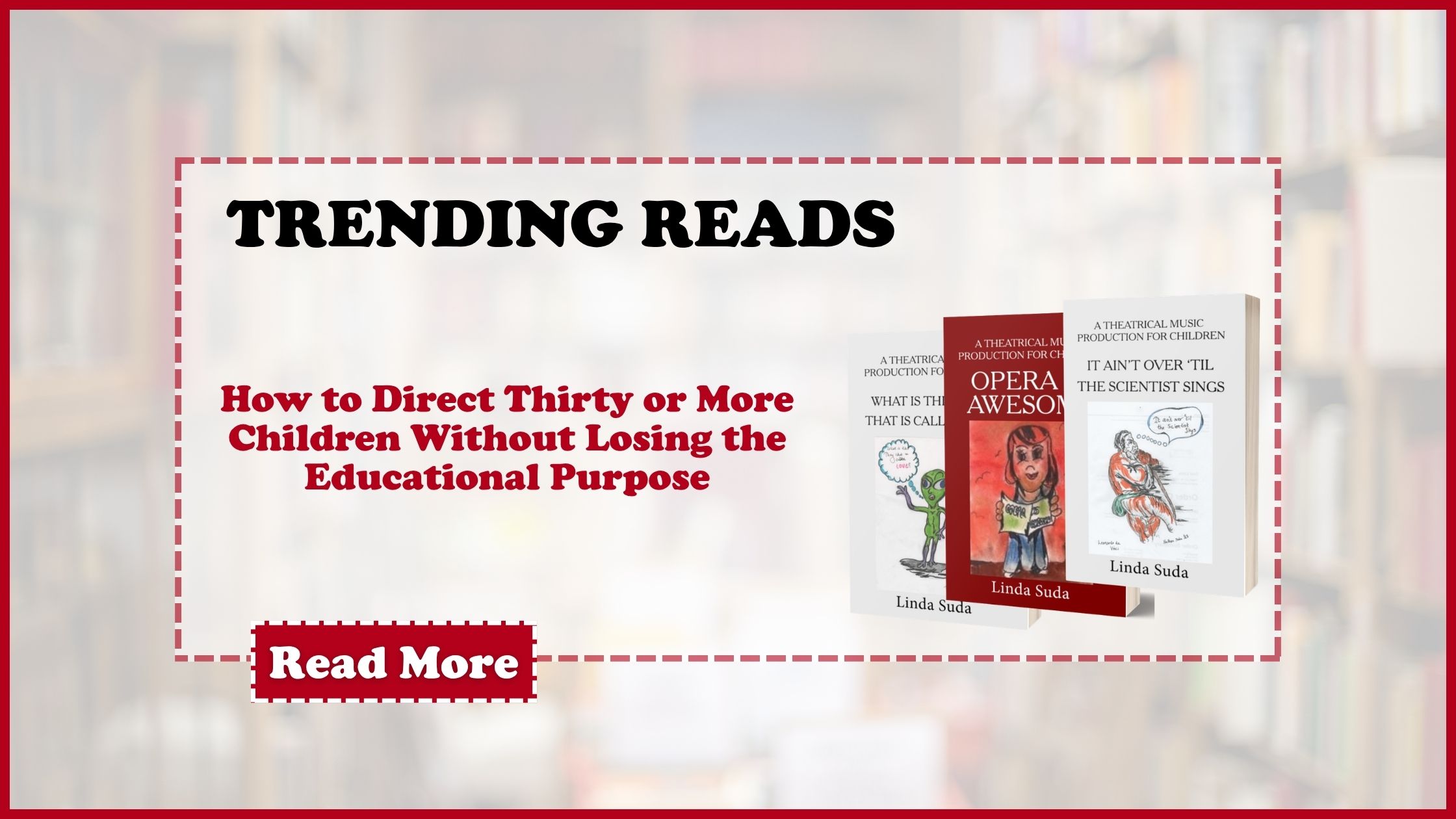
Linda Suda’s theatrical music productions are designed for large casts, including groups of thirty or more children. Her approach keeps education at the centre by giving students meaningful responsibilities while combining singing, acting, movement, and subject based learning.
The first priority is participation. A large cast should not mean that most children stand in the background. Speaking roles, ensemble singing, dancing, character groups, and repeated parts can give more students an active place in the production. When children know that their contribution matters, rehearsals become more purposeful.
The second priority is understanding. Students should know more than where to stand and when to speak. They should understand what the production is teaching. In Opera Is Awesome, children learn about the vocal apparatus while performing. In It Ain’t Over ’Til the Scientist Sings, they explore the relationship between the arts and scientific discovery. In What Is This Thing That Is Called Love?, they examine different forms of love, friendship, purpose, and human connection.
Rehearsal also becomes part of the lesson.
Children learn to listen for cues, remember sequences, cooperate with classmates, and recover when something goes wrong. These are not separate from the educational purpose. They are part of it.
Large productions also require patience. Some children will learn quickly, while others may need more repetition. Anxiety can appear as the performance approaches. Suda’s experience shows the importance of reassuring students and reminding them that they can depend on their fellow cast members.
Teachers can also strengthen the experience by participating. When educators perform alongside students, children often respond with enthusiasm and see their teachers in a different way. The production becomes a shared school experience rather than an activity directed entirely from the sidelines.
The goal is not perfection.
The goal is to give children an experience in which they learn, contribute, cooperate, and discover confidence through performance.
Linda Suda’s books provide schools, music teachers, theatre educators, and community arts programmes with productions created for that purpose. They allow large groups of children to participate without separating performance from education.
When the final curtain closes, the most important question is not simply whether the show went smoothly.
It is whether the children learned something worth carrying with them after they left the stage.
Available Now On Amazon: https://www.amazon.com/stores/author/B0GMD8C4G6