Artificial intelligence (AI) was designed to make work faster, safer and more efficient. Across industries, it has succeeded in doing exactly that. Machines now assemble products, analyze data, guide surgical procedures, manage logistics networks and even assist in emergency response. Robotics and AI systems have reduced exposure to dangerous environments and improved productivity in ways once considered impossible.
But amid this rapid transformation, a critical oversight has emerged: we built AI to replace labor but forgot to protect the humans working alongside it.
While automation reduces physical risks, it introduces a new and often invisible category of workplace hazards. These risks are not always mechanical or environmental; they are psychological, cognitive and ethical. Employees today are increasingly exposed to constant algorithmic monitoring, AI-driven performance evaluation and systems that make decisions once reserved for human judgment. This shift creates pressure, uncertainty and a growing sense of displacement in the workplace.
In many organizations, workers are no longer just interacting with machines; they are working under them. AI systems influence scheduling, hiring, productivity tracking and even disciplinary actions. This creates an environment where human autonomy can feel diminished and professional identity increasingly fragile.
The result is a new workplace paradox: while physical danger may decrease, mental and emotional strain is rising.
Research from global institutions highlights this concern. The World Economic Forum has projected massive labor transformation driven by automation, with millions of roles displaced while new ones emerge. At the same time, reports from McKinsey & Company warn that without proper safeguards, AI adoption can lead to increased burnout, stress and workforce instability. These findings suggest that technological progress alone is not enough; human protection must be built into the system itself.
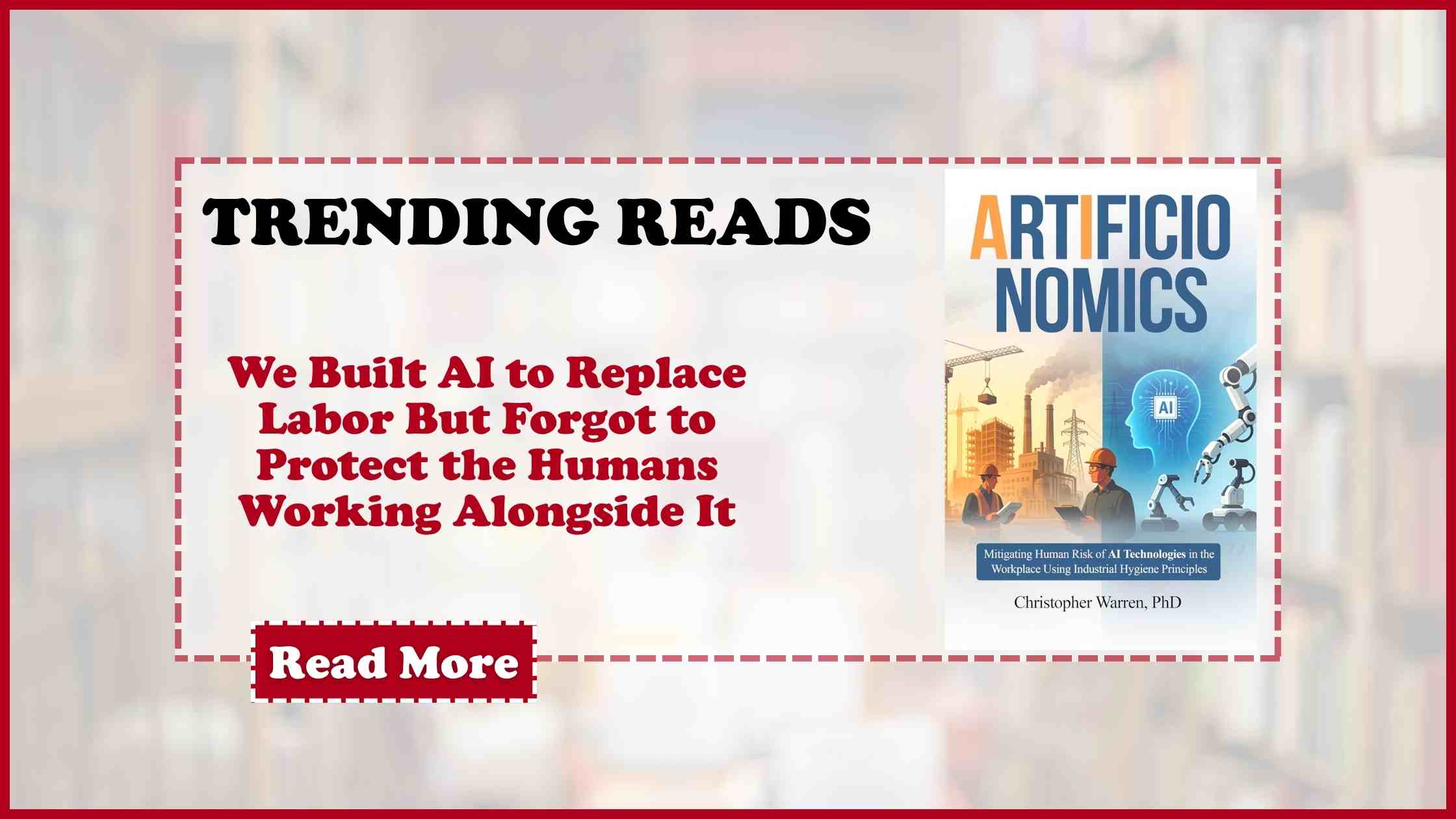
This is where Christopher Warren introduces a critical solution: ArtificIonomics.
ArtificIonomics is a groundbreaking discipline that applies industrial hygiene principles to the age of artificial intelligence and robotics. Traditionally, industrial hygiene has focused on identifying and controlling physical hazards such as chemical exposure, noise and ergonomic strain. ArtificIonomics expands this framework to include the hidden risks of intelligent systems’ psychological stress, cognitive overload, surveillance pressure and ethical uncertainty.
The central idea is simple but powerful: if AI is transforming the workplace, then workplace safety must evolve with it.
ArtificIonomics operates through a structured approach: identify, evaluate and control.
First, organizations must identify not only technical risks in AI systems but also human-centered hazards such as loss of autonomy, algorithmic bias and emotional fatigue caused by constant monitoring. These risks are often invisible but deeply impactful.
Second, evaluation must go beyond productivity metrics. It must include human indicators such as trust, mental workload, fairness perception and psychological safety. A system may be efficient, but still harmful to the people operating within it.
Finally, control strategies must adapt to this new reality. This includes redesigning AI systems for transparency, implementing ethical governance frameworks, providing mental health support and ensuring workers are trained to collaborate effectively with intelligent machines.
The rise of AI is not simply a technological shift; it is a human transformation. As automation expands into every sector, from manufacturing and healthcare to logistics and public services, the role of the human worker is being redefined. In many cases, humans are no longer performing the task; they are supervising the system that performs it.
The question is no longer whether AI will change work. It already has. The real question is whether we will design systems that protect the people within this transformation.
This is the central message of ArtificIonomics. It is not a call to slow innovation, but a call to humanize it. It recognizes that while AI can enhance efficiency and reduce physical risk, it must also preserve dignity, mental well-being and ethical integrity in the workplace.
Without intentional design, the human cost of AI will remain unseen but deeply felt. With it, we can build a future where technology and humanity evolve together, not in conflict, but in balance.
Available On Amazon: https://www.amazon.com/dp/B0GFY4RL6B/