In a world increasingly shaped by technology, individualism and social fragmentation, one timeless question continues to echo across cultures and generations: What does it mean to be human?
For centuries, philosophers and theologians have searched for answers through Western intellectual traditions. Yet beyond the familiar frameworks of Europe and North America lies a rich and often overlooked body of African thought that offers profound insights into identity, dignity, community and existence itself.
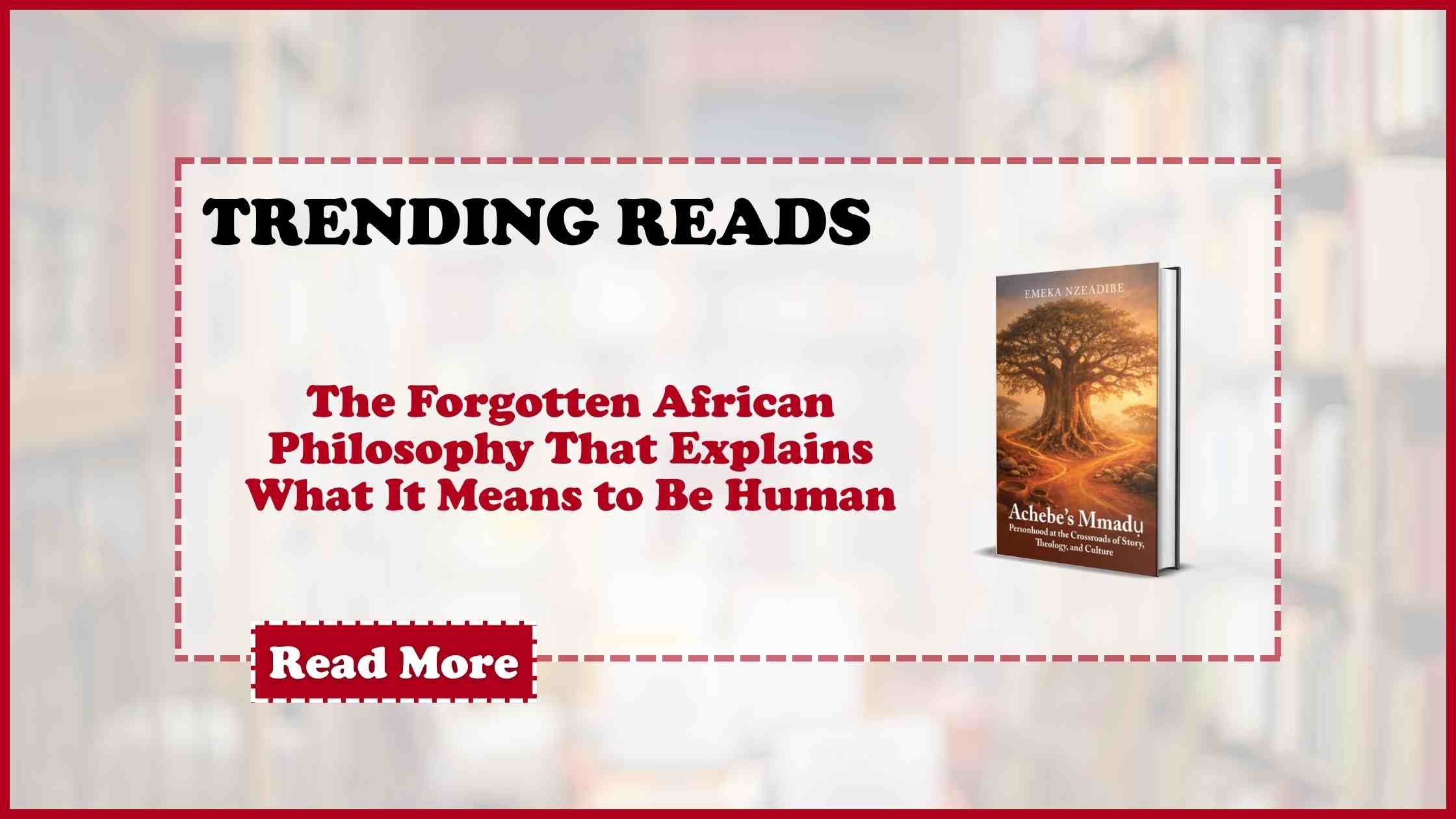
This is the world explored in Achebe’s Mmadụ, a groundbreaking new work by Emeka Nzeadibe that brings the Igbo concept of Mmadụ into global conversations about personhood and humanity. Drawing deeply from the literary vision of Chinua Achebe, the book uncovers an African philosophy of the human person that feels remarkably relevant in today’s world.
At its core, Mmadụ means “human being” or “person.” But within Igbo cosmology, it carries far greater depth. It is not merely a biological category or an abstract philosophical idea. Mmadụ expresses a relational understanding of humanity, one rooted in community, spirituality, moral responsibility, storytelling and belonging.
In Achebe’s world, a person does not exist in isolation. Human identity is formed through relationships with family, society, ancestors, culture and the spiritual world. One becomes fully human through participation in the life of others.
This worldview stands in sharp contrast to many modern ideas that prioritize radical independence and self-centered achievement. While contemporary culture often celebrates the individual above all else, the Igbo philosophy presented in Achebe’s Mmadụ reminds us that humanity is fundamentally relational.
The book explores these themes through Achebe’s celebrated novels, including Things Fall Apart and Arrow of God. Characters like Okonkwo and Ezeulu become more than literary figures; they become mirrors reflecting the struggles, fears, ambitions and spiritual tensions that define human existence.
One of the most fascinating aspects of the book is its exploration of Chi, a central concept in Igbo thought often understood as a personal spiritual destiny or guiding presence. Achebe’s famous proverb, “Onye kwe, chi ya ekwe,” “When one says yes, one’s chi says yes,” illustrates the relationship between human effort and spiritual alignment.
In this understanding, human life is neither entirely controlled by fate nor detached from transcendence. Instead, existence unfolds through a dynamic relationship between personal freedom, moral responsibility and spiritual guidance. This delicate balance gives Achebe’s vision of humanity both emotional depth and philosophical sophistication.
What makes Achebe’s Mmadụ especially important is its challenge to long-standing misconceptions about African intellectual traditions. Too often, African worldviews have been dismissed as merely cultural or anthropological rather than philosophical. Nzeadibe’s work powerfully overturns that assumption.
Through detailed engagement with theology, literature and Igbo cosmology, the book reveals a sophisticated African understanding of personhood that deserves a central place in global discussions about humanity. Storytelling, proverbs, ritual, communal ethics and spirituality emerge not as relics of the past but as living sources of wisdom for the modern world.
The book also demonstrates how Achebe’s literary imagination bridges local and universal concerns. Though rooted in the Igbo experience, the themes explored in Achebe’s Mmadụ speak to readers everywhere: identity, dignity, suffering, community, destiny and the search for meaning.
In an age marked by division and uncertainty, this forgotten African philosophy offers something deeply needed: a vision of humanity grounded not in isolation, but in connection.
Achebe’s Mmadụ is more than a study of literature or theology. It is an invitation to rediscover what it means to be human through the wisdom of the Igbo world and the enduring legacy of Chinua Achebe.
Available On Amazon: https://www.amazon.com/dp/B0GZV57B1G/