It no longer feels like disorder arrives by accident. Across politics, media, and global events, chaos appears increasingly structured, almost deliberate. Crises unfold in rapid succession, each one louder than the last, each one pulling attention in a new direction. For many, the question is no longer whether instability exists, but whether it is being shaped, guided, and perhaps even engineered. Disorder arrives by accidents
Modern society is more connected than at any point in history, yet that connection has not brought clarity. Instead, it has amplified confusion. Information travels instantly, but so does misinformation. Narratives compete, overlap, and contradict each other until truth becomes difficult to define. In this environment, control does not always come from stability. Sometimes it comes from disruption.
Political systems contribute to this growing sense of unease. Decisions are made behind closed doors, then presented as inevitabilities. Policies shift, alliances change, and explanations often feel incomplete. Citizens are left trying to interpret events without access to the full picture. Over time, this fosters suspicion. When people cannot trace cause and effect, they begin to assume intent.
The media landscape intensifies this perception. Sensational stories dominate attention while deeper analysis is often overlooked. Outrage becomes a currency. Fear becomes a tool. Audiences are drawn into cycles of reaction, moving from one crisis to the next without resolution. It creates the impression of a world permanently on edge, where calm is rare and certainty even rarer.
In such an atmosphere, the idea of manufactured chaos gains credibility. Not necessarily as a grand conspiracy, but as a pattern of behavior. Systems that benefit from distraction, division, or fear may have little incentive to restore order. A distracted public is easier to manage than an informed one. A divided society struggles to challenge authority effectively. Chaos, when controlled, can serve a purpose.
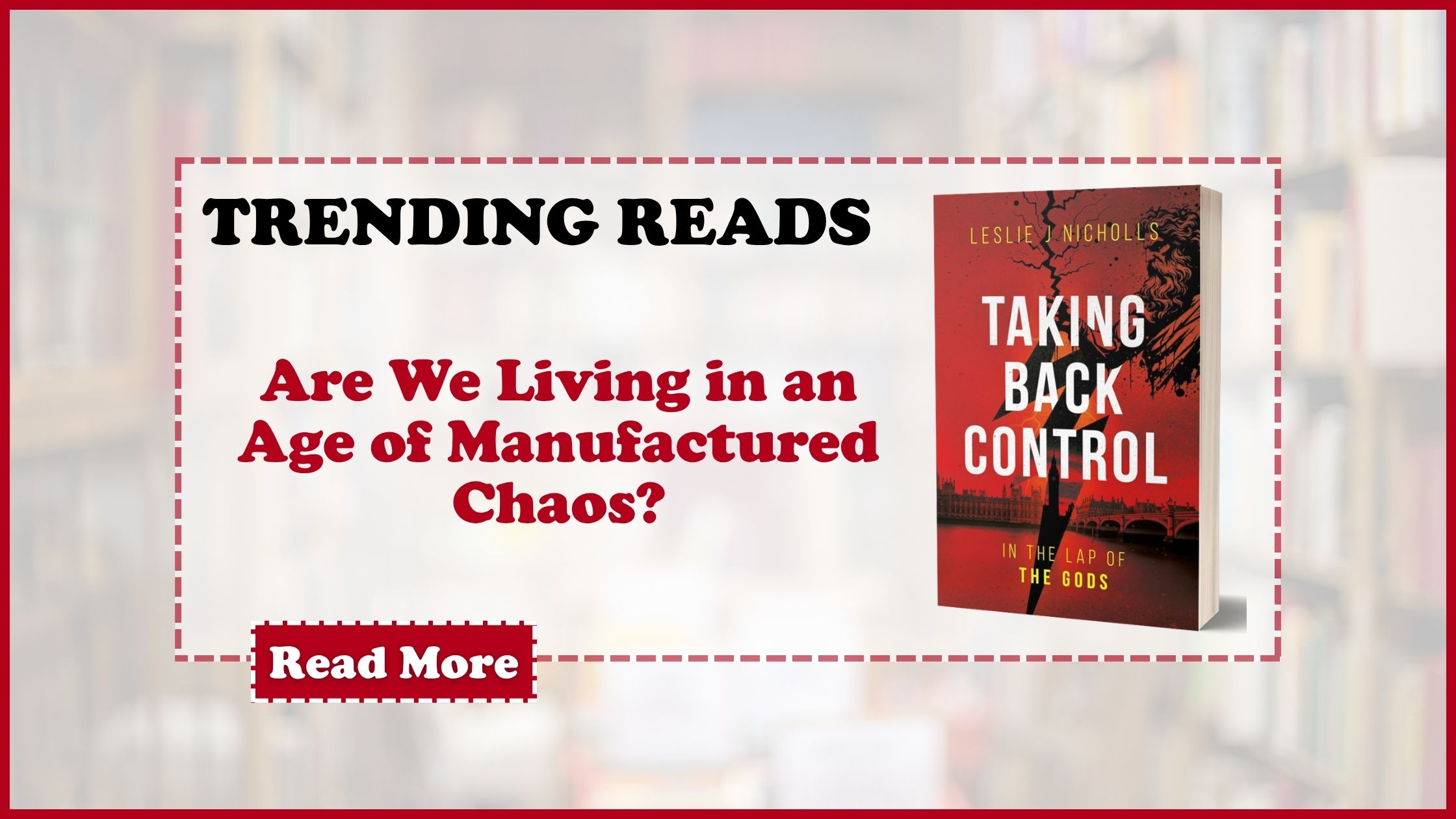
This is precisely the territory explored in Taking Back Control by Leslie J Nicholls. The book steps into a world where disorder is not random, but part of a larger design. It examines how power operates when institutions falter and how individuals respond when the rules no longer feel reliable. The story unfolds with a sharp awareness of how quickly stability can fracture and how easily people can be pushed toward extremes.
Nicholls presents a narrative that feels unsettling because it mirrors the questions many are already asking. Who benefits when systems break down? Who gains when fear spreads? And what happens when ordinary people decide they can no longer rely on the structures around them?
The strength of Taking Back Control lies in its refusal to simplify these questions. It does not offer comfort or easy conclusions. Instead, it pulls readers into a world where every action has consequences and where the line between order and chaos is constantly shifting. The result is a gripping exploration of power, control, and the fragile balance that holds society together.
In a time when reality often feels unpredictable, this book provides a lens through which to examine that uncertainty. It challenges readers to look beyond the surface and consider the forces shaping the world around them. Whether chaos is truly manufactured or simply the byproduct of a complex system, one thing is clear. Understanding it has never been more important.
Explore the full story here: https://www.amazon.com/dp/B0G4F2KTJC.