Unity was one of the most important ideas in Fidel Castro’s political philosophy. Throughout his leadership, Castro repeatedly argued that nations facing crisis could not survive through division, hesitation or fragmented purpose. For him, unity was not simply a political slogan. It was a strategy for resistance, a method of leadership and a foundation for revolutionary survival.
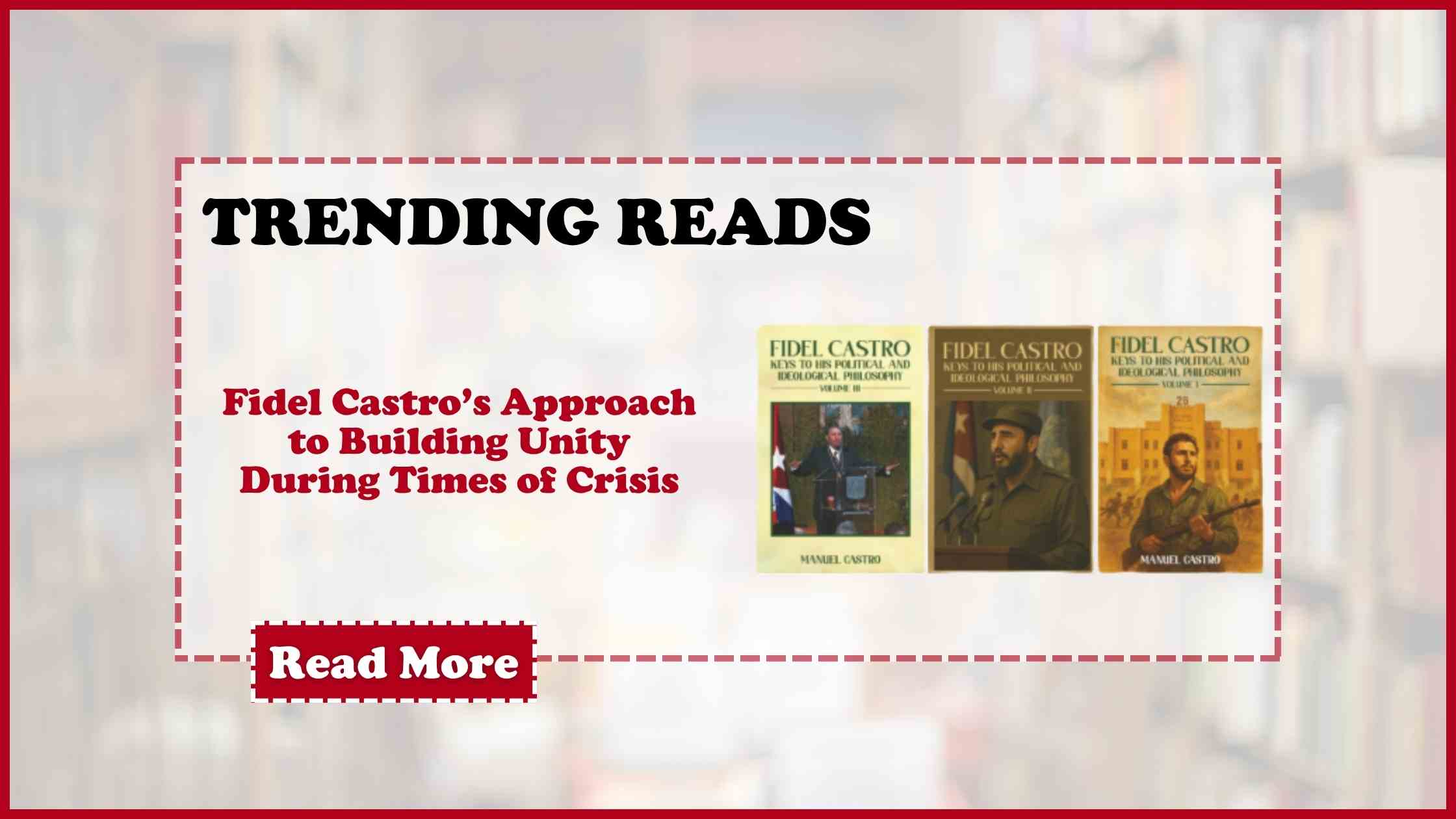
This theme is explored in depth in Fidel Castro: Keys to His Political and Ideological Philosophy (Volumes I, II and III) by Manuel Castro, a comprehensive study of the concepts that shaped Fidel Castro’s worldview. Across the trilogy, readers encounter Castro’s repeated emphasis on unity, sovereignty, revolutionary consciousness, leadership, solidarity and national purpose.
Fidel Castro understood crisis as a defining test of leadership. Whether facing internal division, economic hardship, foreign pressure, ideological conflict or social uncertainty, he believed that the first task of leadership was to create a shared sense of direction. A divided society, in his view, became vulnerable to domination, confusion and defeat. A united society, however, could endure hardship and transform adversity into collective strength.
One of Castro’s most important leadership principles was the ability to unite people around common goals. He often emphasized that unity did not require absolute agreement on every issue. Instead, it required commitment to essential objectives: national independence, social justice, sovereignty and the defense of collective dignity. This practical understanding of unity allowed him to present leadership as both ideological and strategic.
For Castro, unity also depended on communication. His speeches were central to his efforts to build political consensus. He used public language to explain challenges, identify enemies, defend policies and inspire participation. In moments of uncertainty, communication became a tool for educating the public and strengthening collective confidence.
Manuel Castro’s three-volume collection helps readers see how this approach developed across decades of Fidel Castro’s speeches and reflections. Rather than treating unity as an isolated theme, the books place it alongside related concepts such as revolution, socialism, values, discipline, consciousness, solidarity, democracy, internationalism and political thought. This structure allows readers to understand unity within a broader ideological framework.
Another key aspect of Castro’s approach was his belief that unity had to be rooted in history. He frequently connected contemporary struggles to Cuba’s tradition of independence, invoking figures such as José Martí and earlier generations of Cuban patriots. By linking present challenges to historical memory, Castro encouraged people to see themselves as part of a continuing national project.
This gave unity an emotional and moral dimension. It was not only about political organization; it was about identity, sacrifice and loyalty to a shared future. In times of crisis, that sense of historical continuity helped reinforce resilience and purpose.
The trilogy also shows that Castro viewed unity beyond Cuba’s borders. He often connected Cuban unity with Latin American integration, anti-colonial struggles and international solidarity. In his vision, nations of the developing world needed cooperation and shared purpose to resist external domination and pursue independent development.
For students, researchers, historians and readers interested in leadership, Fidel Castro: Keys to His Political and Ideological Philosophy offers a valuable guide to understanding how Castro used ideas to build unity during difficult times. Manuel Castro’s work organizes these themes with clarity, making the collection useful for political science, Latin American studies, history, international relations and leadership research.
By examining Fidel Castro’s approach to unity, readers gain insight into one of the central principles behind his political endurance. In Manuel Castro’s trilogy, unity emerges not as a temporary tactic, but as a core element of Castro’s ideological legacy.
Discover the framework. Start reading today.
Volume I: https://www.amazon.com/dp/197213454X
Volume II : https://www.amazon.com/dp/1972134558
Volume III : https://www.amazon.com/dp/1972134566