Studying Fidel Castro is not a simple task. His political life extended across decades, revolutions, international crises, ideological debates, economic challenges and global transformations. For researchers, students, historians and political thinkers, the difficulty is not only that Fidel Castro produced a vast body of speeches and reflections. The greater challenge is understanding how his ideas connect.
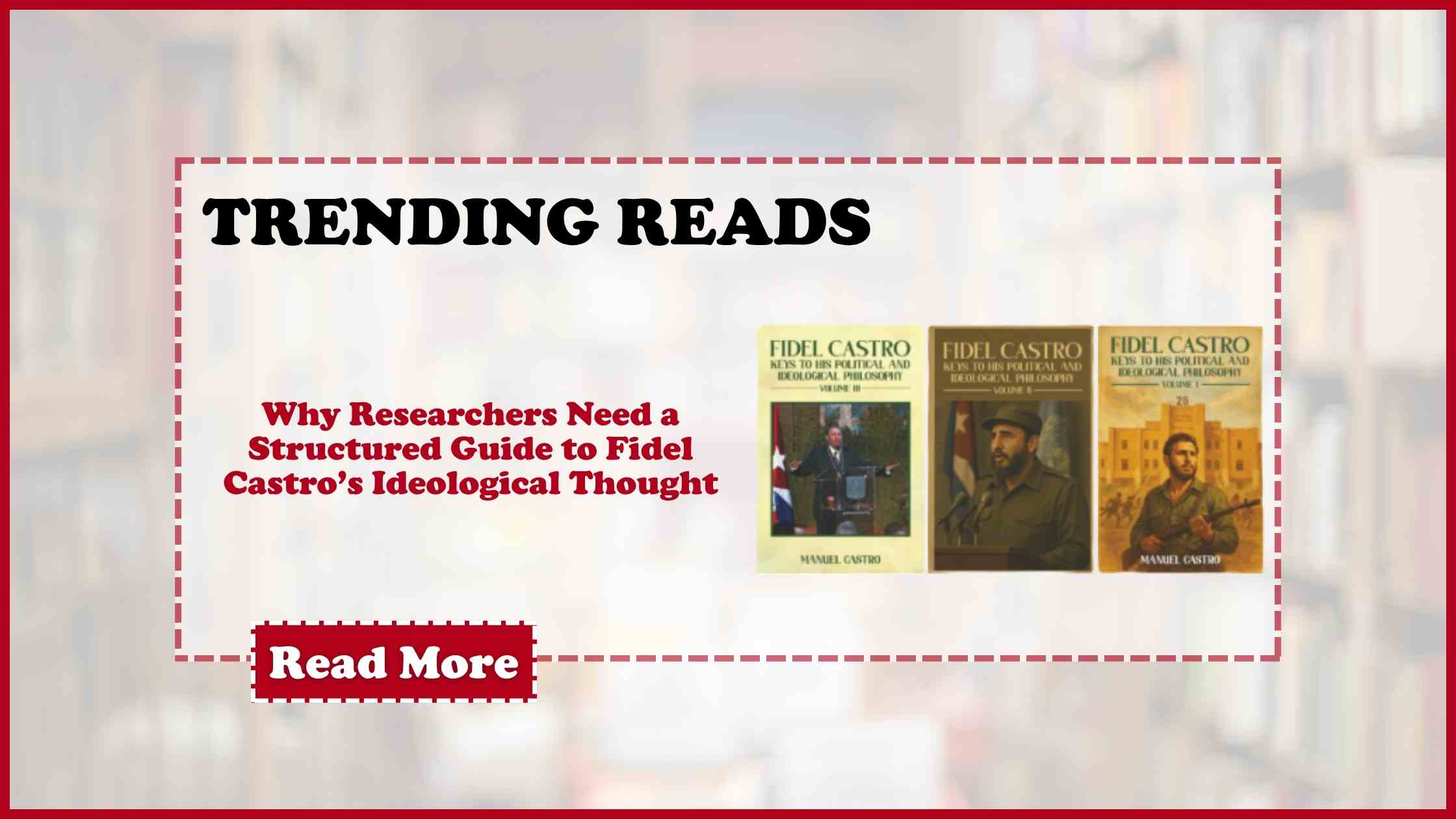
This is where Fidel Castro: Keys to His Political and Ideological Philosophy by Manuel Castro becomes an essential resource.
Across Volumes I, II and III, Manuel Castro offers more than a historical overview. He provides a structured guide to Fidel Castro’s ideological thought, organizing complex themes into clear political, social, economic and philosophical categories. Instead of forcing readers to search through decades of speeches without direction, these books create a map of Castro’s worldview.
Fidel Castro’s ideas cannot be reduced to a single slogan or political label. His thought included revolution, socialism, sovereignty, education, culture, internationalism, anti-imperialism, ethics, public health, development, national independence and the role of ideas in history. Each of these themes appears repeatedly throughout his speeches, but often in different historical moments and political contexts. A researcher needs structure to see the pattern.
Manuel Castro’s three-volume collection answers that need.
The books arrange Fidel Castro’s concepts into thematic “variables,” allowing readers to study how particular ideas developed and how they related to one another. This method is especially useful for academic research because it helps transform a large and scattered body of political discourse into an organized reference system. Readers can examine one theme at a time while still understanding its place within the broader ideological framework.
For example, a researcher interested in sovereignty can explore how Castro connected national independence with economic self-determination. A student studying socialism can trace how Castro presented it as both a political system and a moral project. A historian examining Latin America can better understand Castro’s emphasis on unity, anti-colonialism and international solidarity.
This structured approach makes the books valuable not only for experts but also for readers encountering Castro’s thought for the first time. The volumes help clarify why his speeches became such powerful tools of political education, mass mobilization and ideological communication. They show how Castro used language to define problems, defend principles and inspire collective action.
What makes Manuel Castro’s work especially important is its scope. These books do not focus only on isolated events such as the Cuban Revolution, the Bay of Pigs or Cuba–United States relations. Instead, they examine the philosophical foundation behind Castro’s political positions. That makes the collection highly relevant for political science, history, international relations, Latin American studies and ideological research.
In a time when many political figures are remembered through fragments, headlines and simplified narratives, serious researchers need deeper tools. Fidel Castro: Keys to His Political and Ideological Philosophy offers that depth. It gives readers a way to study Castro not only as a historical leader but as a thinker whose ideas shaped debates about power, justice, sovereignty, development and resistance.
For anyone seeking to understand Fidel Castro’s ideological legacy with clarity and structure, Manuel Castro’s three-volume work is an indispensable starting point.
Discover the framework. Start reading today.
Volume I: https://www.amazon.com/dp/197213454X
Volume II : https://www.amazon.com/dp/1972134558.
Volume III : https://www.amazon.com/dp/1972134566