When people think about leadership, they often imagine authority, status, influence and power.
But what if the strongest leader is not the person who stands above everyone else? What if real leadership begins with service?
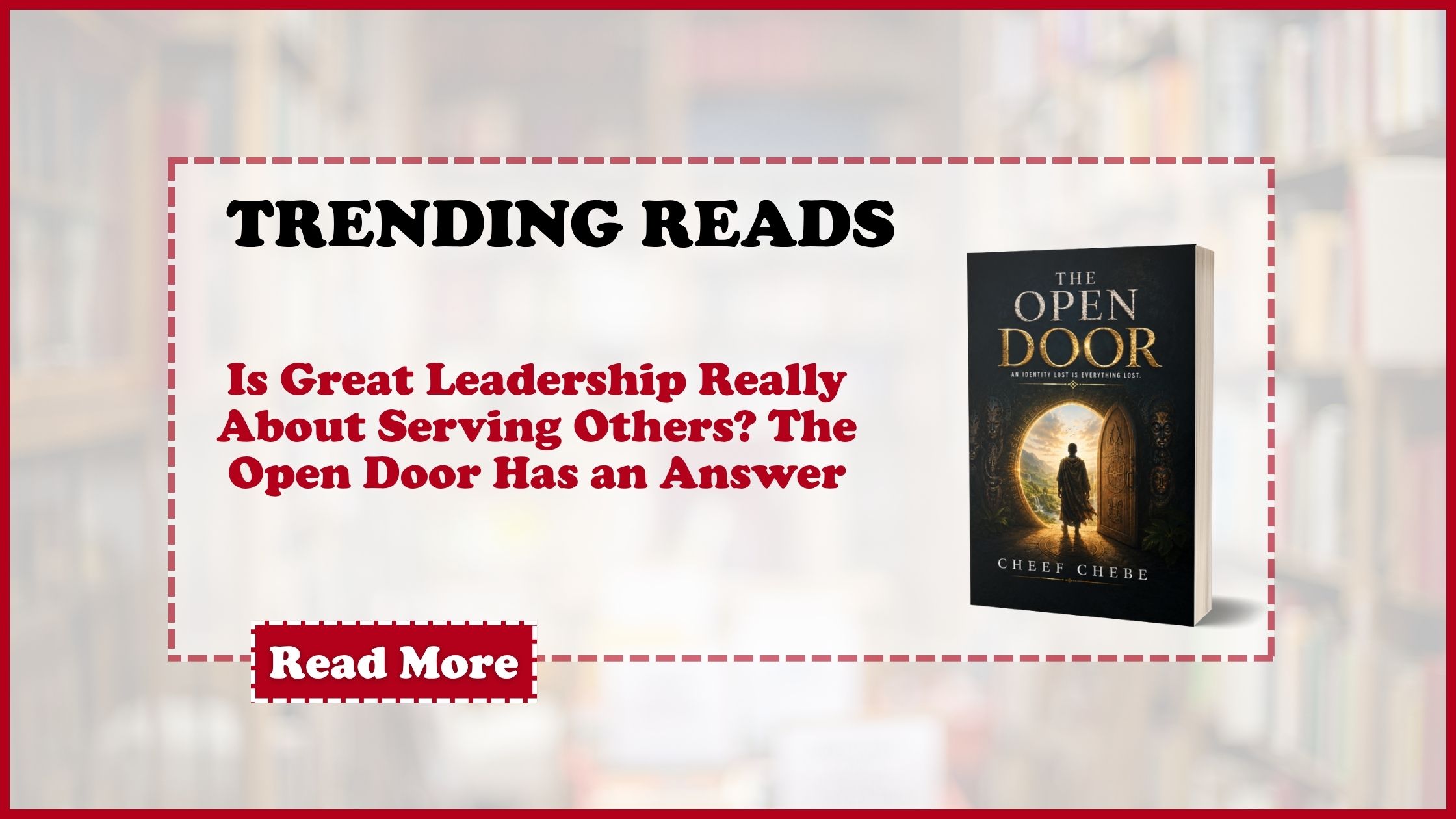
That question becomes especially important in The Open Door by Cheef Chebe, where Djambay’s extraordinary journey eventually forces him to reconsider what it really means to lead.
Djambay does not begin the story looking for a throne, a title or recognition. In fact, much of his journey is about trying to understand who he is. He awakens confused, slowly recovers memories of his former life, reconnects with his African heritage and discovers that his future may involve responsibilities far greater than he expected.
Among those responsibilities is leadership.
Djambay Does Not Chase Power
One of the most interesting things about Djambay is his reluctance to define himself through status.
As he learns more about his identity and destiny, he is confronted with the idea of becoming King of Zawoomba. Yet his instinct is not to celebrate the position. Instead, he sees himself more naturally as a healer, teacher and servant.
That reaction reveals an important theme running through the book.
Leadership, in Chebe’s fictional world, is not simply about being obeyed. It is about understanding the needs of others and using responsibility for something larger than personal ambition.
Father Godson reinforces this idea by teaching Djambay that a great king should also be a humble and loyal servant of the people.
Greatness Becomes a Shared Responsibility
The Open Door also challenges the idea that one extraordinary individual can solve every problem.
As Djambay’s journey develops, he begins to understand that meaningful change depends on collective effort. A better community, nation or world cannot be built by one leader alone.
People must participate.
This connects leadership to one of the book’s broader themes: cooperation over endless competition.
Chebe imagines a future in which communities place greater value on fairness, dignity, shared responsibility and human wellbeing. In that context, leadership becomes less about controlling people and more about helping them work toward a common purpose.
Leadership Starts With Knowing Who You Are
Djambay’s transformation also suggests that effective leadership begins with self-understanding.
Before he can help anyone else, he must face his own past.
He reconnects with his ancestry, remembers lessons from his grandfather, revisits his former life in Glasgow, questions beliefs he once accepted and learns to see himself through a wider spiritual and cultural perspective.
That journey matters because leadership without identity can easily become performance.
Djambay must decide what he believes, what he values and what kind of man he wants to become before he can accept responsibility for others.
A Different Definition of Power
Through fantasy, spirituality, satire and social commentary, The Open Door offers readers a leadership message that feels surprisingly relevant to everyday life.
You do not need to be a king to practice it.
Parents, teachers, managers, community leaders and ordinary individuals all face the same basic choice: use influence primarily for themselves or use it to help others grow.
Cheef Chebe’s story clearly leans toward the second path.
In The Open Door, greatness is not measured only by how many people follow you. It is also measured by how many people you are willing to serve, support and inspire.
And perhaps that is the kind of leadership the modern world needs most.
Read the book on Amazon: https://www.amazon.com/dp/B0HKXFPZLN/