The relationship between the United States and China has become one of the defining geopolitical tensions of the modern era. Trade disputes, technology restrictions, military alliances, Taiwan, sanctions and competing visions of global power have all pushed the two countries into a far more confrontational relationship.
But does that confrontation have to end in war?
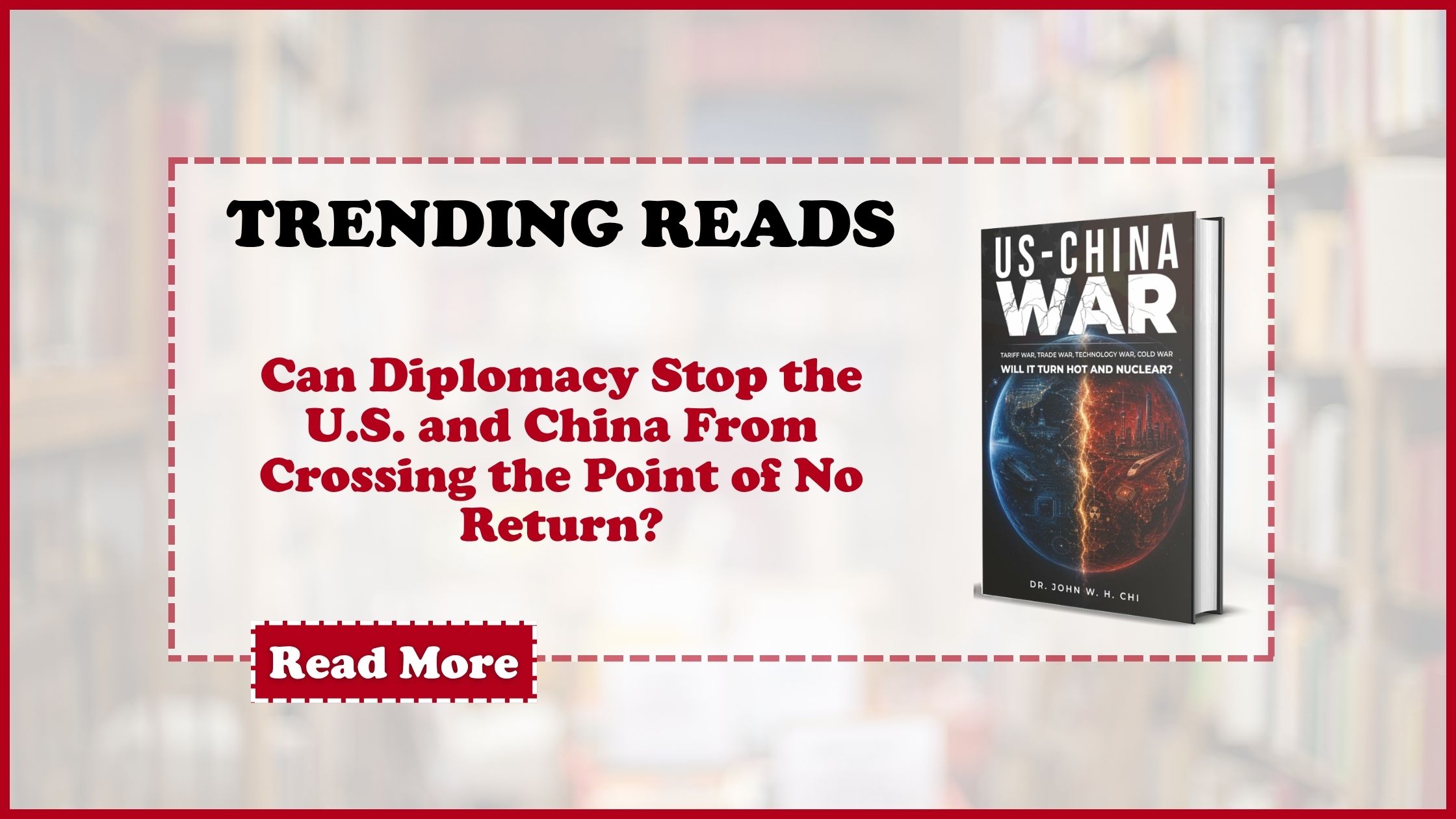
In US-China War: Will It Turn Hot and Nuclear?, Dr. John W. H. Chi argues that the answer should be no. His book examines the forces driving the rivalry while repeatedly returning to a simple but urgent idea: diplomacy, coexistence and cooperation are far better than allowing mistrust and escalation to become permanent.
The Danger of Treating Conflict as Inevitable
One of the central concerns in Dr. Chi’s book is the way rivalry can become self-reinforcing.
Economic restrictions lead to retaliation. Military deployments create counter-deployments. Political pressure creates harder rhetoric. Each side begins interpreting the other’s actions through the assumption that confrontation is unavoidable.
That is precisely the kind of environment in which diplomacy becomes most important.
Dr. Chi argues that U.S.-China relations would improve if Washington stopped treating China primarily as an enemy and instead returned to a more cooperative relationship. In the book’s conclusion, he stresses that both countries are deeply interconnected and that a return to more normal bilateral ties would benefit both societies.
Taiwan Makes Diplomacy Even More Urgent
Few issues illustrate the need for restraint more clearly than Taiwan.
Throughout US-China War, Dr. Chi presents Taiwan as a potentially dangerous flashpoint. He discusses military activity, arms sales, political visits, naval operations and the risk that either side could interpret the other’s actions as deliberately provocative.
The problem is not simply that Washington and Beijing disagree.
The problem is that disagreement exists alongside military power.
In such an environment, diplomacy is not a sign of weakness. It can be the mechanism that prevents misunderstanding from turning into confrontation.
Cooperation Is Still Possible
Near the end of the book, Dr. Chi highlights principles centered on mutual respect, peaceful coexistence and what he describes as win-win cooperation.
The book cites the idea that the United States and China should respect each other’s social systems and development paths, avoid conflict and confrontation, manage sensitive disagreements constructively and work together on international challenges.
That vision stands in sharp contrast to a zero-sum approach in which one country’s success must automatically mean the other’s defeat.
Dr. Chi argues that the world is large enough for both countries to develop and that cooperation is necessary on problems that neither nation can solve alone, including climate change, resource pressures, financial instability and other global challenges.
A Personal Commitment to Peace
Dr. Chi’s anti-war message is also deeply personal.
He explains that one reason for writing the book is his commitment to the Confucian goal of Píng tiān xià, helping create a better and more peaceful world. He wants readers to better understand the forces shaping U.S.-China relations and to support policies based on peace rather than confrontation.
His background makes that appeal particularly noteworthy. Dr. Chi spent years working on national-defense and nuclear-power projects at Westinghouse, including serving as chief designer of space nuclear power reactors connected with the Strategic Defense Initiative.
US-China War: Will It Turn Hot and Nuclear? ultimately asks whether the world will allow competition to become catastrophe or whether diplomacy can interrupt that path before the point of no return.
For Dr. Chi, the choice is clear.
Conflict may dominate the headlines, but cooperation must remain the goal.
Read US-China War: Will It Turn Hot and Nuclear? by Dr. John W. H. Chi: https://www.amazon.com/dp/B0HC8TJT28/