Sometimes strength can be the greatest weakness. Germany, long admired for its discipline, technical brilliance, and industrial dominance, has been walking into a trap it does not fully see. For years, Berlin has prided itself on being one of the few Western nations to enjoy a trade surplus with China. In 2022, German exports to China reached 77 billion euros, while imports were valued at 66 billion euros. A surplus of 11 billion euros is nothing to dismiss. Yet in the larger picture, it is a dangerous illusion.
Here’s where things become interesting and cautious. While Germany celebrates its 11 billion gain, China continues to pocket an annual global trade surplus of roughly 870 billion dollars. That imbalance enriches Beijing far more than Germany’s modest edge enriches Berlin. In other words, Germany may feel secure, but it is swimming in a pool where China controls the tides.
German industry has deep ties with China, from automakers to heavy machinery. Former Chancellor Angela Merkel embodied this approach, lobbying hard to push a trade agreement between the European Union and China in the early 2000s. The idea was to protect German business interests. The result was more complicated. By focusing on short-term industrial gains, Germany underestimated the long-term threat of Chinese economic power.
Jonathan Holslag, a Belgian China expert, has pointed out that this thinking is dangerously limited. When Germany pressured Brussels to move ahead with the trade agreement, it gave Beijing an opportunity to drive a wedge between Europe and the United States. Divide and conquer is one of China’s oldest strategies, and once again it worked. For a while, Brussels seemed content to placate Beijing. Thankfully, the European Parliament later blocked the ratification, but the damage to perception had already been done.
The larger issue is how China uses its economic model to sustain itself regardless of temporary setbacks. During the coronavirus pandemic, the IMF reported China’s growth dipping to 3.9 percent, with talk of a possible contraction. Yet even a slowdown leaves China with a massive trade surplus. If that surplus drops by 5 percent, the remaining 95 percent still drives enormous enrichment. The machine does not stop; it only pauses before continuing on the same track.
This is where Germany’s misconception becomes a European and global problem. Berlin’s surplus with China does not protect it from Beijing’s overarching economic advantage. Instead, it blinds policymakers into thinking that technical skill and competitiveness alone can shield them. They cannot. For every euro Germany earns, Beijing gains many times more in dollars from its trade surpluses worldwide. That money is not just wealth; it is power—power to expand influence, strengthen its military, and project authority across continents.
The real danger is complacency, and Germany is not alone in this, as Europe’s largest economy, its choices influence the continent. If Berlin continues to prioritize its industries over the collective security of democracies, it risks weakening both. The next German chancellor might see this more clearly, but there’s no guarantee.
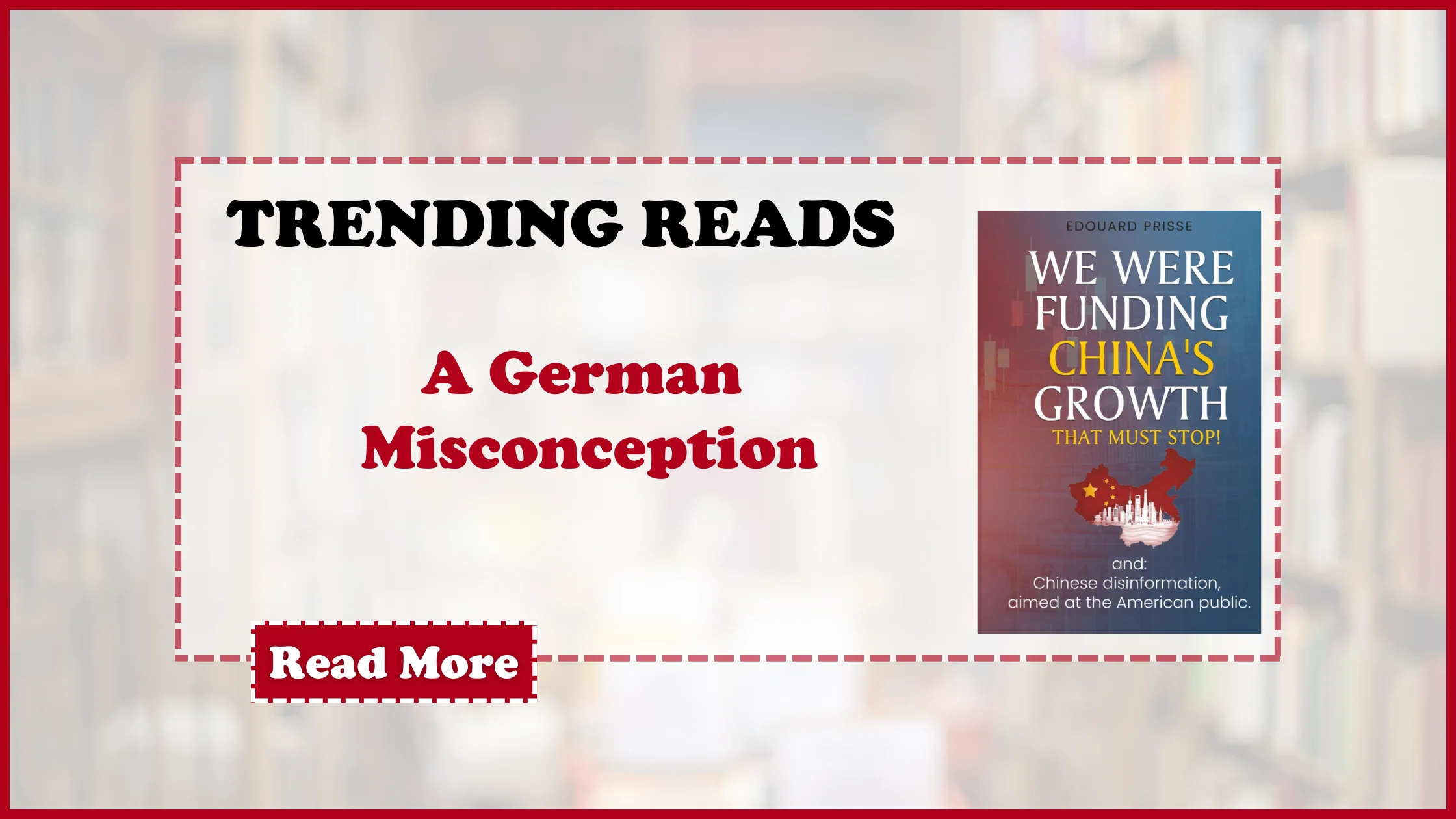
In light of this, Edouard Prisse’s book makes it clear that the fallacy of free trade with China is not a national problem related to America alone. It is a global one. The United States must take the lead, but Europe, including Germany, must stop looking at narrow surpluses and recognize the larger imbalance.
For anyone who wants to understand why illusions of strength can become traps of weakness, We Were Funding China’s Growth That Must Stop! is essential reading.
Read the book to know the answer and to take action before it is too late.
Here is a link to purchase: www.amazon.com/dp/1967963053.
We Were Funding China’s Growth That Must Stop! by Edouard Prisse is a sharp, well-researched examination of how decades of misguided free trade with China have fueled the rise of America’s greatest rival. Drawing on the economic insights of John Maynard Keynes, Prisse explains how the 2001 decision to welcome China into the global trade system created a one-sided relationship that drained Western industries while empowering Beijing’s authoritarian regime. The book not only exposes the dangers of this ongoing imbalance—job losses, weakened manufacturing, and growing geopolitical risks—but also offers a clear solution: shifting from “free trade” to “Equal Trade,” a value-balanced system that ensures reciprocity and protects democracy. Both a warning and a roadmap, this book is essential reading for policymakers, business leaders, economists, and citizens who care about safeguarding the future of free societies.