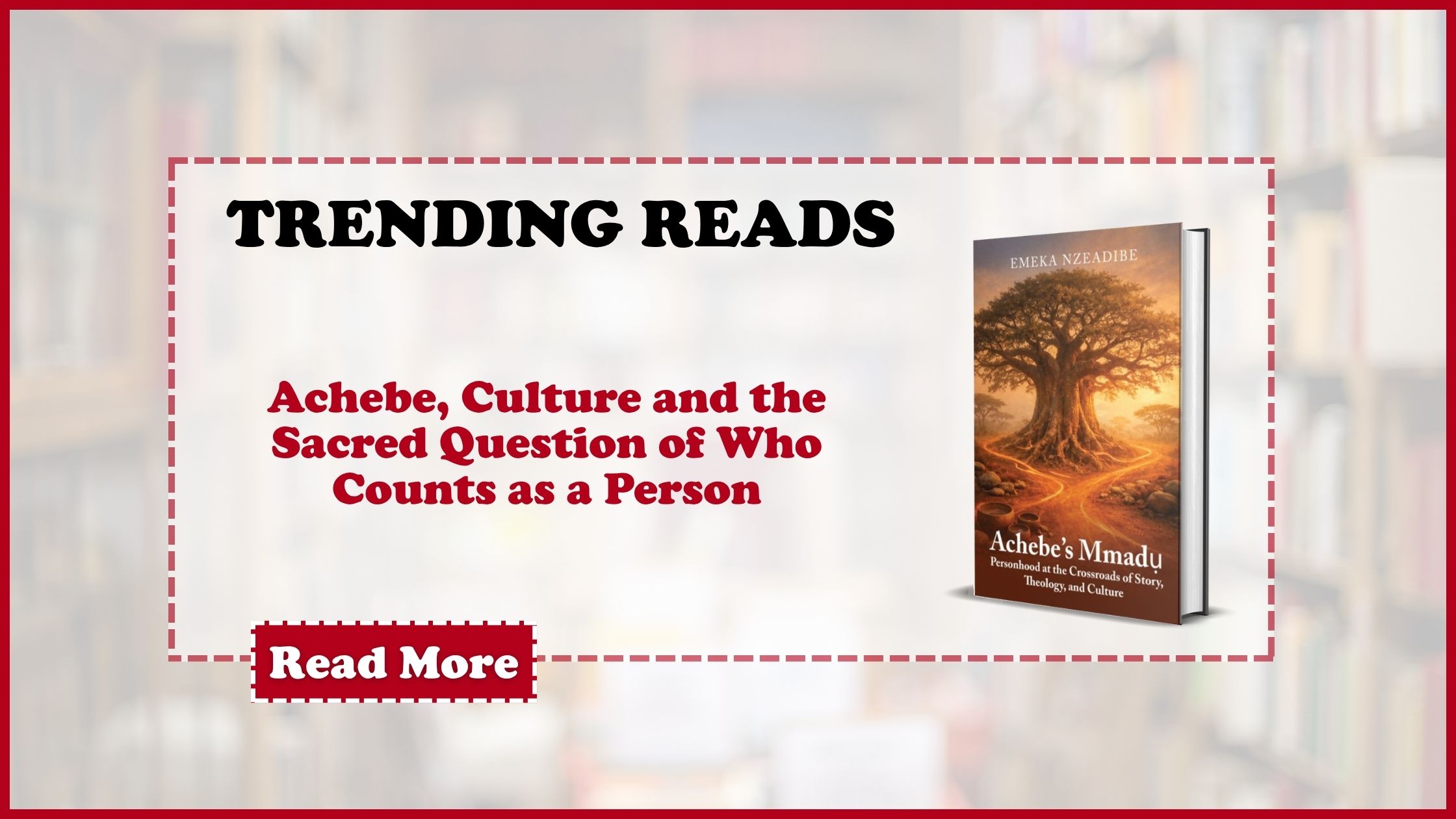
Who counts as a person? At first, the question may sound simple. Yet history, culture, religion and social power have repeatedly shown that human beings are not always treated as if their dignity were equal. Communities often judge people according to wealth, achievement, status, gender, usefulness or conformity. In Achebe’s Mmadụ: Personhood at the Crossroads of Story, Theology, and Culture, Emeka Nzeadibe confronts this difficult question through Chinua Achebe’s literary world and the Igbo concept of Mmadụ.
Mmadụ can be translated as “human person” or “human being,” but the book reveals a much deeper meaning. It includes personhood, consciousness, identity, humanity and the way individuals relate to the world around them. For Nzeadibe, the central issue is not only what a person is, but who a person is and whether that person’s dignity can ever be withdrawn.
Achebe’s fiction provides a powerful setting for this exploration. His characters are rarely presented as purely good or entirely bad. Okonkwo and Ezeulu, for example, possess strength, authority, ambition, fear, pride, spiritual responsibility and vulnerability. Their lives reveal how family, tradition, communal expectations, personal choices and historical upheaval shape individuals. They may fail, suffer or become separated from their communities, but their humanity remains more fundamental than their success or social standing.
This distinction is vital. The book separates ontological personhood, the personhood inherent in every human being, from normative personhood, which societies may associate with moral conduct, maturity, recognition or achievement. Normative status can change, but inherent human worth cannot. A person may lose prestige, wealth, influence or acceptance without losing the essential quality of being Mmadụ.
The concept of Chi adds another dimension. In Igbo thought, Chi is closely connected to individuality, destiny and spiritual identity. It helps explain why a person belongs to a community without becoming merely an extension of it. The community contributes to identity, but Chi protects the uniqueness and personal significance of each individual. This creates a rich balance between belonging and individuality, correcting the assumption that African personhood always places the collective above the person.
Nzeadibe also brings Mmadụ into dialogue with the Christian idea of imago Dei, the belief that humanity bears the image of God. This connection strengthens the argument that dignity does not depend on performance. Every person possesses worth that transcends title, origin, gender, social condition or circumstance. The book therefore challenges all systems that classify some human beings as less valuable, less complete or less worthy of recognition.
Storytelling is essential to this work because stories determine who is remembered, who is understood and who is allowed to appear fully human. Achebe’s narratives resist colonial portrayals that reduced African people to objects, stereotypes or cultural abstractions. By portraying ordinary people in all their contradictions, he restores their complexity and insists that they be seen as human subjects.
Achebe’s Mmadụ is both an academic study and a moral invitation. Emeka Nzeadibe asks readers to reconsider the standards by which society measures human worth. The book’s answer is profound: personhood is not a reward granted by society. It is an inviolable reality grounded in humanity itself.
Read the book on Amazon: https://a.co/d/0363OG8A