Belonging is easy to celebrate when everyone in the room shares the same history, customs and assumptions. Its meaning becomes harder to defend when a newcomer arrives with different loyalties, habits or beliefs. The question is no longer whether a community values unity, but whether it can welcome someone without first demanding that they become identical to everyone else.
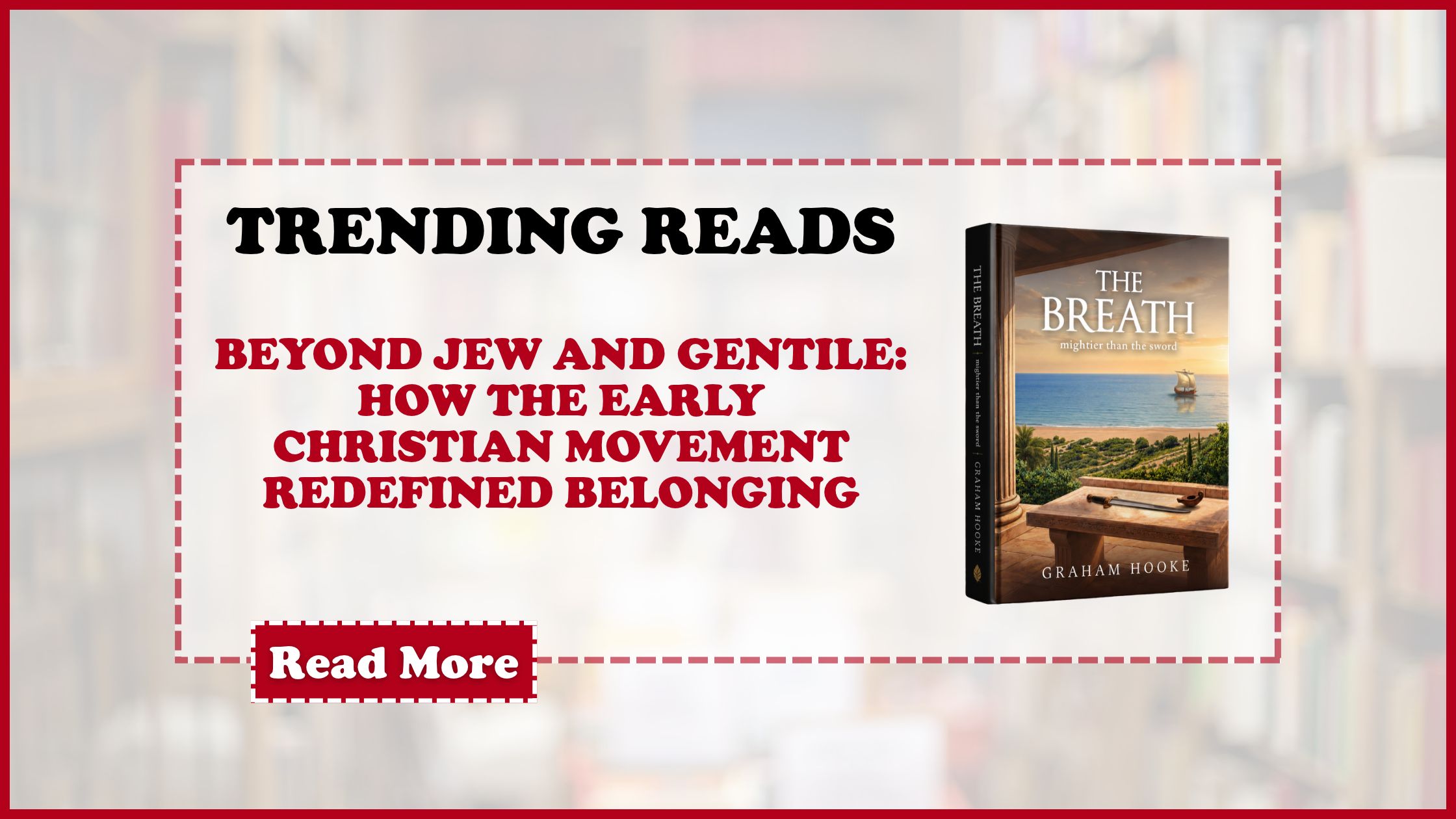
In Graham Hooke’s The Breath, that tension unfolds amid the religious and political divisions of the Roman world. The followers of Yeshua, called people of the Way, come together across social divisions, sharing resources and caring for the poor. Yet their movement begins among Jews, and the arrival of Gentile believers challenges assumptions that once seemed beyond question.
One pivotal encounter takes place in Caesarea. Peter, a Jewish disciple, enters the home of Cornelius, a Roman centurion, after a vision prompts him to reconsider what he calls unclean. When Cornelius and those gathered with him receive the sacred Breath, Peter welcomes their baptism. The image is striking: an invitation across the threshold of a home becomes an invitation into a community.
That welcome is not universally accepted. In The Breath, Peter must defend his decision before believers who object to his contact with Gentiles. Others later insist that Gentile converts should be circumcised. Mary recounts how Paul and Barnabas take the dispute to Jerusalem, where the apostles decide that circumcision is not required of Gentile believers. The disagreement exposes a difficult distinction: honouring a tradition is not necessarily the same as making every aspect of it a condition of belonging.
Just as revealing is the response of Marcellinus, a Roman soldier with a Jewish mother. He repeatedly insists that following Yeshua is not for Romans, even as friends and colleagues embrace the Way. His resistance shows how identity can become a shield. Sometimes people reject a new possibility not because they have considered it fully, but because accepting it would disturb the story they tell about themselves.
Graham Hooke also follows the longer wounds separating Jews and Samaritans. Philip describes Samaritan believers who had inherited resentment toward Jews but came to reject a cycle of hostility. Their change is not described as effortless. It requires learning another way of living, one that refuses to make violence the answer to exclusion.
These experiences pose a demanding question for any group that claims to value openness. Is welcome simply a statement of good intentions, or does it affect who is invited, heard and trusted? Genuine belonging asks people to take differences seriously without using them as an automatic reason for exclusion. It also requires shared responsibilities; openness does not mean that convictions disappear.
The enduring insight of The Breath is that boundaries are not crossed by slogans alone. They are crossed when someone opens a door, sits at an unfamiliar table and recognises another person as worthy of fellowship. The question for any community is not whether it has boundaries, but whether it can distinguish a conviction worth keeping from a barrier maintained merely because it is familiar.
Read the book on Amazon: https://a.co/d/0bUn7xwq
Amazon UK link: https://www.amazon.co.uk/s?k=the+breath+graham+hooke
Amazon UK link: https://www.amazon.co.uk/s?k=the+breath+graham+hooke