What happens when a country once associated with widespread poverty becomes one of the world’s most influential economic powers? China’s remarkable transformation offers more than a story of industrial growth. It raises important questions about economic development, international competition, and how established powers respond when the global balance begins to change.
Over several decades, China’s rise has reshaped manufacturing, international trade, technological innovation, and geopolitical relationships. Yet its growing prosperity has also intensified tensions, particularly with the United States.
FROM ECONOMIC HARDSHIP TO GLOBAL COMPETITIVENESS
Following the establishment of the People’s Republic of China in 1949, the country faced enormous economic challenges. Earlier wars, foreign intervention, political instability, and widespread poverty had left much of its population struggling.
A major turning point arrived in 1978 when Deng Xiaoping introduced sweeping economic reforms. China moved away from traditional Marxist economic practices toward a system combining state capitalism, market competition, and private enterprise.
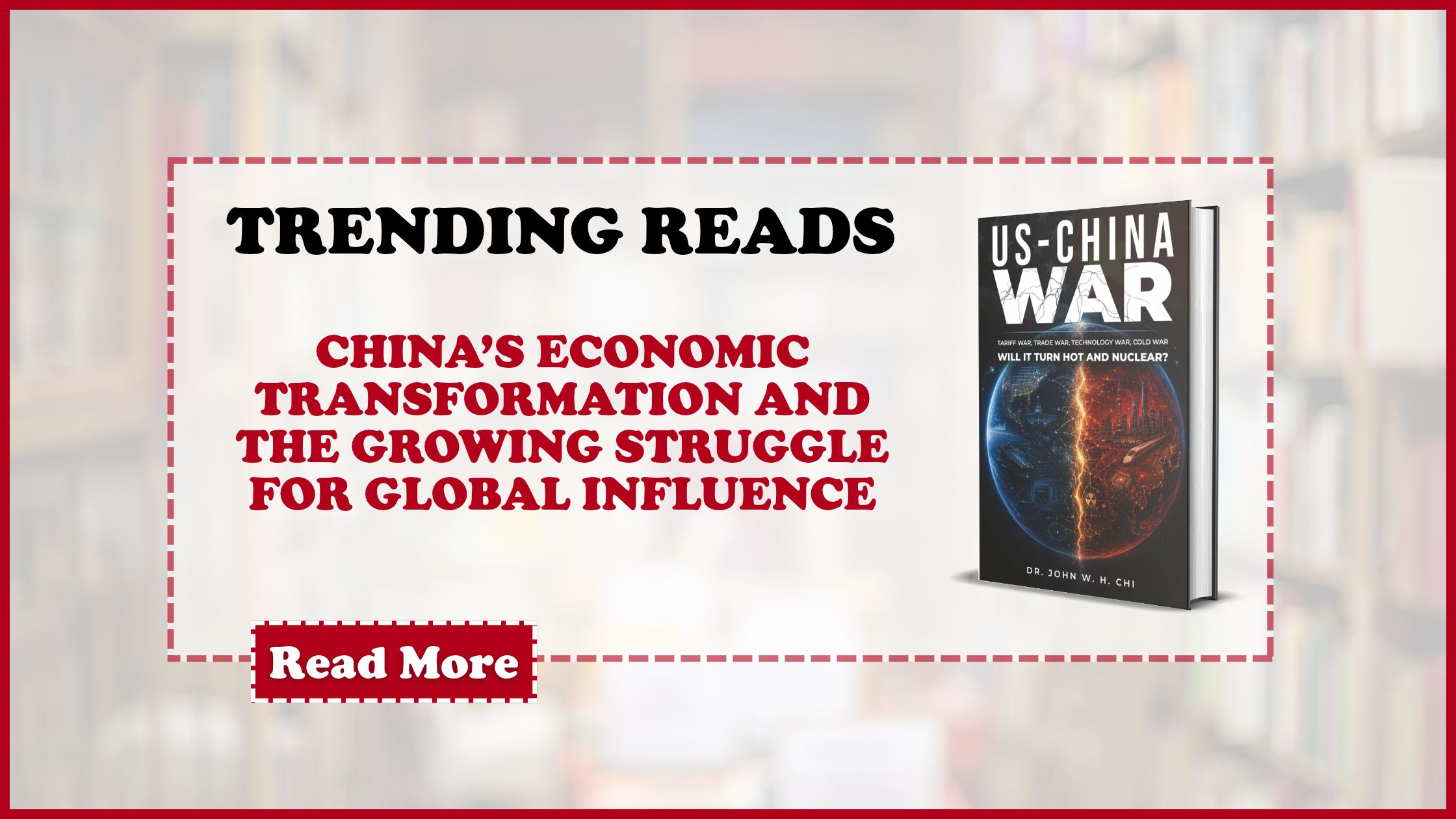
As Dr. John W. H. Chi discusses in US-China War, these reforms transformed China’s economic direction and created opportunities for industrial development, international investment, and technological advancement.
Instead of remaining dependent on traditional agriculture and low-cost manufacturing, China gradually developed increasingly sophisticated industries and modern infrastructure.
POVERTY REDUCTION AS A MEASURE OF PROGRESS
One of China’s most significant achievements has been its large-scale reduction of extreme poverty.
Over approximately four decades, around 800 million Chinese citizens were lifted out of extreme poverty, fundamentally changing living conditions across the country.
Behind these figures are families gaining access to better housing, education, transportation, employment, and essential services.
This transformation also raises questions about how human rights and national development should be evaluated.
In US-China War, Dr. John W. H. Chi emphasizes poverty reduction as a central contribution to human welfare, challenging narratives that focus primarily on allegations concerning China’s political system and human rights record.
While debates surrounding civil liberties and governance remain contested, improvements in material living conditions represent an important dimension of human development.
ECONOMIC GROWTH AND THE CHALLENGE TO ESTABLISHED POWER
China’s expanding economic influence has introduced new competitive pressures into international relations.
Its manufacturing capabilities, infrastructure development, and technological progress have strengthened its position in industries ranging from telecommunications and renewable energy to electric vehicles and semiconductors.
These advancements have also created concerns within the United States regarding economic competitiveness, technological leadership, and strategic influence.
Consequently, relations between the two countries have increasingly involved tariffs, trade restrictions, sanctions, and limitations on advanced technology exports.
Dr. John W. H. Chi examines these developments as part of a broader struggle over global influence, questioning whether economic competition must inevitably become political confrontation.
WHY COOPERATION STILL MATTERS
Economic rivalry becomes particularly dangerous when competition replaces opportunities for cooperation.
Trade disputes can disrupt supply chains, increase business uncertainty, and affect workers and consumers far beyond the countries directly involved.
The concerns explored in US-China War extend beyond economic disagreements to the possibility of a prolonged Cold War and dangerous military escalation.
China’s transformation demonstrates how economic reforms, long-term development strategies, and international trade can reshape a nation’s position in the world.
The essential lesson is that changing global influence does not have to produce permanent hostility. Recognizing economic achievements, examining competing narratives critically, and maintaining meaningful diplomatic engagement can help countries manage differences without sacrificing international stability.
A more prosperous world depends not simply on which nation advances fastest, but on whether growing economic power becomes an opportunity for cooperation rather than conflict.
Explore the realities behind US-China tensions and the growing importance of global peace.
Discover US-China War by Dr. John W. H. Chi.
📖 Paperback: https://www.amazon.com/US-China-War-Will-Turn-Nuclear/dp/B0HC8TJT28/
📱 Kindle: https://www.amazon.com/US-China-War-Will-Turn-Nuclear-ebook/dp/B0HC8MY852/