
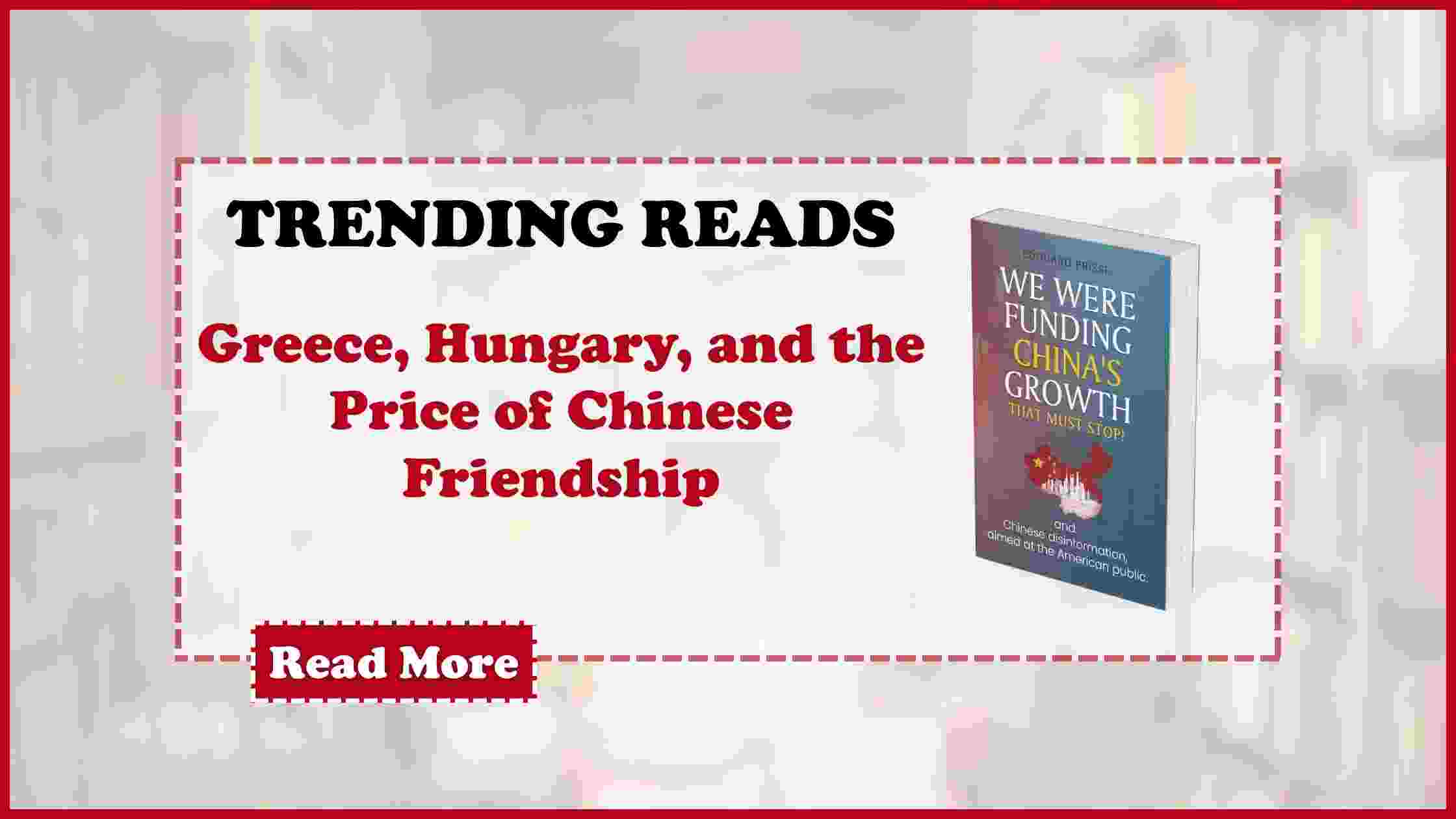
In diplomacy, there’s no such thing as a free lunch. But for China, offering discounted infrastructure, loans, and investments has proven to be a highly effective entrée into the heart of European politics—and Edouard Prisse wants the world to take notice.
In We Are Funding China’s Growth: That Must Stop!, Prisse highlights how China’s economic power, amassed through years of trade surpluses with the West, has become a tool for political manipulation, especially in smaller, financially vulnerable European states like Greece and Hungary.
Let’s start with Greece.
After the global financial crisis in 2008, Greece found itself economically devastated, politically unstable, and desperate for investment. Enter China. In 2016, the Chinese state-owned shipping company COSCO acquired a controlling stake in the Port of Piraeus, Greece’s largest seaport. It was sold as a win-win: China got a strategic maritime hub in Europe, and Greece got much-needed cash and jobs.
But the long-term consequences? Less “win,” more “warning.”
As Prisse explains, the port deal gave China a foothold in the EU and allowed it to project economic and political influence within the bloc. Soon after the investment, Greece used its position in the European Council to block an EU statement criticizing China’s human rights record. Coincidence? Highly unlikely.
Then there’s Hungary.
Prisse describes how Prime Minister Viktor Orbán welcomed China with open arms, signing up for Belt and Road projects and securing Chinese investment in rail infrastructure, universities, and telecom deals. The catch? Hungary, too, has consistently sided with China in EU deliberations, shielding it from collective criticism and action.
This strategy—invest, influence, protect—is now part of China’s foreign policy playbook. And it’s all made possible by one thing: money. Specifically, the $3 trillion Beijing holds in foreign exchange reserves, much of it earned from Western trade.
“China is buying political influence within the European Union,” Prisse writes, pointing out that economic leverage is the new diplomacy. Where tanks and treaties once ruled, now it’s ports and railways.
But the problem isn’t just what China is doing—it’s what the West is allowing it to do. European nations, especially those economically weaker or politically isolated, are susceptible to Chinese investments that come with unspoken conditions: don’t oppose Beijing, don’t support Taiwan, and certainly don’t criticize the Chinese Communist Party.
Prisse’s concern is that this piecemeal infiltration weakens the unity of the EU, undermines human rights advocacy, and gives China effective veto power over Europe’s foreign policy. And it’s all been purchased—cheaply—through surplus cash generated by Western consumerism.
What’s the solution?
Prisse calls on the U.S. and its allies to rethink trade policies. Rather than continuing “free trade” with a system that exploits openness for political gain, he urges a pivot to equal trade. This approach would balance import-export flows, reduce China’s cash reserves, and thereby limit its ability to buy influence abroad.
Because the real price of Chinese friendship, as seen in Greece and Hungary, isn’t paid in Euros or dollars—it’s paid in silence, in softened criticism, and in surrendered sovereignty.
And the bill is still coming due.


