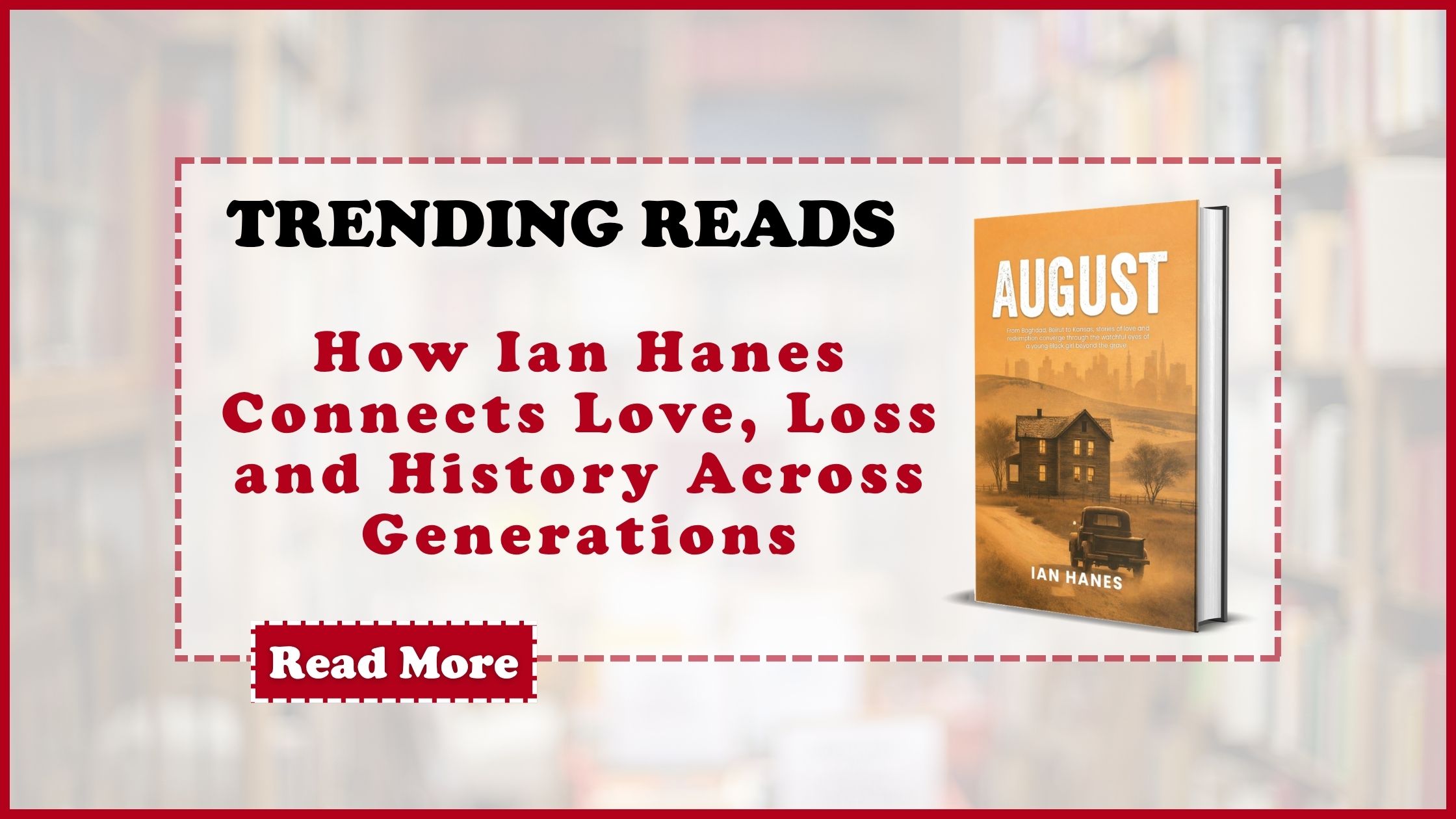
Some novels focus on a single relationship or one defining moment. August: We Carry What We Bury by Ian Hanes reaches further, showing how love and loss can travel across decades, families and countries. Through interconnected lives in Kansas, Baghdad and Beirut, the novel explores how personal memories become part of a much larger historical story.
At the emotional centre of the book is August Harper, a talented basketball player growing up in Lebanon, Kansas, during the 1970s. His future appears full of possibility. He has the ability to earn a scholarship, leave his small town and build a different life. However, his connection with Rose changes everything.
Rose is intelligent, ambitious and determined to make a difference. She dreams of becoming a civil rights lawyer, but she also understands the limitations placed on her as a young Black woman in a predominantly white community. Her relationship with August develops through private conversations, shared dreams and moments that must remain hidden from public view.
Their love is young and hopeful, yet it exists under the shadow of racism and social judgment. When Rose dies while trying to reach August’s championship basketball game, their future disappears in an instant. August experiences public triumph and private devastation on the same night.
That loss does not remain in the past.
August carries Rose’s memory into adulthood. He turns away from opportunities, remains on his family farm and builds a quiet life shaped by grief. Although he rarely speaks openly about what happened, his choices reveal how deeply the tragedy affected him. The love he lost becomes part of the man he grows into.
The novel then extends this idea into the next generation through John, August’s son. August raises him with patience, loyalty and a strong sense of justice. John inherits more than the family farm or his father’s basketball talent. He also inherits the emotional consequences of a history he does not fully understand.
Through John, Ian Hanes shows how families often pass down silence alongside love. Children may not know every detail of their parents’ pain, but they can still feel its presence. The past influences the way August protects his son, the values he teaches him and the fears he struggles to express.
The story also moves beyond America. In Baghdad and Beirut, other families carry memories shaped by dictatorship, disappearance, migration, war and political neglect. Layla grows up with the loss of her father and the experience of fleeing Iraq. Later, she creates a life in Lebanon with Bahri and their son, Malik.
Although their experiences differ from August’s, the emotional pattern is similar. Each generation inherits something unfinished. Some carry names that were erased. Others carry homes they were forced to leave, loved ones they could not save or questions that history never answered.
By connecting these stories, Ian Hanes demonstrates that history is not only found in official records. It also lives in family habits, private grief, inherited fears and the memories people protect.
August: We Carry What We Bury ultimately presents love as both a source of strength and a source of lasting pain. The novel suggests that people survive not by escaping the past, but by recognizing what it has placed in their hands.
Through August, Rose, John, Layla, Bahri and Malik, Ian Hanes creates a moving intergenerational story about remembrance, survival and the powerful ways history continues to shape those who come after us.