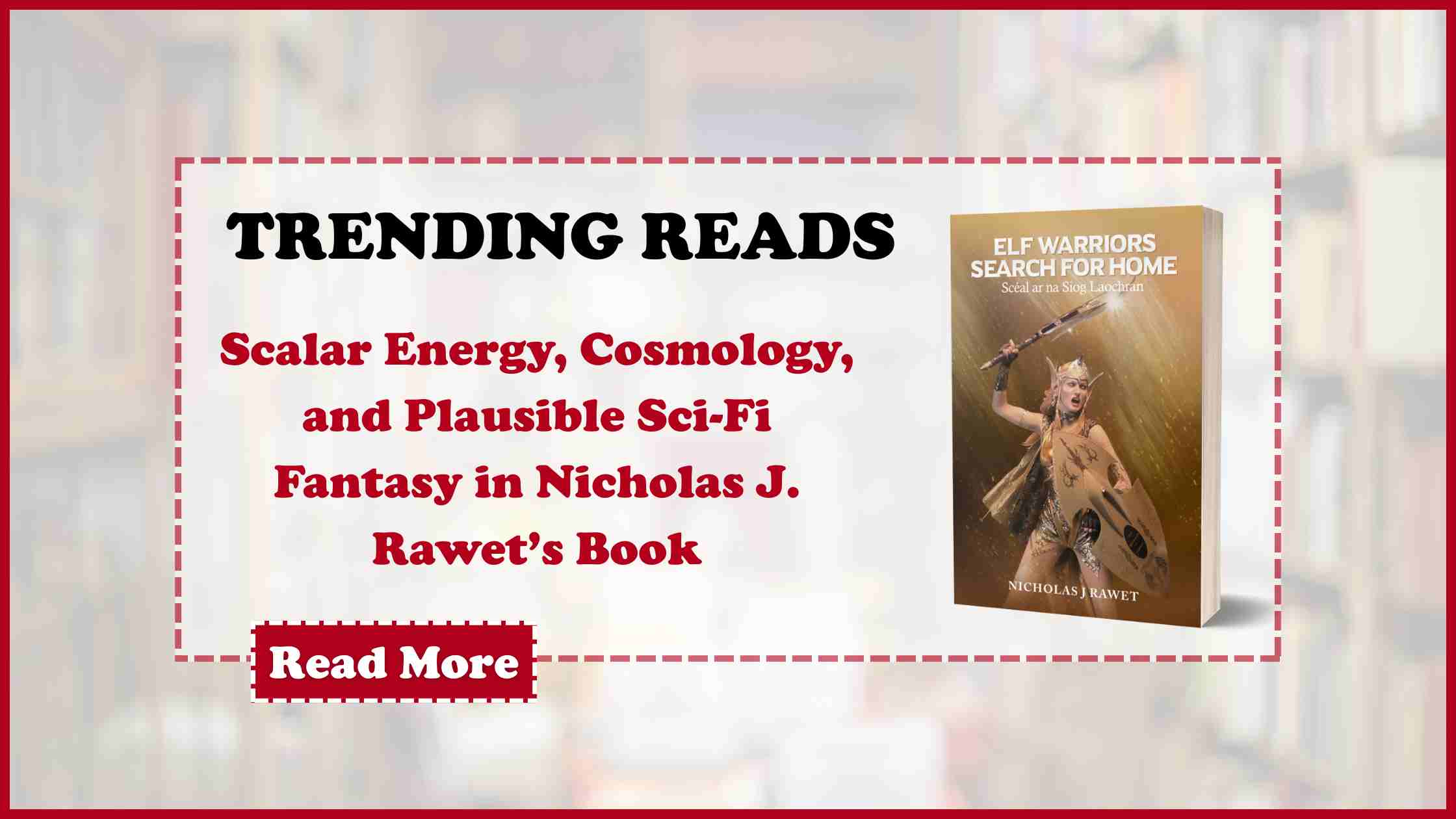
Fantasy often relies on mystery to explain how its worlds function, while science fiction tends to explain everything through rules and systems. Elf Warriors Search for Home: Scéal ar na Siog Laochran by Nicholas J. Rawet finds a careful balance between these approaches. From the very beginning, the book introduces concepts such as scalar energy, cosmic movement, and planetary systems in a way that feels structured without becoming overly technical. This balance allows the story to remain accessible while adding a sense of realism to its universe.
Scalar energy is one of the key concepts that shapes the story. Rather than acting as vague magic, it functions as a defined force with limits and consequences. The Siogach utilize scalar energy to travel between worlds and sustain their civilization, but this energy is not unlimited. When their homeworld begins to fail, the energy required to hold it together comes at a cost. It creates tension that feels grounded, because power is treated as a resource rather than a miracle. The elves cannot simply solve problems by drawing on endless strength. Every use of energy has implications.
The cosmology of the book reinforces this sense of structure. Planets, moons, and stars are not just background scenery. They influence survival, travel, and long-term planning. The Siogach flee through a cosmic vortex to a distant moon that is cold, harsh, and unfamiliar. This setting is not shaped to suit them. Instead, they must adapt to it. Gravity, climate, and distance all matter. These elements echo real scientific concerns, which helps the world feel believable even as it remains fictional.
Nicholas J. Rawet also blends science-inspired thinking into the way societies function. The collapse of the Siogach homeworld is not sudden or unexplained. It follows a logical progression tied to cosmic instability and energy strain. This approach mirrors how real civilizations might respond to environmental collapse. Leaders must make decisions based on incomplete information, limited resources, and the pressure of time. The science-inspired framework supports the emotional stakes rather than distracting from them.
What makes this approach effective is that it does not overpower the fantasy elements. Telepathy, elemental abilities, and ancient traditions still exist, but they operate within a system that has boundaries. The presence of scalar energy enhances believability rather than diluting the fantasy. Readers are given enough structure to understand the risks without being distracted from the story by technical details.
The interaction between science-inspired concepts and cultural identity is another strength. The Siogach do not treat their knowledge as abstract theory. It is woven into rituals, leadership roles, and daily survival. This integration makes the civilization feel cohesive. Science and belief coexist rather than compete, reflecting how real societies often blend understanding with tradition.
By grounding its science fantasy elements in clear cause and effect, this bookcreates a universe that feels stable enough to explore yet dangerous enough to matter. The rules are consistent, the consequences are real, and the sense of scale remains intact.
Readers who enjoy fantasy that respects structure while embracing imagination will find much to appreciate in Elf Warriors Search for Home by Nicholas J. Rawet. It is a thoughtful example of how science-inspired ideas can deepen a fantasy world without losing its sense of wonder, and it is well worth reading.
Available on Amazon, read now: https://www.amazon.co.uk/dp/1971002615/