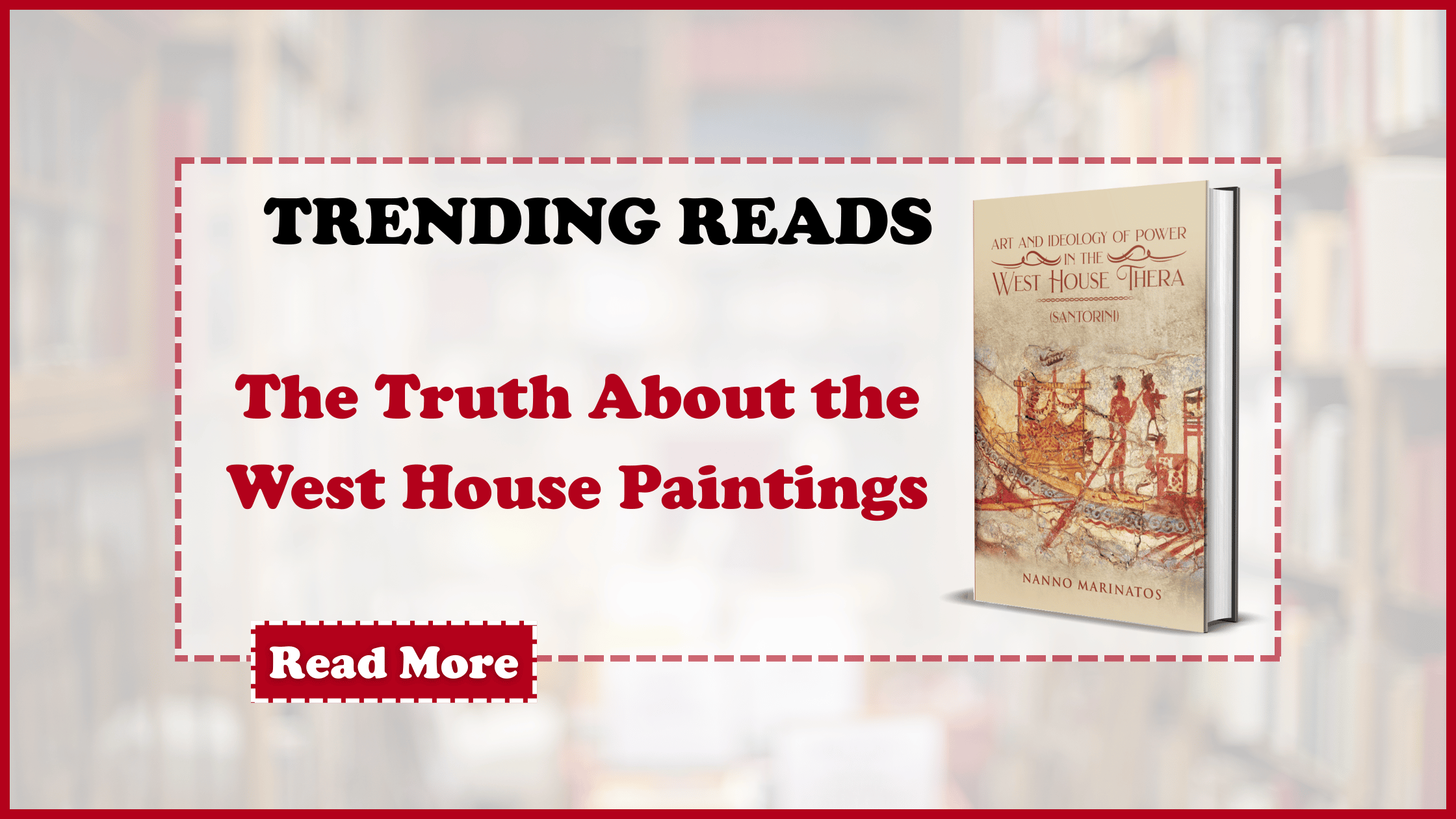
Few archaeological discoveries capture the imagination and our fascination like the wall paintings found at the West House in Akrotiri, Santorini. These frescoes, preserved under volcanic ash for over three thousand years, are nothing short of a miracle. They are a record of how an ancient people saw themselves and their world. In Art and Ideology in the West House Paintings of Thera (Santorini), archaeologist Nanno Marinatos revisits these extraordinary works and offers a grounded explanation of what they truly mean. Her research invites us to look beyond the colour and form to understand what these paintings were saying to the people who lived with them.
When the site of Akrotiri was uncovered in the late twentieth century, it was immediately clear that the buildings preserved there were not ordinary homes. The West House, in particular, stood out for its artistic richness. Walls were covered from floor to ceiling with scenes of ships, flowers, people, and animals. Some thought the paintings told a story of myth or ceremony, others of war and trade. Marinatos brings these interpretations into balance. She argues that the frescoes represent the ideology of a thriving civilisation that valued harmony, leadership, and devotion to its gods.
The famous Ship Frieze is a central piece of this interpretation. It shows a fleet sailing across calm seas, not into battle, but as part of a grand procession. Each vessel is adorned with lions, crocus flowers, and the image of the sun. These were the symbols that appear repeatedly in Minoan art. In fact, according to Marinatos, these specific images reflect the reach of Minoan influence, the unity between its islands, and its belief in divine order. Here, the fleet was both a political message and a spiritual one, showing that power could be exercised through cooperation and shared faith rather than force.
The frescoes also include scenes of everyday life, such as the Fishermen and the First Lady. These show people not as distant figures of myth but as real participants in a functioning society. Marinatos points out that even these human figures reflect the same core ideas: respect for the sea, devotion to natural cycles, and an awareness of the divine within the ordinary. Every line of the artwork connects human experience to the larger rhythms of nature.
Marinatos comes to the startling conclusion that Minoan art was ideological rather than merely beautiful. A belief system was incorporated into the colors, compositions, and even the surrounding architecture. She claims that the West House paintings had their own language and were used to convey ideals of harmony, wealth, and heavenly protection. The earlier notion of the Minoans as a peaceful or exclusively artistic people is replaced by this interpretation. Instead, it portrays them as intellectuals who expressed moral and social ideas via art.
Today, when visitors walk through the preserved remains of Akrotiri, it is easy to be overwhelmed by the beauty alone. But the truth about the West House paintings, as Marinatos explains, is that they are as much about thought as they are about sight. They represent one of the earliest examples of visual communication used to bind a civilisation together through shared meaning.
If you want to explore more and want to take a deeper look into these paintings and the history behind them, Art and Ideology in the West House Paintings of Thera (Santorini), will help you to see this ancient world clearly, not as myth, but as a place where art and belief shaped life itself. To experience the full depth of these frescoes and the civilisation that created them, read Nanno Marinatos’s remarkable book. Head to Amazon to purchase your copy: https://www.amazon.com/dp/B0GGKK64DM/