African literature has long shaped global conversations about identity, colonialism, culture and resistance. Few writers have contributed more to that legacy than Chinua Achebe, whose novels transformed how the world understands Africa and its people. Yet while Achebe’s works are widely studied through political and postcolonial lenses, a deeper philosophical and theological dimension has often remained underexplored.
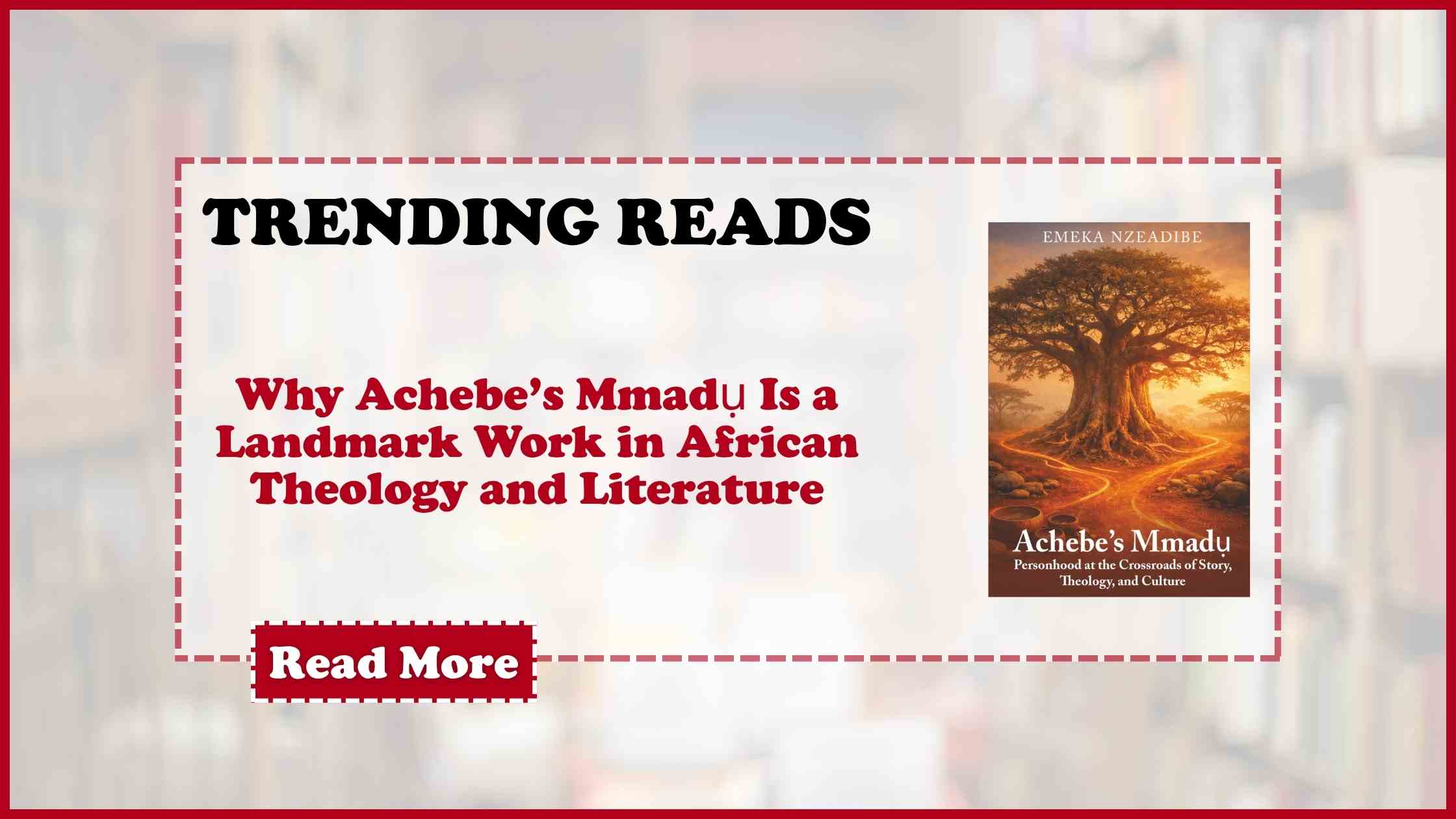
That is precisely why Achebe’s Mmadụ: Personhood at the Crossroads of Story, Theology, and Culture by Emeka Nzeadibe stands out as a landmark contribution to both African theology and literary scholarship.
At its core, the book introduces a groundbreaking exploration of the Igbo concept of Mmadụ, a term that means “human being” or “person,” but also encompasses consciousness, dignity, relationality, spirituality and communal identity. Drawing extensively from Achebe’s literary universe, Nzeadibe demonstrates that Achebe was not merely telling stories about colonial disruption; he was articulating a profound vision of humanity rooted in Igbo cosmology.
This shift in perspective is significant.
For decades, African literature has often been approached primarily as a response to colonialism. While that framework remains important, Nzeadibe argues that Achebe’s work deserves recognition for something far greater: its contribution to global philosophical and theological discussions about what it means to be human.
Through novels such as Things Fall Apart, Arrow of God and Anthills of the Savannah, Achebe presents a world where personhood is deeply relational. Human beings are not isolated individuals existing apart from others; they are interconnected through family, community, spirituality, destiny and moral responsibility. The famous Igbo expression “Ife kwụrụ, ife akwụdebe ya” “Where something stands, something else stands beside it” becomes a guiding principle for understanding existence itself.
Nzeadibe skillfully places this African understanding of personhood into conversation with Christian theological anthropology, particularly the concept of imago Dei, the belief that every person is created in the image of God. By doing so, he creates an intercultural dialogue that challenges the dominance of purely Western theological frameworks while affirming the intellectual richness of African thought.
What makes Achebe’s Mmadụ especially remarkable is its interdisciplinary reach. The book moves seamlessly between literature, theology, philosophy, anthropology and cultural studies, offering readers a deeply layered understanding of Achebe’s work. It does not simply analyze texts; it repositions African cosmology as a serious intellectual tradition capable of enriching global debates about identity, dignity, ethics and coexistence.
The timing of this work is also crucial. In a world increasingly shaped by division, individualism and identity crises, the book’s emphasis on relational humanity feels urgently relevant. Achebe’s vision of Mmadụ reminds readers that human beings are defined not by isolation or competition, but by connection, belonging and shared existence.
More importantly, the book challenges outdated assumptions that African intellectual traditions are secondary or peripheral to “mainstream” philosophy and theology. Instead, Nzeadibe presents Igbo thought as a living, sophisticated and globally significant framework for understanding humanity.
Ultimately, Achebe’s Mmadụ is more than a literary study. It is a bold reimagining of African thought as a vital participant in global conversations about the human person. By bringing together story, theology and culture, Emeka Nzeadibe has created a work that not only deepens our understanding of Chinua Achebe but also expands the future possibilities of African theology and literature itself.
Available On Amazon: https://www.amazon.com/dp/B0GZV57B1G/