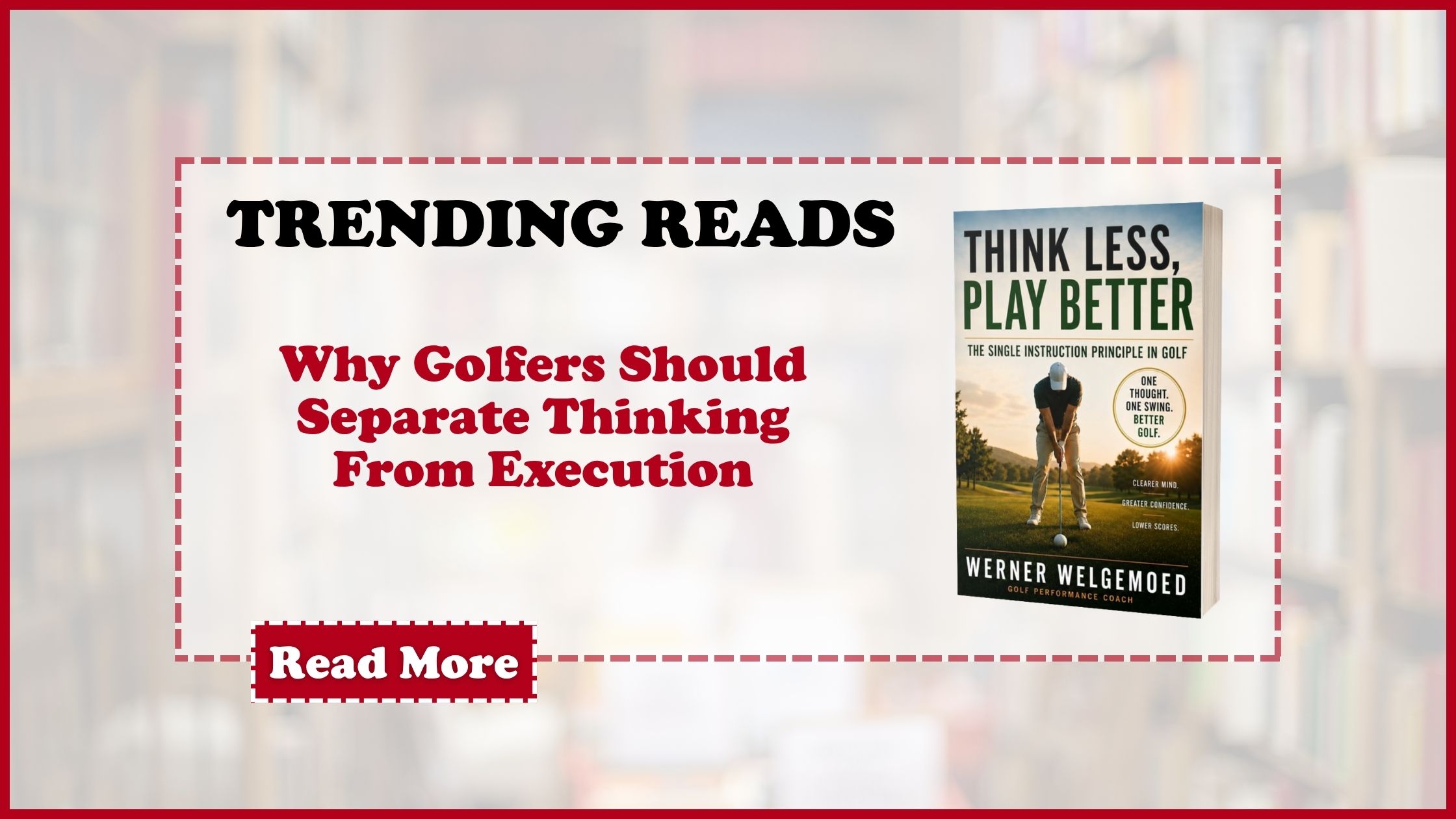
Golf is a thinking game but that does not mean you should be thinking throughout the entire swing.
That distinction is central to Think Less, Play Better: The Single Instruction Principle in Golf by Werner Welgemoed.
Every golf shot requires decisions. You need to consider distance, wind, lie, hazards, target and club selection. Good golf is not about ignoring those factors.
The problem starts when the thinking continues after the decision should already be made.
That is when analysis becomes interference.
Two Different Jobs
Welgemoed divides every shot into two distinct phases: thinking and executing.
The thinking phase is where you assess the situation.
You gather information.
You choose your target.
You select your club.
You decide what type of shot you want to play.
This is the time to analyze.
But once you are ready to hit the ball, the job changes.
Execution is where you swing, react, trust and commit.
The mistake many golfers make is allowing the first phase to follow them into the second.
They step over the ball but keep thinking.
They question the club.
They adjust their setup.
They add another technical reminder.
They wonder whether the last swing thought was correct.
Instead of executing the decision they already made, they keep reopening it.
Why This Creates Problems
A golf swing happens quickly.
There is very little time to consciously control positions or make corrections once the motion begins.
Yet golfers often try to manage the swing in real time.
The result, according to Think Less, Play Better, can be tension, hesitation, disrupted rhythm and inconsistent execution.
The golfer is trying to perform and analyze at the same time.
That is a difficult combination.
A better approach is to complete the thinking first.
Then commit.
The Role of One Clear Instruction
The book’s Single Instruction Principle gives golfers a practical way to make that transition.
Once the thinking phase is complete, reduce everything to one simple instruction.
That might be:
“Smooth tempo.”
“Commit to target.”
“Strike through.”
“Roll it on the line.”
The instruction becomes the final thought carried into execution.
Instead of several competing ideas, the mind has one clear direction.
Welgemoed describes this as reducing complexity rather than ignoring it. The golfer still does the necessary thinking but does not carry all of that information into the swing.
Know When to Stop Thinking
One of the most valuable lessons in Think Less, Play Better is that good decision-making also includes knowing when the decision is finished.
Once you have chosen the shot, continuing to analyze can weaken commitment.
This is why the book introduces the idea of a Commitment Line.
Before that line, thinking is allowed.
After it, no new thoughts, changes or adjustments should be added.
If doubt becomes strong enough that you cannot commit, step back and restart rather than standing over the ball trapped between deciding and swinging.
Clearer Thinking, Freer Golf
Separating thinking from execution does not make golf less intelligent.
It makes your thinking more purposeful.
Analyze when analysis is useful.
Decide when the information is clear.
Then stop trying to solve the shot while you are already hitting it.
That is the philosophy Werner Welgemoed presents throughout Think Less, Play Better.
The goal is not an empty mind.
It is a clear one.
Think fully. Decide clearly. Choose one instruction. Then execute with commitment.
Think Less, Play Better: The Single Instruction Principle in Golf by Werner Welgemoed is available on Amazon: https://www.amazon.com/dp/B0H2M2L1PB