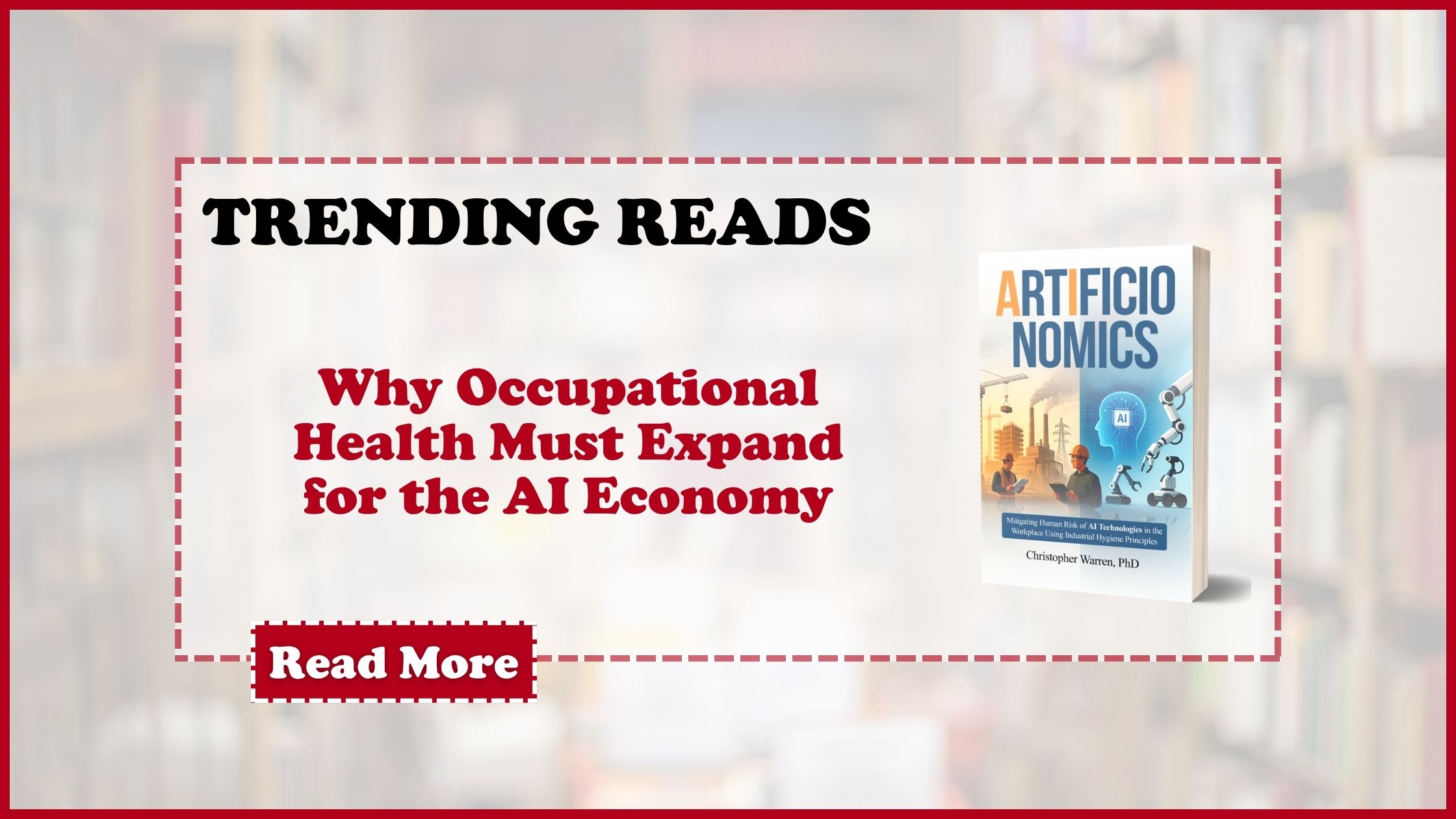
Artificial intelligence is no longer limited to research labs, software companies or futuristic predictions. It is now part of daily workplace operations across manufacturing, healthcare, logistics, finance, construction, customer service, security and many other industries. AI helps organizations move faster, analyze more data, automate repetitive tasks, predict failures and improve productivity. Yet as businesses welcome these advantages, they must also face a growing reality: the AI economy is creating new risks for workers that traditional occupational health systems were not fully designed to address.
This is the urgent message behind ArtificIonomics: Mitigating Human Risk of AI Technologies in the Workplace Using Industrial Hygiene Principles by Christopher Warren, PhD. The book explains why workplace safety must evolve as artificial intelligence becomes more deeply embedded in how people work, think, decide, communicate and perform.
For decades, occupational health has focused on visible and measurable hazards. Safety professionals have identified and controlled risks such as chemical exposure, poor ergonomics, excessive noise, heat stress, machinery hazards and physical strain. These remain important. However, AI introduces a different class of workplace risks. Many of them are psychological, cognitive, ethical, social and organizational.
A worker may not be exposed to a toxic substance, but they may be exposed to constant algorithmic monitoring. An employee may not face a traditional machine hazard, but they may work beside autonomous robots that require new safety boundaries and new training. A manager may not experience physical strain, but they may face decision fatigue from relying on complex AI systems. A customer service representative may not be injured by equipment, but they may feel emotionally drained by machine-paced work, reduced autonomy and pressure to meet AI-driven performance targets.
Dr. Warren’s book makes it clear that these issues are not separate from occupational health. They are part of it. If AI changes the conditions of work, then occupational health must expand to evaluate how those changes affect human well-being, dignity, trust and safety.
ArtificIonomics offers a practical way to make that expansion possible. By applying industrial hygiene principles to AI risk, the book encourages organizations to identify where AI-related hazards exist, evaluate how workers are exposed to them and control those risks before they cause harm. This approach transforms AI adoption from a purely technical decision into a human-centered safety responsibility.
The book also highlights the growing role of safety professionals in the AI economy. As companies adopt surveillance systems, predictive analytics, robotics, automated scheduling and AI decision tools, safety leaders must be included early in the conversation. They can help ask the right questions. How will this system affect the workload? Will it increase stress? Does it reduce worker autonomy? Can employees challenge automated decisions? Is the technology transparent? Are there safeguards for privacy, fairness, training and human oversight?
These questions matter because successful AI adoption depends on trust. Workers are more likely to accept new technology when they understand it, when they are trained to use it and when they know their well-being is being protected. Without that trust, even the most advanced systems can create resistance, fear, burnout and organizational instability.
What makes ArtificIonomics especially valuable is its balanced approach. Christopher Warren, PhD does not argue against AI. Instead, he shows how businesses can use it responsibly. AI can reduce dangerous work, improve emergency response, support better decisions and strengthen productivity. However, those benefits must be matched with a serious commitment to protecting the people affected by these systems.
The AI economy needs more than innovation. It needs responsibility. It needs leaders who understand that occupational health must now include digital stressors, algorithmic management, human-robot interaction, privacy concerns and psychological safety.
ArtificIonomics is a timely guide for that new reality. It reminds businesses that the future of work should not only be intelligent. It should also be safe, ethical, humane and built around the people who make progress possible.