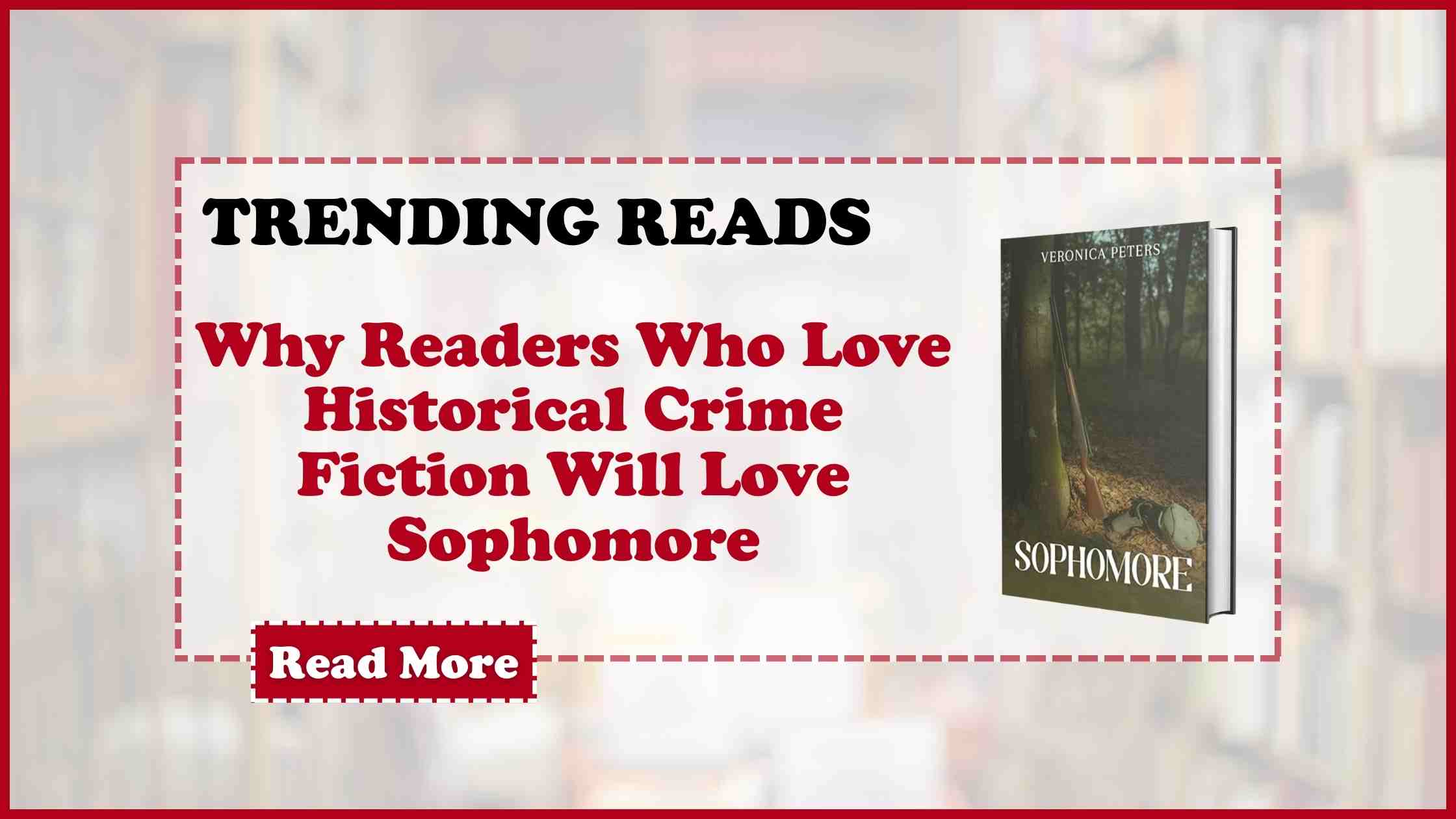
Historical crime fiction thrives on tension, atmosphere, and the slow unraveling of truth within a world shaped by its time. Sophomore by Veronica Peters delivers all of this with precision and emotional depth, placing readers inside a 1949 rural community where tragedy fractures both families and trust.
Set in postwar America, Sophomore captures the texture of small town life in remarkable detail. Farms define the landscape. Neighbors know one another’s business. Reputation carries weight. In a setting like this, a violent crime does not remain contained to a single household. It ripples outward, touching every family, every classroom, every church pew. Readers who appreciate the immersive quality of historical crime fiction will find themselves grounded in a fully realized era, from the routines of farm work to the social expectations that govern daily life.
The novel opens with the promise of an ordinary celebration, New Year’s Eve in a community still rebuilding after the war. That promise collapses when four innocent children are murdered. The shock is not just personal. It is communal. The crime shatters the illusion of safety that defines rural America in the late 1940s. From that moment forward, fear begins to circulate through the town like a silent contagion.
At the center of the investigation is Sheriff Charles Gordon, a man who represents steady procedure rather than dramatic flair. Readers who favor methodical investigations over sensationalism will appreciate his disciplined approach. He documents details carefully. He retraces footsteps. He asks questions repeatedly. This is policing before modern forensic technology, before DNA databases and instant lab reports. Evidence depends on observation, logic, and persistence. The suspense builds through human reasoning rather than technological shortcuts.
Another strength of Sophomore lies in its exploration of suspicion. When a suspect emerges, the weight of public opinion becomes almost as powerful as the evidence itself. In a small town, accusation carries consequences that extend beyond the courtroom. Families are scrutinized. Teenagers face whispers at school. Friends question loyalties. The emotional toll of being connected to a suspect becomes one of the most compelling layers of the narrative.
For readers who enjoy character driven crime fiction, the novel offers a range of perspectives. Parents struggle with grief that feels unbearable. A young man wrestles with fear and reputation. A migrant worker becomes the focus of suspicion, revealing the era’s quiet biases and anxieties about outsiders. Through these intersecting viewpoints, the story examines not only who committed the crime, but how a community reacts when certainty is out of reach.
The historical setting deepens these tensions. Postwar America is portrayed as hopeful yet fragile. Immigrants are building new lives. Families are investing in land, children, and education. Beneath that optimism lies vulnerability. The novel captures this contrast with clarity, showing how quickly stability can fracture when violence intrudes.
Readers who value emotional authenticity will also connect with the intimate family dynamics woven throughout the mystery. Grief is not rushed. Fear lingers. Conversations are strained. Decisions about leaving town or staying become acts of survival rather than preference. The crime investigation is inseparable from the emotional landscape it reshapes.
Ultimately, Sophomore offers more than a whodunit. It presents a layered portrait of justice in a time when community reputation, moral responsibility, and law enforcement intersect in complicated ways. The pacing allows suspense to build gradually, drawing readers deeper into both the mystery and the lives affected by it.
For fans of historical crime fiction who seek atmosphere, character depth, and a carefully constructed investigation grounded in its era, Sophomore by Veronica Peters is a compelling addition to the genre. It reminds us that in small towns, truth is never uncovered in isolation. It must pass through the hearts and fears of everyone who calls that place home.
Get Your Copy On Amazon: https://www.amazon.com/dp/1971950025/