Honestly, religious tradition provides a sense of comfort and continuity. It connects generations, builds community, and offers rituals that shape the rhythms of Catholic life.
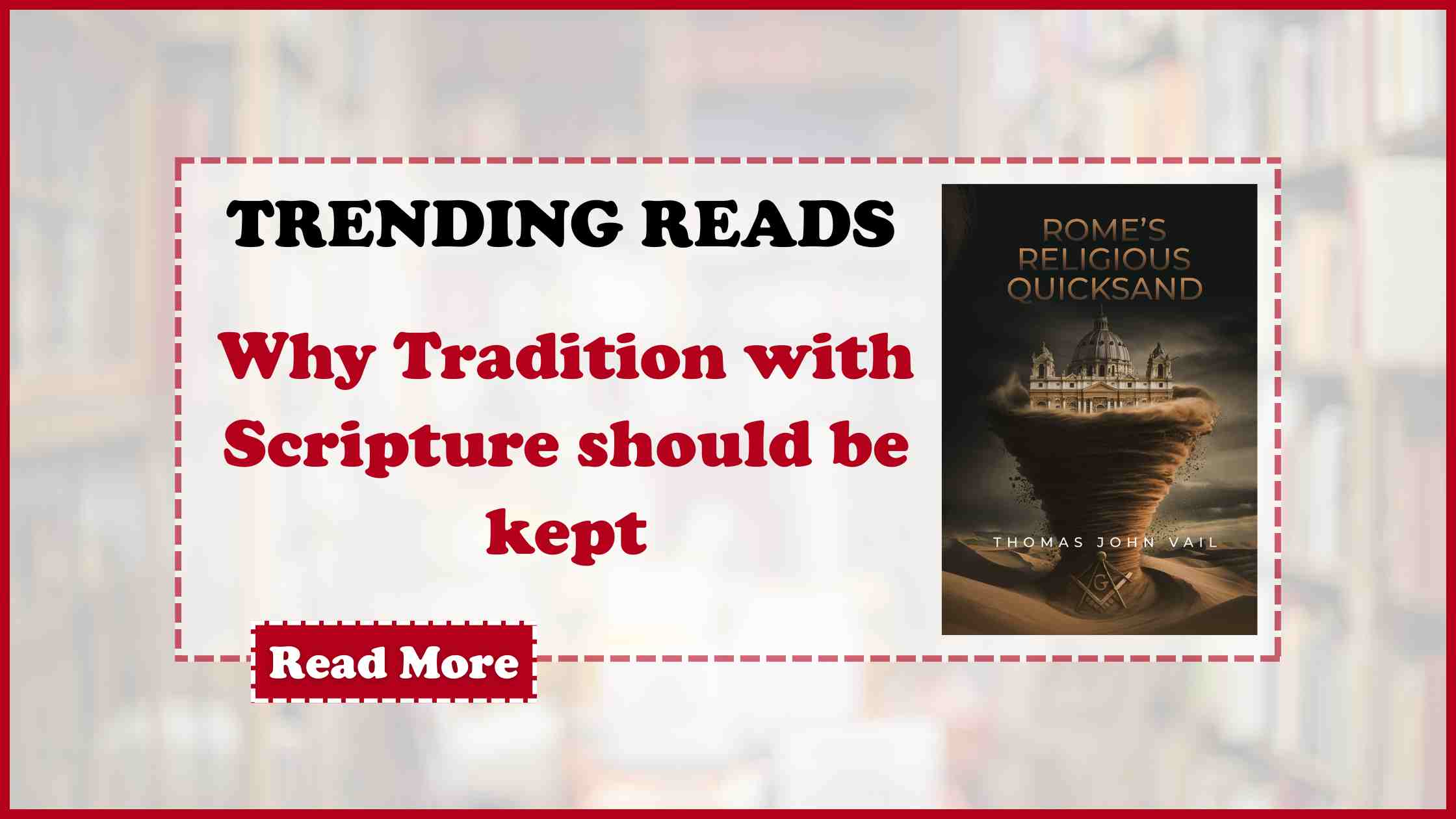
But what happens when modernism contradicts the very traditions and scriptures it claims to uphold? Along with proving the validity of the Catholic faith this is the central concern addressed in Rome’s Religious Quicksand by Thomas John Vail. It is a bold critique woven throughout the pages of how the Roman Catholic Church evolved its traditions to coincide with scripture through the centuries to the present day and how in recent years the authorities of the church have come to redesign it and usurp to the detriment of all.
The book argues that when human modernism replaces the work of the Holy Spirit and the authority of God’s Word, faith becomes unstable. Like building a house on shifting sand, blind reliance on modernism to weaken and void scripture and tradition as the foundation of belief – invites spiritual collapse. The early church, as recorded in the New Testament, was centered on the teachings of Christ and His apostles. In this regard, the Holy Bible has been the final authority.
As the church grew in size and power, especially after Constantine’s rise in the fourth century, it became increasingly entangled with the empire, politics, and institutional survival. Doctrinal additions began to accumulate, some of which lacked scriptural basis but still guided by the inspiration of the Holy Spirit. Jesus or the apostles did not teach practices like indulgences, purgatory, and the veneration of saints, yet they became pillars of the church’s theological structure. These traditions were later codified in councils and defended by appeals to authority and continuity.
The book points out that Jesus Himself warned against changes by man coming in the future. That caution should always be made a prime directive because Christ’s Church in today’s world runs the risk of stifling God’s voice in favor of its own when it elevates its own decisions to change the status of tradition and scripture.
One of the clearest examples is the doctrine of transubstantiation. It is the belief that the bread and wine become the literal body and blood of Christ. This teaching, through modernism, has come into doubt in recent years. This long-established dogma along with scripture has been attacked by today’s modernism. The book argues that modernistic teachings, while wrapped in layers of theological reasoning, ultimately rest on human ideas, not divine command as demonstrated in today’s priestly ordinations and the Novas Ordo Mass.
When believers are taught that truth comes from a combination of scripture, church tradition, and church law, they will find a clear compass. They may read the pages of this book and come to one inevitable conclusion, that today’s church leaders are not in concert with centuries of past papal authorities.
The book does not advocate for an anti-historical faith. It respects the rich history of Christian thought and acknowledges that tradition can serve a valuable role when it supports, not replaces, scripture. The problem arises when modernism becomes the law of the land that is untouchable, unquestioned, and ultimately unbiblical.
For anyone who comes from a Catholic background or who is exploring the differences between Protestant and Catholic beliefs, this book challenges the mind of all believers to examine what they believe and why this book details and points clearly to the answer. One should ask, are today’s mainstream Catholic practices grounded in the historical traditions and scriptures of the Bible? If your answer is no, then you should search your soul and let it lead you to the truths that you will find in this book. Your eternal resting place hangs in the balance.
In the end, Rome’s Religious Quicksand reminds us that there is only one solid foundation for faith. It is found in the writings of the 4 gospels of Mathew, Mark, Luke, and John along with the Acts of the Apostles. Anything else is, as Jesus said, like building on sand.
Head to Amazon to purchase your copy : https://www.amazon.com/dp/B0FMM3CZZT/