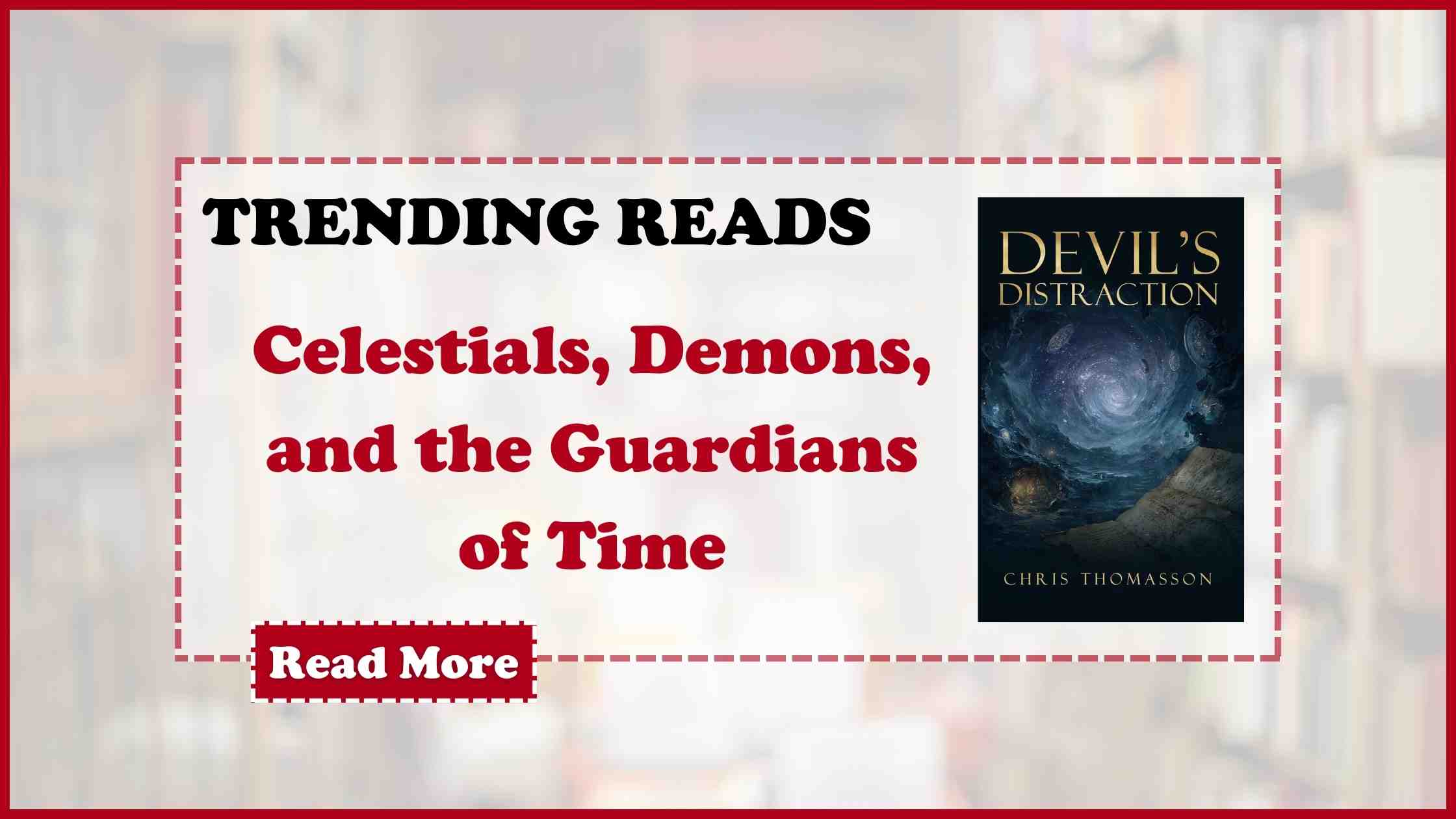
Celestials, Demons, and the Guardians of Time
One of the most unique aspects of Devil’s Distraction is how it structures the supernatural world. Rather than presenting good and evil as a simple opposition, the book introduces a layered hierarchy where power, responsibility, and restraint matter as much as intention. Celestials, demons, and the guardians of time do not exist to overlook one another. They exist to maintain balance, even when that balance demands difficult choices.
This hierarchy gives the story its depth. Every supernatural force operates within limits, and those limits shape the conflict more than raw strength ever could.
Celestials in the book are not portrayed as distant symbols of purity or authority. They function as keepers of order, bound by laws that restrict direct interference. Their role is not to save humanity from consequence, but to ensure that the structure of time and existence does not collapse under unsupervised chaos.
What makes them interesting is their restraint. They see far more than humans do, yet they act far less often. This restraint is not weakness. It is discipline. Acting too freely would destabilize the balance they are meant to protect.
The celestials represent a form of responsibility that prioritizes long term survival over immediate resolution. They understand that preventing every tragedy would erase free will, and erasing free will would unravel everything else.
Demons in Devil’s Distraction are not simply creatures of destruction. They are agents of disruption, thriving in moments of distraction, doubt, and delay. Rather than relying on constant violence, they exploit human weakness and inattention.
Their power grows when focus slips. When people ignore warnings. When they assume someone else will interrupt.
This approach makes demons far more unsettling. They do not force collapse. They encourage it. They rely on patience rather than speed, and manipulation rather than brute strength.
In the hierarchy, demons function as a necessary threat. Without disruption, balance would become stagnation. Their existence tests the system, exposing its vulnerabilities.
Perhaps the most complex group in the hierarchy is the guardians of time. They exist outside simple moral alignment. Their duty is not to favor good or punish evil, but to preserve the integrity of time itself.
They enforce boundaries. They decide when intervention is allowed and when restraint is required. Their presence reinforces the idea that time is not a tool to be used freely, but a structure that must be protected.
The guardians represent consequence in its purest form. They remind every other force that action has cost, and that cost cannot always be undone.
This layered structure creates tension without constant confrontation. No group has absolute authority. Every force is constrained by purpose.
Jack Skye moves through this hierarchy not as a ruler or equal, but as a participant bearing the weight of its rules. He experiences how power without permission becomes liability.
By framing the supernatural world this way, Devil’s Distraction avoids simplistic morality. Good does not always intervene. Evil does not always attack. Time does not forgive misuse.
Instead, the story shows a system where survival depends on awareness, restraint, and responsibility. The order does not exist to answer every question. It exists to make the result of choice inevitable. Are you ready to face the music?
Read this book now.https://www.amazon.com/Devils-Distraction-Chris-Thomasson-ebook/dp/B0G22H9S8X/