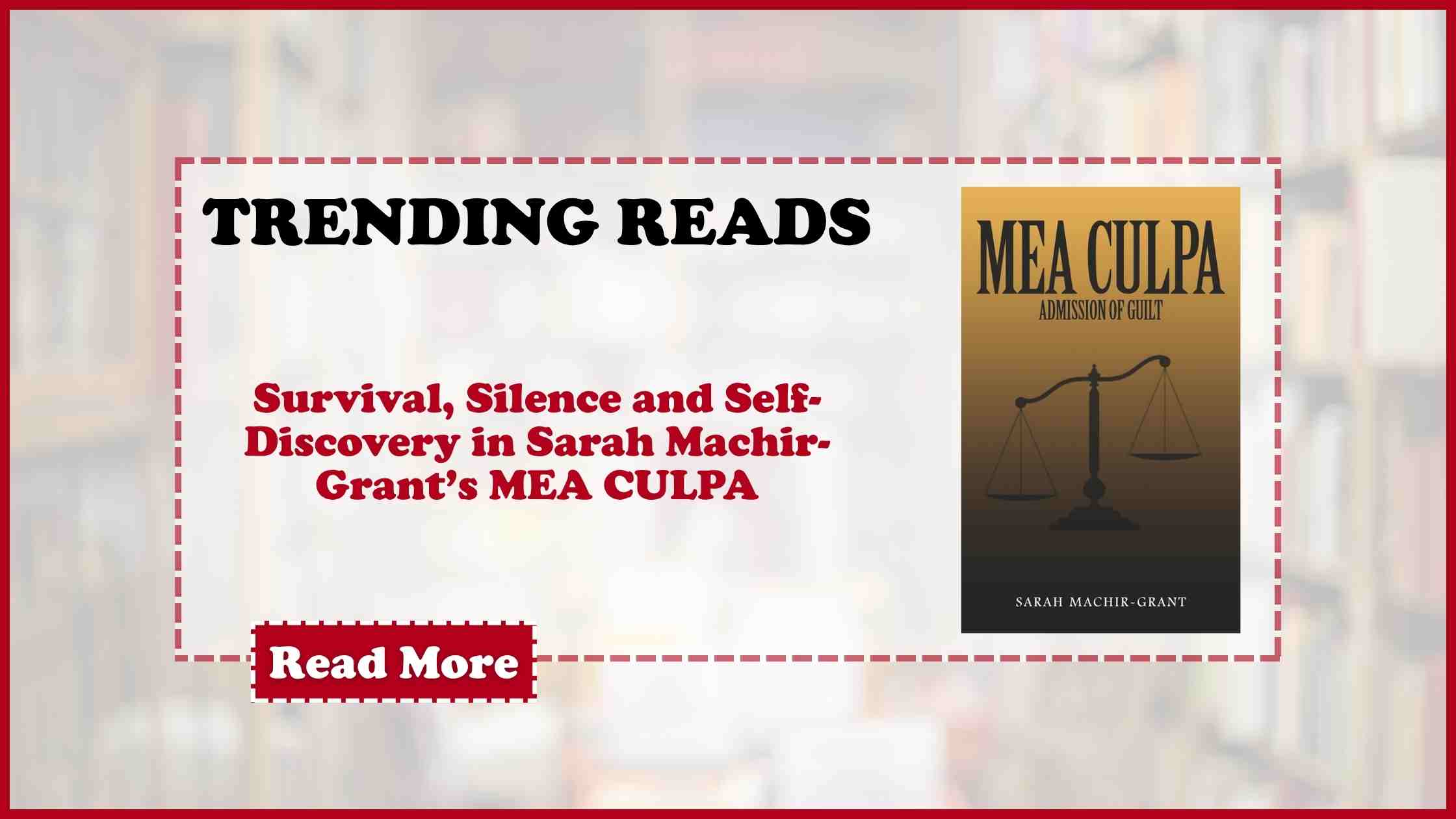
In MEA CULPA, Sarah Machir-Grant delivers a memoir that does not simply recount a life; it excavates it. Through a deeply introspective, emotionally unflinching narrative, the book explores what it means to survive a childhood shaped by fear, to grow in silence and to slowly begin the difficult process of self-discovery in the aftermath of trauma.
At its foundation, MEA CULPA is a story of survival. But this is not survival in the heroic or cinematic sense. It is quiet, fragmented and often invisible to the outside world. The protagonist grows up in an environment defined by emotional instability and authoritarian control, where love is entangled with fear and safety is never guaranteed. Within this world, survival becomes less about escape and more about adaptation, learning when to speak, when to stay silent and how to navigate shifting emotional terrain.
Silence, in particular, plays a central role in the memoir. It is not merely the absence of speech, but a conditioned response. The protagonist learns early that voicing distress can carry consequences and so silence becomes both shield and prison. It is through this silence that much of the narrative’s emotional weight is conveyed. What is not said often carries more impact than what is spoken, reflecting the complex ways trauma can shape communication and identity.
Sarah Machir-Grant captures this dynamic with striking psychological insight. The memoir moves through memory in a nonlinear, almost disjointed way, reflecting how deeply internalized experiences often resurface in fragments rather than clear narratives. This structure allows readers to experience the instability of memory itself, where past and present blur and where emotional truths emerge gradually rather than all at once.
As the protagonist grows older, silence begins to transform. What once functioned as protection slowly becomes a barrier to understanding the self. The journey of MEA CULPA is, in many ways, the journey of breaking that silence not through dramatic revelation, but through gradual recognition. The act of remembering becomes an act of reclaiming voice.
Self-discovery in MEA CULPA is neither immediate nor linear. It is complicated by the lingering presence of fear, which continues to shape decisions, relationships and internal dialogue well into adulthood. The memoir powerfully illustrates how early environments do not simply fade with time; they echo. They influence how love is understood, how trust is formed and how identity is constructed.
Yet within this emotional complexity, there is also resilience. The protagonist’s journey is marked by moments of awareness, small but significant shifts in perception that suggest the beginning of change. These moments do not erase the past, but they offer a different way of engaging with it. Memory becomes not just a source of pain, but a tool for understanding.
One of the most compelling aspects of MEA CULPA is its refusal to simplify survival. There are no easy resolutions, no neatly packaged healing arcs. Instead, Sarah Machir-Grant presents a deeply human experience: one in which progress is uneven, understanding is gradual and self-knowledge is hard-won.
This honesty is what makes the memoir so impactful. It invites readers into a psychological space that is both intimate and uncomfortable, asking them to sit with the realities of emotional survival without offering escape from them. In doing so, it challenges conventional narratives of trauma and recovery.
Ultimately, MEA CULPA is a story about becoming. It is about what remains after silence is broken, after fear is named and after memory is confronted. It is about the fragile, ongoing process of discovering oneself not in spite of the past, but through it.
Sarah Machir-Grant’s memoir stands as a powerful reflection on survival, silence and the difficult, often painful path toward self-discovery. It is not just a story to be read, it is a story to be felt, remembered and understood long after the final page.
Get your copy of MEA CULPA today. https://www.amazon.com/dp/197100216X/