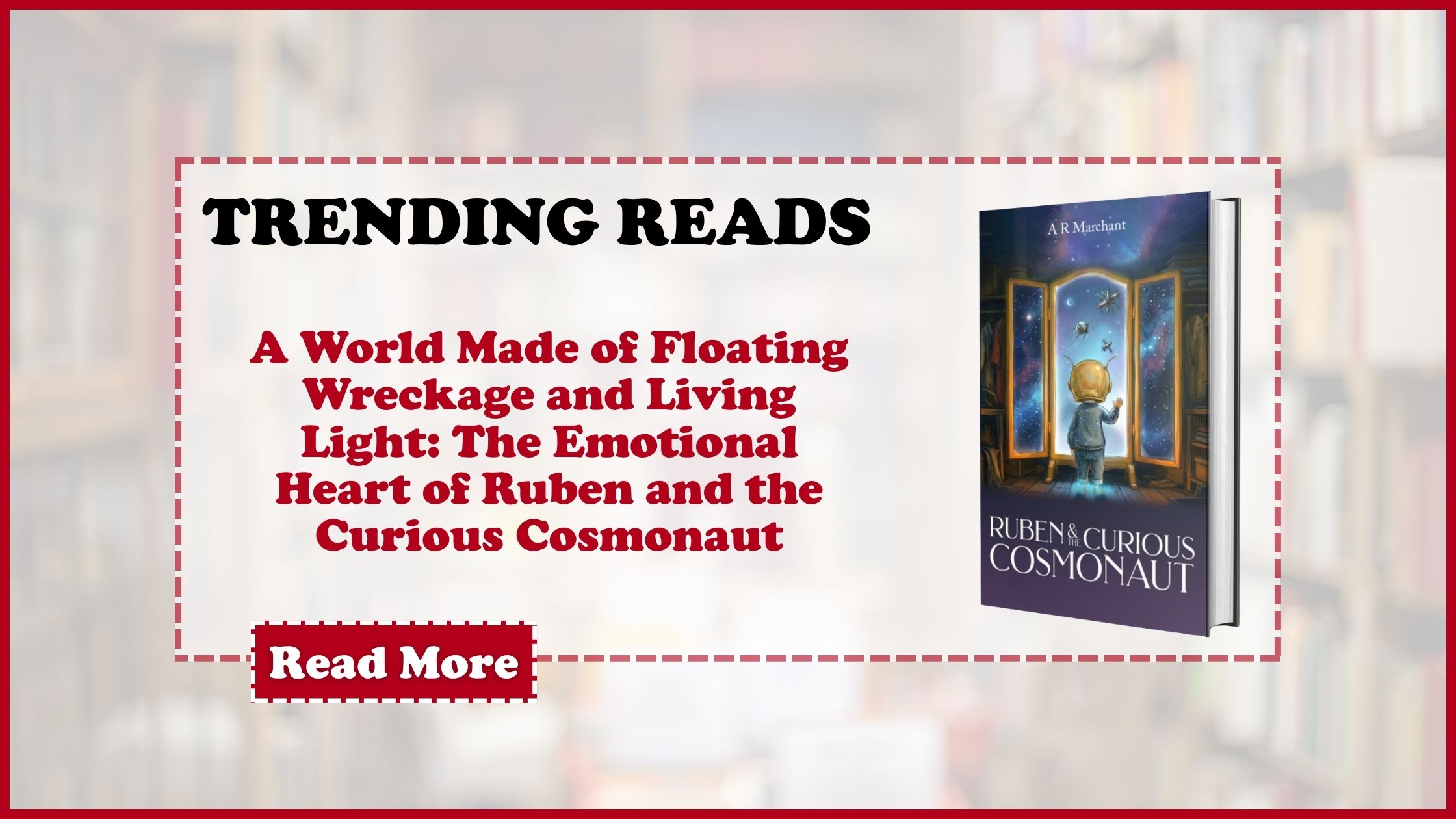
Ruben and the Curious Cosmonaut begins with a boy who does not think of himself as important.
That is the truest thing you can say about Ruben Grey. He is quiet, careful, and good at going unnoticed. He watches. He waits. He keeps his face still when things are difficult. He has learned, without anyone teaching him, how to hold doubt at a distance while still functioning. These are not flaws to overcome. They are skills he has built because he has needed them. But at the start of this story, he hasn’t yet understood that they might be useful to anyone else.
Then a battered cosmonaut helmet wakes up a threshold inside an ordinary mirror. And Ruben steps sideways into somewhere else entirely.
He does not step through because he feels ready. He is not ready. He does not feel brave, or certain, or chosen. He steps through because the moment is there and something in him decides to meet it. This is the first and most honest thing the book says about courage. It has nothing to do with confidence. Confidence is a feeling. Trying is a choice. And you can make the second without ever having the first.
The world Ruben enters, the Yard, does not make things easier. It is vast and suspended and built from wreckage. Industrial debris, torn structures, drifting panels, the fragments of things that were once part of something whole. At first glance it looks abandoned. At second glance it looks like it has been waiting. Pieces of old worlds hang motionless in the air as though the universe has paused them, unwilling to let them go entirely. Even the silence here has weight. Something watchful in it. Something that has not given up.
The Yard is not accidental. It is a mirror for Ruben’s interior world. A place built from broken and overlooked things, still functioning, still part of a system that most people cannot see.
At the heart of the Yard sits the Cosmic Engine, the mechanism that holds the connection between stars across the universe. When it fails, constellations begin to fade. Quietly. One by one. The kind of fading that happens slowly enough that you might not notice until it is almost too far gone. Ruben learns that the wreckage around him is not random. It is consequence. Parts of a system that drifted when they fell out of alignment.
What the Engine requires to be restored is not strength or certainty. It requires care. Crystals must be placed precisely. Mirrors must be aligned with patience. Faults must be understood, not forced into submission. The Yard responds to attention and presence. It does not respond to armour.
This is where the story makes its most important argument. Because Ruben arrives uncertain. He does not know if he can do what is needed. He says as much, internally, more than once. And yet his uncertainty, rather than disqualifying him, turns out to be the very thing that makes him capable. He is open to what he encounters. He does not arrive with fixed ideas about how things should behave. He looks at a cracked crystal and does not discard it. He considers it. He tries to understand what it can still do.
Someone who arrived certain may have forced things. Broken them.
Vulnerability, in this story, is not weakness. It is receptivity. The willingness to be affected by what you find, to sit with not-knowing long enough to actually understand something. Ruben’s doubt keeps him honest. It keeps him careful. It keeps him from the kind of confident error that would have cost the stars their light.
Sparky, the small glowing being who becomes Ruben’s guide, embodies the same idea. He is not powerful in obvious ways. His form flickers and shifts and warms as he moves through the debris. He is light that behaves like a living presence, aware and gentle, understanding the Yard not as ruin but as something unfinished. He does not offer certainty. He offers company. He helps Ruben see what is already there, not by solving anything, but by staying close enough that Ruben stops feeling entirely alone in the not-knowing.
Together, they begin to restore the Engine. And here the story defines bravery in terms a child can actually use. Not the kind that announces itself. Not the kind that waits until fear has passed. Ruben’s courage is the decision to step onto unstable ground while paying full attention to what is beneath his feet. It is the willingness to act without guarantees. To keep going not because he is sure it will work, but because stopping feels worse than trying.
This is a different kind of brave than children are usually shown. There is no dramatic moment where Ruben stops being scared and starts being a hero. The fear is there throughout. The self-doubt does not vanish. What changes is his relationship to it. He learns to carry it and move anyway. To let his hands be steady even when his certainty is not.
A cracked crystal still carries light. A dented helmet still remembers its purpose. The Yard’s broken things are not lesser for having been damaged. They are simply part of a longer story.
Stars begin to return. Not because Ruben was exceptional, or chosen in the way that stories usually demand. But because he was careful. Because he noticed. Because he tried, repeatedly, without knowing if it would work, and did not mistake his lack of confidence for lack of worth.
This is what the story gives to any child who has ever felt too quiet, too uncertain, too ordinary to matter. It does not tell them to feel braver. It tells them something more useful: that they do not need to feel brave to act. That vulnerability is not the thing standing between them and the life they want. It is, often, the thing that makes them good enough to help with the things that actually need doing.
By the time Ruben steps back through the mirror and returns home, the floating wreckage and the living light are no longer two separate ideas. They have become one understanding. The universe is not divided into the broken and the whole, the confident and the capable. It is a system where all of it coexists, kept in motion by those willing to pay close enough attention.
Ruben began uncertain of his place in the world. He returns as someone who understands that presence itself is a form of power. That a quiet voice, placed at the right moment, can carry more light than it knows.
Ruben and the Curious Cosmonaut is a book about smallness. And about what becomes possible when someone small enough to be overlooked stops waiting to feel ready and decides, quietly and carefully, to try anyway.