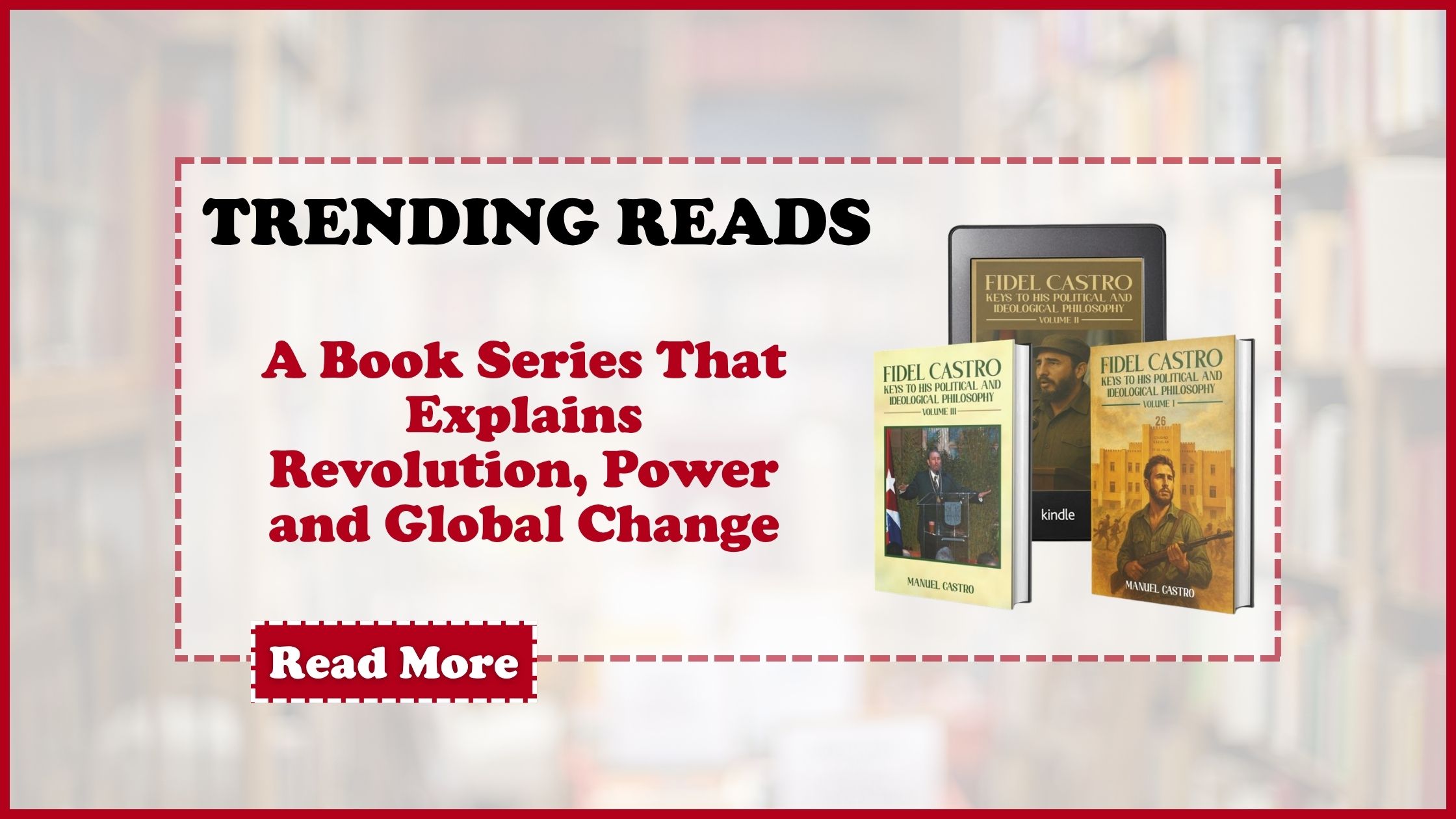
In a rapidly evolving world defined by political shifts, economic uncertainty and global power struggles, understanding the forces that shape societies has never been more important. While news cycles offer snapshots of events, they rarely explain the deeper ideas driving those changes. This is where Fidel Castro: Keys to His Political and Ideological Philosophy by Manuel A. Castro stands apart as a powerful three-volume series that explores the foundations of revolution, the dynamics of power and the realities of global change through the lens of Fidel Castro.
Rather than presenting a simple historical narrative, this series offers a structured and comprehensive analysis of political ideology. It draws from decades of speeches, policy decisions and historical developments to organize more than 300 key concepts into a coherent framework. These concepts cover a wide range of themes, including revolution, socialism, sovereignty, international relations, economic systems and social transformation. For readers seeking clarity in a complex world, this structured approach provides a clear pathway to understanding how ideas shape reality.
At the core of the series is the concept of revolution not as a single event, but as a multidimensional process that transforms every aspect of society. From economic restructuring to cultural development and education, revolution is presented as a long-term effort to redefine how a nation functions. Through detailed analysis, the books show how these ideas were applied in practice, offering readers a deeper appreciation of the relationship between theory and implementation.
Power is another central theme explored throughout the series. Instead of viewing power solely as control exercised by governments or institutions, the books present it as a dynamic force shaped by ideology, communication and collective action. The leadership of Fidel Castro demonstrates how ideas, when effectively communicated, can mobilize populations, challenge established systems and reshape national identity. This perspective encourages readers to think critically about how power operates both within and across nations.
The series also provides valuable insight into global change and international influence. By examining issues such as imperialism, economic inequality and geopolitical conflict, the books connect local developments to broader global trends. This is particularly relevant in today’s interconnected world, where political and economic decisions in one region can have far-reaching consequences. Readers gain a deeper understanding of how global systems function and why certain patterns of inequality and dependency persist.
One of the most compelling aspects of Fidel Castro: Keys to His Political and Ideological Philosophy is its focus on the role of people in shaping history. The series emphasizes that lasting change is not driven by leaders alone but by the collective consciousness and participation of society. Education, political awareness and unity are presented as essential tools for building sustainable systems. This human-centered approach adds depth to the discussion of revolution and power, highlighting the importance of shared responsibility in achieving progress.
Beyond its intellectual depth, the series is also highly practical. It bridges the gap between abstract theory and real-world application, showing how political ideas are translated into policies, movements and long-term strategies. For students, researchers and professionals, this makes the books a valuable resource for understanding both historical developments and contemporary challenges.
In an era where information is often fragmented and oversimplified, having access to a comprehensive and well-organized body of knowledge is invaluable. Fidel Castro: Keys to His Political and Ideological Philosophy provides that depth, offering readers a chance to engage with ideas that have shaped not only a nation but also global discourse.
Ultimately, this book series is more than a study of one leader or one revolution. It is a guide to understanding the broader forces that influence power, drive transformation and shape the future. For anyone seeking to make sense of revolution, power and global change, this series is an essential and thought-provoking resource.