Every day, we make sense of the world through stories.
A colleague does not respond to a message, and we create an explanation.
A project fails, and we decide who or what is responsible.
Someone behaves differently than expected, and we fill in the missing pieces with a story about why.
The event itself may be simple. Our interpretation of it often is not.
This ability to create explanations is one of the ways we navigate an uncertain world. We rarely have access to every fact, every motive, or every circumstance surrounding what happens around us. Our minds naturally fill those gaps, connecting information and creating narratives that help us understand what we are seeing.
The problem begins when we forget that the narrative is ours.
An interpretation can feel like a fact simply because we have repeated it to ourselves enough times.
From Observation to Interpretation
Consider a simple example.
A colleague sends you a short response to an email.
Observation:
“They replied with one sentence.”
Interpretation:
“They sound irritated.”
Narrative:
“They must be unhappy with my work.”
The first statement describes something that happened.
The second assigns meaning to it.
The third builds a larger story around that meaning.
By the time we reach the third step, we may already be reacting emotionally to a conclusion that was never actually established.
The colleague may have been busy. They may have been distracted. They may simply communicate differently.
Or they may actually have been irritated.
The point is not that one interpretation is always correct.
The point is that we often act on interpretations before recognizing that they are interpretations.
That distinction can influence everything from personal relationships to business decisions.
Why the First Explanation Is So Powerful
The human mind is designed to recognize patterns and create meaning.
This is useful. It allows us to learn from experience, anticipate problems, solve complicated situations, and make decisions without analyzing every possible variable.
But efficiency has a cost.
Once we develop an explanation that seems to fit the available information, we tend to organize subsequent information around it.
A manager who believes an employee is disengaged may interpret a missed deadline as evidence of poor commitment. A business owner who believes a campaign failed because of the advertising strategy may overlook problems with the product or customer experience. Someone who believes another person dislikes them may interpret an ordinary disagreement as confirmation.
The original interpretation becomes a lens.
And once that lens is in place, information can stop being something we evaluate and start becoming something we use to reinforce the story we already believe.
This is where first impressions can become difficult to correct.
The Story Can Become More Powerful Than the Evidence
One of the most dangerous aspects of a personal narrative is that it can continue growing even when the original evidence remains limited.
A single unanswered message becomes a perceived change in a relationship.
One failed project becomes evidence that a strategy does not work.
One mistake becomes proof that someone is unreliable.
One unusual event becomes part of a larger pattern.
The story becomes increasingly detailed, while the underlying facts may remain surprisingly small.
This does not mean our interpretations are necessarily wrong.
It means they deserve to be separated from what we actually know.
A useful habit is to ask:
What happened?
Then ask:
What am I telling myself about what happened?
Those two questions can produce very different answers.
The Pattern-Recognition Trap
Pattern recognition makes this even more complicated.
Our ability to identify patterns is one of the most powerful tools we possess. It helps investigators connect evidence, helps professionals identify recurring problems, and helps individuals learn from previous experiences.
But patterns can become traps when we stop testing them.
Imagine finding three events that appear connected. The connection seems convincing. Then a fourth event appears to fit the same explanation.
The pattern becomes stronger.
But there is another possibility:
What if the pattern is real, but its meaning has been misunderstood?
Or even more troubling:
What if someone deliberately created the pattern?
This distinction is central to understanding how information can influence perception.
When Someone Else Controls the Story
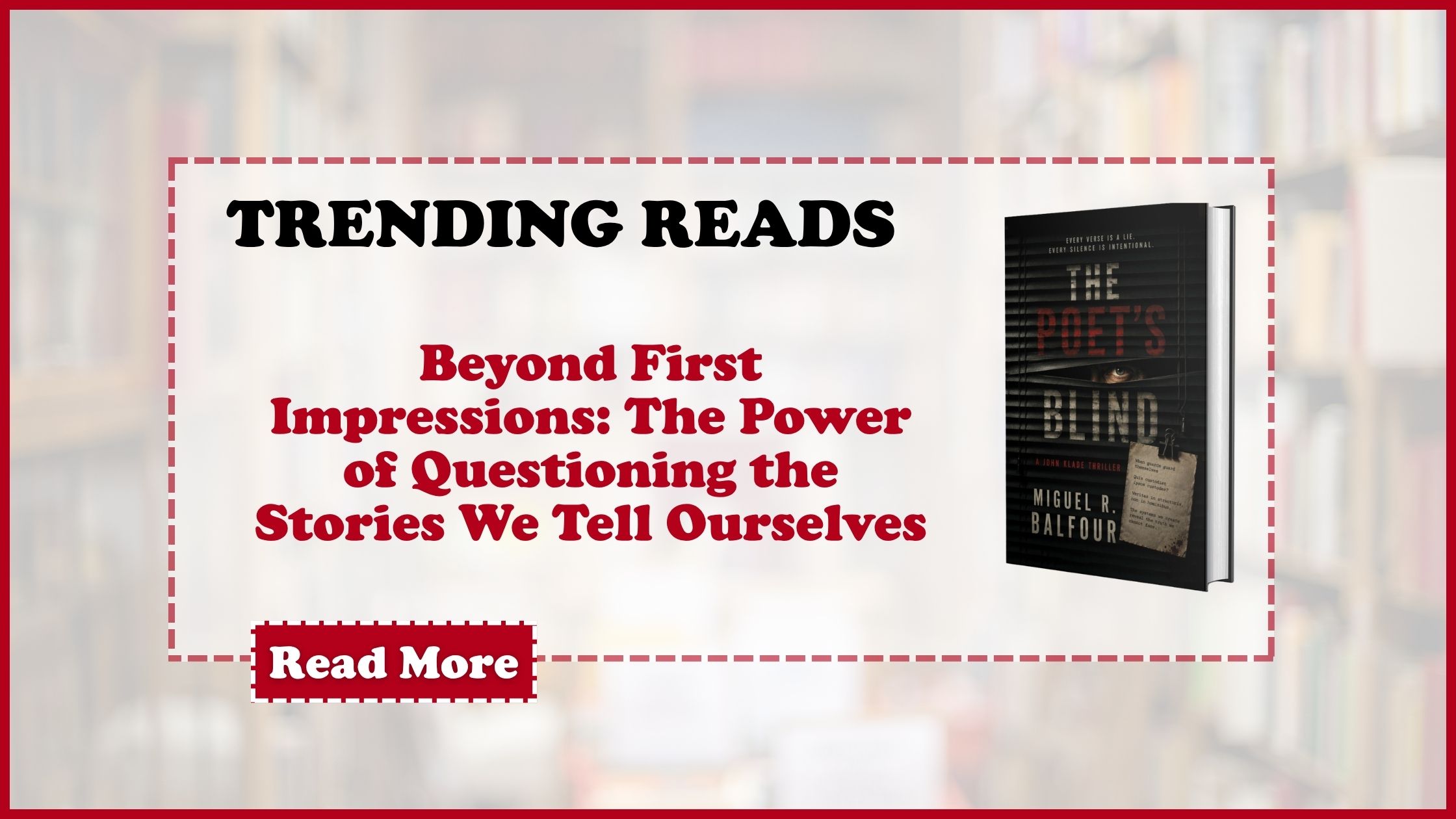
This idea is explored through John Klade in Miguel R. Balfour’s The Poet’s Blind.
Klade, a former military and intelligence operative with an exceptional ability to recognize patterns, becomes involved in a series of meticulously constructed murders. Cryptic poems and symbolic clues appear to offer investigators a path toward understanding the crimes.
At first, the evidence seems to tell a coherent story.
But as Klade examines the case more closely, the coherence itself becomes suspicious.
What if the clues are not simply revealing information?
What if they are influencing how investigators interpret the information?
The distinction changes the nature of the investigation.
Klade is no longer simply asking:
“What does this evidence tell us?”
He must also ask:
“Why was this evidence presented this way?”
That question introduces a more complicated problem. If someone understands how investigators think, they may not need to hide every piece of information. They may only need to arrange enough information to encourage the right interpretation.
The result is a battle not only over facts, but over the narrative constructed from those facts.
The Same Problem Exists in Everyday Life
Most people will never investigate a series of murders.
But everyone constructs narratives.
We do it at work.
We do it in relationships.
We do it when evaluating opportunities.
We do it when explaining our own successes and failures.
A person may decide:
“My boss doesn’t value my work.”
A team may decide:
“This process doesn’t work.”
A business may decide:
“Our customers aren’t interested.”
A person may decide:
“I’m simply not good at this.”
Each statement may eventually prove correct.
But before acting on it, there is value in examining the evidence behind the story.
What actually happened?
What did we infer?
What information are we missing?
What alternative explanation could fit the same facts?
And perhaps most importantly:
What evidence would cause us to change our minds?
A Simple Way to Look Again
The next time something seems obvious, try separating the situation into three layers.
1. Observation
Describe what happened without adding motives or explanations.
“The client has not responded to three emails.”
2. Interpretation
Identify the meaning you have assigned to the event.
“The client is probably unhappy with the work.”
3. Narrative
Notice the larger story that interpretation has created.
“They have lost confidence in us, and the project is probably going to fail.”
This exercise does not tell you which conclusion is correct.
It does something more valuable.
It shows you where certainty entered the process.
Once you can see that distinction, you have an opportunity to investigate rather than react.
Curiosity Creates Space for Better Decisions
Questioning our interpretations does not mean becoming suspicious of everything.
It does not mean refusing to trust our instincts or endlessly analyzing ordinary situations.
It means recognizing that the first story we construct is a starting point—not necessarily the final truth.
Sometimes our first impression is exactly right.
Sometimes additional information changes everything.
The difference is whether we remain open enough to notice when the second possibility is true.
That kind of intellectual flexibility can be particularly valuable when decisions involve incomplete information, competing explanations, or significant consequences.
The goal is not to eliminate uncertainty.
It is to become more comfortable examining it.
Looking Again
The deeper lesson explored in The Poet’s Blind is not simply that evidence can be misleading.
It is that the way evidence is presented can influence the story people build around it.
That principle extends far beyond an investigation.
We are constantly receiving incomplete information and turning it into explanations. Those explanations influence what we notice next, what we believe about other people, and what decisions we make.
Sometimes the story helps us understand reality.
Sometimes it becomes a barrier between us and reality.
The difference often comes down to whether we are willing to look again.
The next time a situation seems obvious, pause before completing the story.
Ask what actually happened.
Ask what you have inferred.
Ask what else might explain it.
Because the truth is not always hidden from us.
Sometimes it is simply waiting for us to look beyond the first story we told ourselves.