Do you often get anxious in your office? Perhaps your mind constantly juggles between deadlines and safety. To be honest, psychological safety is either ignored or discussed as a cultural value for many organizations. We, as safety professionals and organizations, need to realize that employees should feel comfortable speaking up, asking questions, and admitting uncertainty. And when it comes to automated work environments, psychological safety is also a system outcome. It is shaped by how tools monitor, evaluate, and respond to human behavior.
When systems assign tasks, track performance, or flag deviations, they influence how safe people feel expressing concern. If workers believe every action is judged without context, they may stay silent. Silence is not efficiency. It is a risk.
Automated systems can unintentionally discourage reporting. Workers may worry that raising concerns will reflect poorly in metrics they do not control. They may hesitate to question outputs that appear authoritative. Over time, this erodes the feedback loops safety depends on.
Psychological safety is closely linked to transparency. When people understand how systems work and what data is used, they are more likely to trust outcomes. When systems feel opaque, anxiety grows. Uncertainty consumes attention that should be focused on work.
Another factor is pace. Automated systems often compress timelines. When recovery time disappears, stress increases. People under constant pressure are less likely to reflect or speak up. Psychological safety requires space, not just permission.
Leadership behavior still matters, but system design amplifies or undermines it. A leader may encourage openness, but if systems punish deviation or flag every pause, the message becomes mixed. Workers trust what systems do more than what leaders say.
Building psychological safety in automated environments requires intentional design. Systems should allow for explanation, questioning, and human judgment. Metrics should be used to support learning rather than punishment. Feedback should be welcomed, not filtered out by dashboards.
Training also plays a role. Workers need confidence in how systems operate and how to respond when something feels wrong. Knowing when and how to intervene reduces fear and hesitation.
Psychological safety is not a soft concept. It affects error rates, reporting, and adaptation. In automated environments, it becomes a leading indicator of safety performance.
Organizations that recognize this link are better positioned to manage risk proactively. They understand that culture and systems are inseparable.
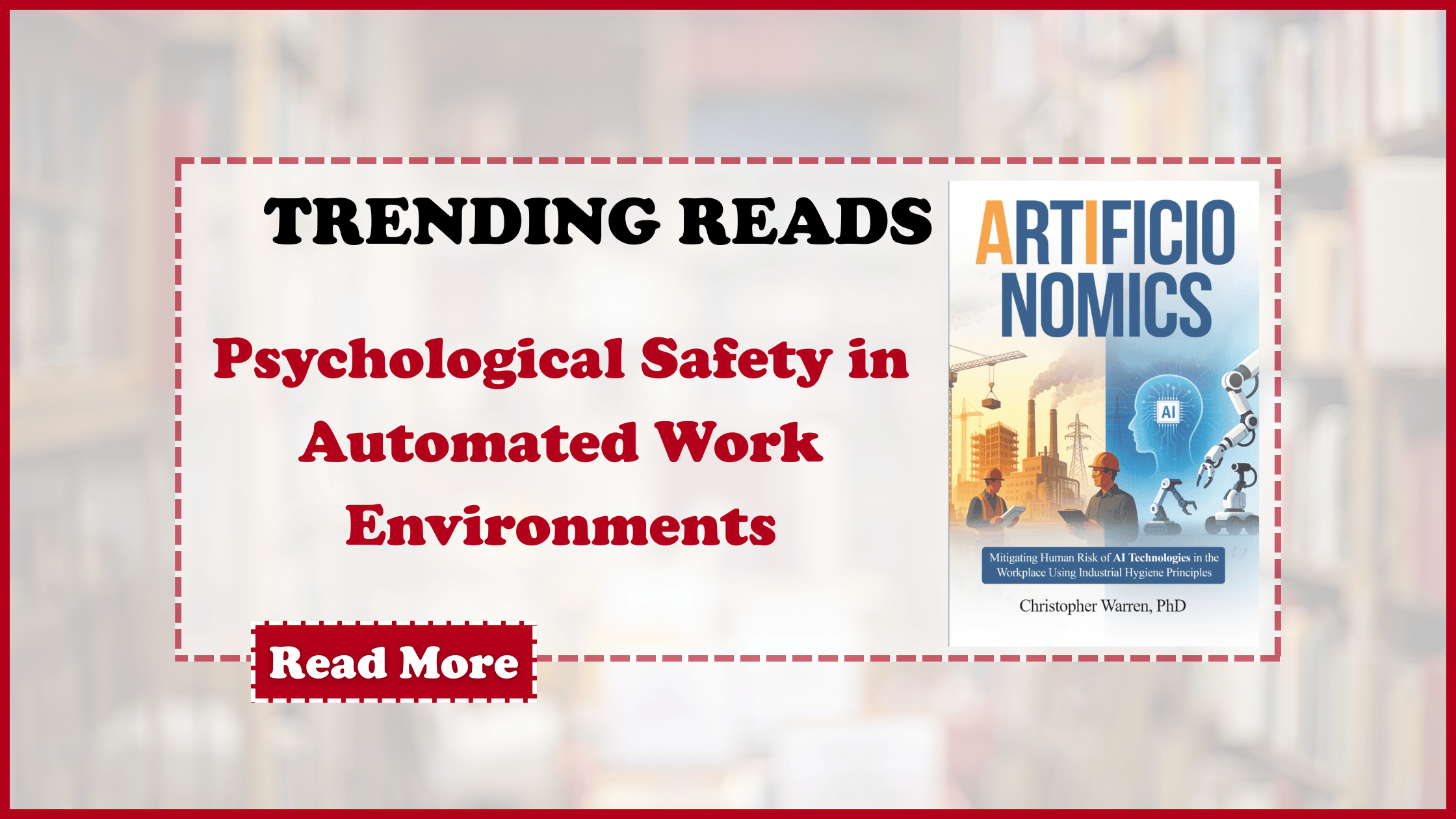
For leaders and professionals who are interested in exploring how technology design influences psychological safety, ArtificIonomics offers a practical perspective. By connecting culture to system behavior, the book helps organizations protect the human conditions that make safety possible, even as work becomes more automated. By focusing on both human impact and performance, ArtificIonomics will help organizations to adopt AI in ways that protect both their brand reputation and workforce stability. Responsible AI does not just prevent harm. It creates the conditions for long-term trust.
For more information and insight please visit https://artificionomics.com/.