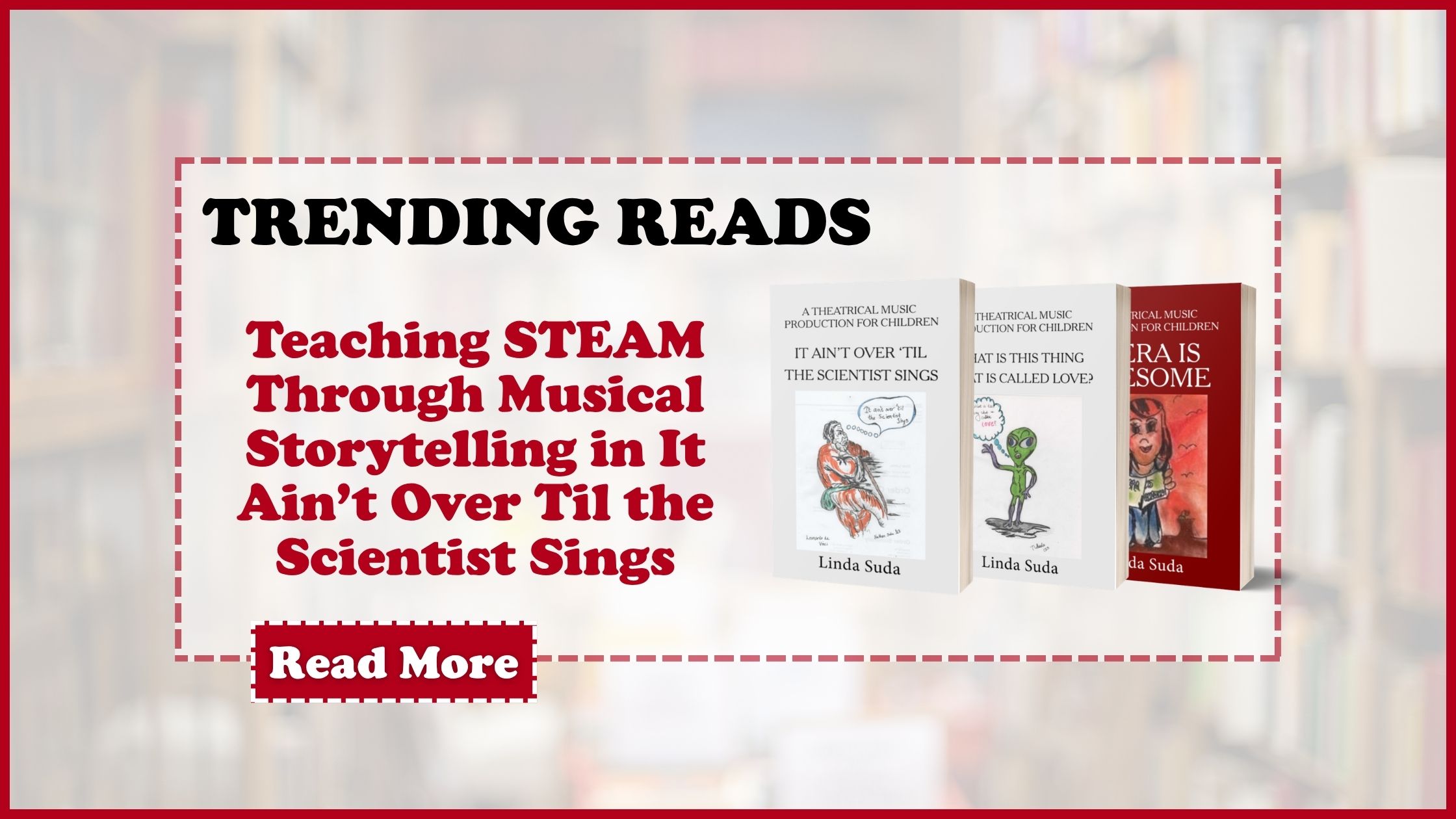
Children are naturally curious about how the world works, yet many struggle to connect abstract scientific ideas with real life. Facts alone rarely spark lasting interest. It Ain’t Over Til the Scientist Sings by Linda Suda offers a different approach. By blending music, theatre, and storytelling, the book introduces STEAM learning in a way that feels engaging, human, and memorable for young audiences.
At the heart of It Ain’t Over Til the Scientist Sings is the idea that creativity and logic belong together. The story brings well-known scientists to life through song and performance, showing children that discovery is not just about numbers or experiments. It is also about imagination, curiosity, and persistence. When historical figures step onto the stage as characters, they become easier to understand and easier to remember.
Musical storytelling plays a key role in this process. Music helps students absorb information through rhythm and repetition. Lyrics allow complex ideas to be simplified without losing meaning. When children sing about scientific achievements, they begin to connect knowledge with emotion. It makes learning feel active rather than passive. Instead of listening to a lesson, students participate in it.
Theatre adds context and structure to the STEAM themes explored in the book. Scenes show how scientific ideas developed over time and why they mattered. Through dialogue and interaction, children learn that science does not exist in isolation. It grows through collaboration, trial and error, and creative thinking. It reinforces the core goal of STEAM education, which is to encourage students to think across subjects rather than keeping them separate.
Another strength of It Ain’t Over Til the Scientist Sings is its focus on role models. By highlighting scientists from different backgrounds and fields, the book shows that innovation comes in many forms. Young performers see that problem-solving can involve art, music, and storytelling alongside research and observation. It helps students who may not see themselves as traditional science learners feel included and capable.
The performance-based structure of the book also supports different learning styles. Some children learn best by moving, others by listening, and others by speaking or singing. Musical theatre allows all of these approaches to exist at once. As a result, students remain engaged and confident while exploring both artistic and scientific ideas.
For educators, the book provides a practical way to integrate STEAM into school programs. It can be used in classrooms, music lessons, or school productions. The material encourages collaboration between teachers of different subjects and helps students see learning as a connected experience rather than a series of separate tasks.
It Ain’t Over Til the Scientist Sings by Linda Suda shows that teaching STEAM does not require removing creativity from the classroom. Instead, it proves that music and theatre can deepen understanding and spark curiosity. For anyone seeking a meaningful and accessible way to introduce children to science through the arts, this book is well worth reading.
Amazon Book Link : https://www.amazon.com/dp/B0GLTZBYQP/