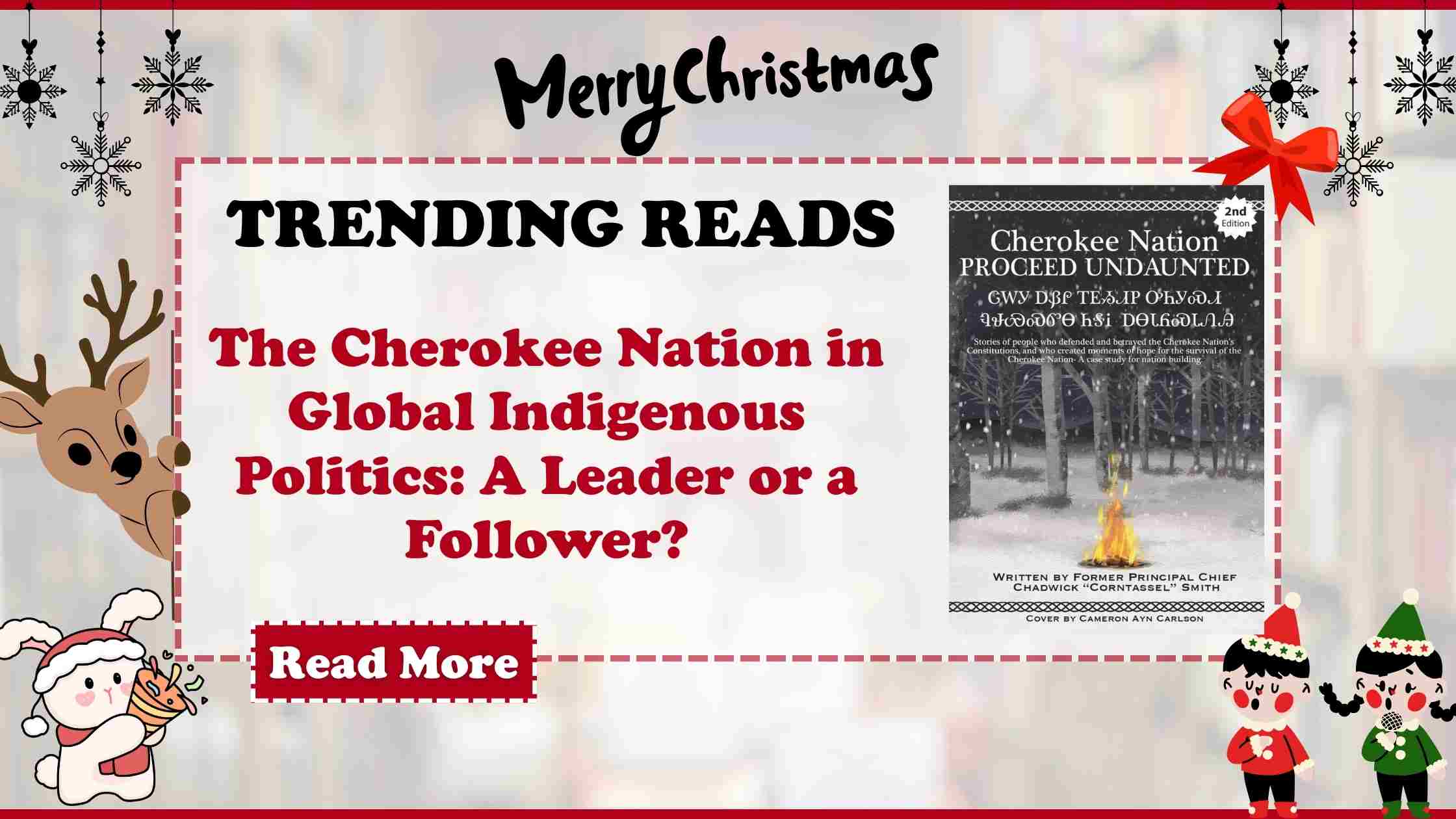
The Cherokee Nation has long been recognized as a powerful force in Indigenous governance, navigating legal and political challenges to maintain its sovereignty. But how does it compare to other Indigenous nations globally? Is it a leader in self-governance, or does it still follow paths laid by others?
Sovereignty in a Global Context
The Cherokee Nation’s status as a “domestic dependent nation,” as defined by the U.S. Supreme Court in Cherokee Nation v. Georgia (1831), places it in a unique legal framework compared to many other Indigenous nations worldwide. Unlike many Indigenous groups in Canada or Australia that still struggle for self-determination, the Cherokee Nation has a recognized government, a constitutional framework, and significant economic assets. However, as Chadwick Smith highlights in Cherokee Nation: Proceed Undaunted, sovereignty has been repeatedly undermined through external pressures and internal challenges, from land dispossession to federal oversight.
Globally, Indigenous nations have fought for various levels of self-determination. The Sámi Parliament in Norway, for example, operates within a framework of recognized cultural autonomy but lacks legislative power. New Zealand’s Māori, through the Treaty of Waitangi, have secured partial self-governance, though disputes remain over land rights. The Cherokee Nation, by contrast, has exercised greater control over its political and economic affairs, from gaming enterprises to healthcare systems. However, as Smith notes, recent governance crises have called into question whether Cherokee leaders are truly working toward Indigenous self-determination or merely replicating mainstream political structures.
Lessons from the Cherokee Experience
One major lesson from the Cherokee Nation’s history is the importance of constitutional integrity. Smith details how various Cherokee leaders have manipulated or disregarded constitutional principles, undermining the very framework that should protect the people. This echoes struggles faced by Indigenous governments worldwide, where internal divisions can sometimes weaken sovereignty claims.
Another key takeaway is the danger of external dependence. Many Indigenous nations, including the Cherokee, have relied on federal funding, which can limit true autonomy. The comparison to Indigenous groups like the Mapuche in Chile—who, despite their marginalization, have fiercely resisted governmental control—raises the question: Is economic stability worth the risk of political compromise?
A Leader or a Follower?
The Cherokee Nation stands as a model of both success and caution. It leads in economic self-sufficiency and governance structures, but its history of legal battles and internal struggles shows that sovereignty is never fully secure. Indigenous nations worldwide can learn from the Cherokee experience, particularly the need to defend constitutional integrity, resist dependency, and maintain unity in the face of external and internal threats.
Get the book on Amazon : https://www.amazon.com/dp/B0FN47D586/