Every government looks strong when times are stable. But when the stakes are high, when institutions are put to the test, when choices must be made fast, and when values are either upheld or undermined, true leadership emerges. In this respect, some of the most persuasive lessons can be learned from tribal governments, such as the Cherokee Nation.
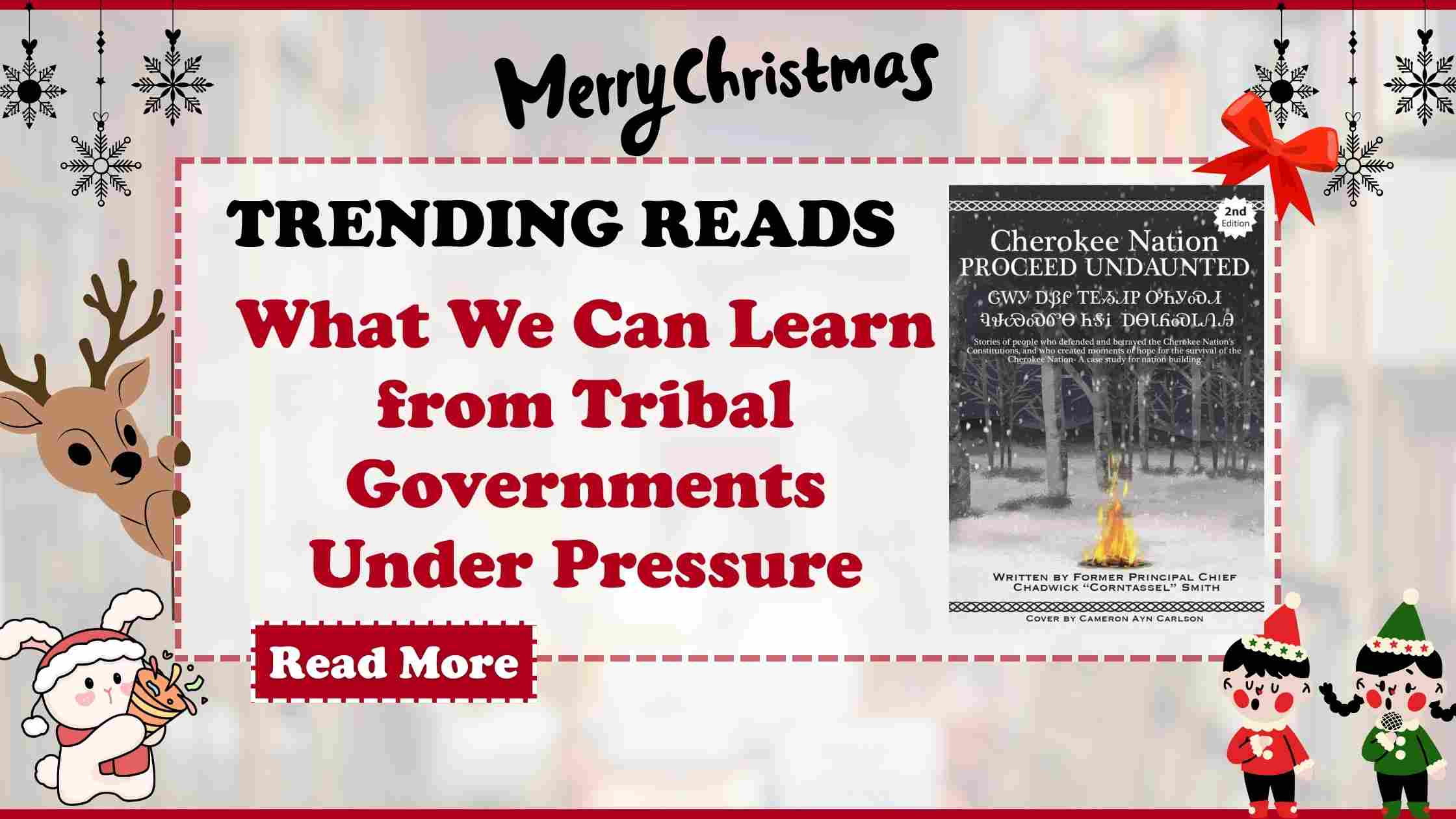
InCherokee Nation Proceed Undaunted, Chadwick “Corntassel” Smith gives us an insider’s view of leadership under pressure. His time as Principal Chief was marked not just by growth and reform, but also by constitutional crises and political tension. And yet, the Cherokee Nation didn’t collapse—it recalibrated.
The key here is the leadership that was willing to lean into accountability, not away from it.
Smith shares how, in the early 2000s, the Cherokee Nation faced internal challenges that could have undermined its democratic system. The executive branch attempted to remove judges prematurely. Constitutional rules were bent, ignored, or challenged. The temptation for unchecked power had crept in, as it often does, disguised as urgency or efficiency.
But instead of meeting power with more power, Smith and others turned to the rule of law. The courts, the constitution, and the voice of the people became the tools for correction, not conflict. What emerged was not a broken system, but a stronger one. By facing its problems head-on, the Nation reminded itself—and its leaders—that real power comes from structure, not force.
This example is rich with takeaways for other governments, whether tribal, local, or national.
First, it shows the importance of the separation of powers. When all authority is concentrated in a single branch—or worse, a single person—democracy falters. Tribal nations like the Cherokee have learned to distribute power across executive, judicial, and legislative branches, not just to copy other systems, but to protect their own future.
Second, it highlights the role of civic responsibility. Cherokee citizens didn’t sit back and let politicians do what they pleased. They learned the law, challenged overreach, voted, advocated, and organized. In doing so, they became active participants in their government, not just spectators.
Third, it underscores the strength of cultural grounding. Cherokee governance isn’t just about policies. It’s about principles rooted in community, justice, and shared responsibility. That grounding makes it easier to navigate hard times without losing the Nation’s sense of purpose.
Leadership under pressure doesn’t mean having all the answers. It means having the humility to listen, the courage to act, and the wisdom to follow rules even when it’s inconvenient. In many ways, the Cherokee Nation has modeled these traits better than many larger governments.
Smith’s reflections in Cherokee Nation Proceed Undaunted are not only about past challenges. Instead, they’re a call to present and future leaders. Whether leading a tribal council, a school board, or a national agency, the core lesson is the same: build systems that survive stress.
Governments that pretend nothing can go wrong often crumble when things do. But governments like the Cherokee Nation, who face their flaws, invest in education, and keep power in check, don’t just survive pressure. They grow from it.
In a world where political systems are under increasing strain, the Cherokee Nation’s experience is not a footnote. It’s a guide. And it reminds us that the most resilient governments are the ones who stay accountable for themselves and their people.
The Cherokee Nation faces new challenges as an administration and a court seemingly ignore its Constitution and laws. This adversity gives Cherokees the opportunity to hold their government accountable again.
For more information, please read Cherokee Nation Proceed Undaunted. available on Amazon : https://www.amazon.com/dp/B0FN47D586/