An ethical state does not exist by law alone. It exists through shared responsibility. Citizenship in such a state requires more than participation. It requires moral engagement. Laws can establish order, but they cannot sustain integrity without the active involvement of citizens who understand their role in maintaining ethical standards. An ethical society is not enforced from above. It is upheld daily through choices made by individuals.
Many people view ethics as personal and politics as separate. This separation weakens democracy. When citizens disengage ethically from public life, power fills the vacuum. Authority becomes concentrated. Accountability fades. Without ethical pressure from the public, institutions drift toward convenience and control rather than responsibility.
An ethical state depends on institutions such as family, education, work, and community. These structures teach responsibility before authority. They shape values long before individuals encounter formal power. When these institutions weaken, individuals turn to ideology for meaning. Ideology promises certainty without obligation. It simplifies complex realities and replaces moral effort with emotional alignment.
Citizenship involves accepting moral limits. It means recognizing that rights are connected to responsibility. Freedom without restraint leads to entitlement rather than justice. Ethical citizenship requires resisting the temptation to reduce politics to identity or emotion. It demands attention to consequence, context, and consistency.
The ethical state also requires pause. Not every action that is possible is justified. Not every demand is ethical. Citizens play a role in reinforcing this restraint by refusing to reward moral simplification. When quick answers replace careful reasoning, ethical judgment erodes.
When citizens abandon ethical responsibility, leadership follows. Power adapts to expectation. Ethical decline is rarely imposed. It is permitted. Leaders reflect the values they are allowed to hold. When moral disinterest becomes common, ethical leadership becomes rare.
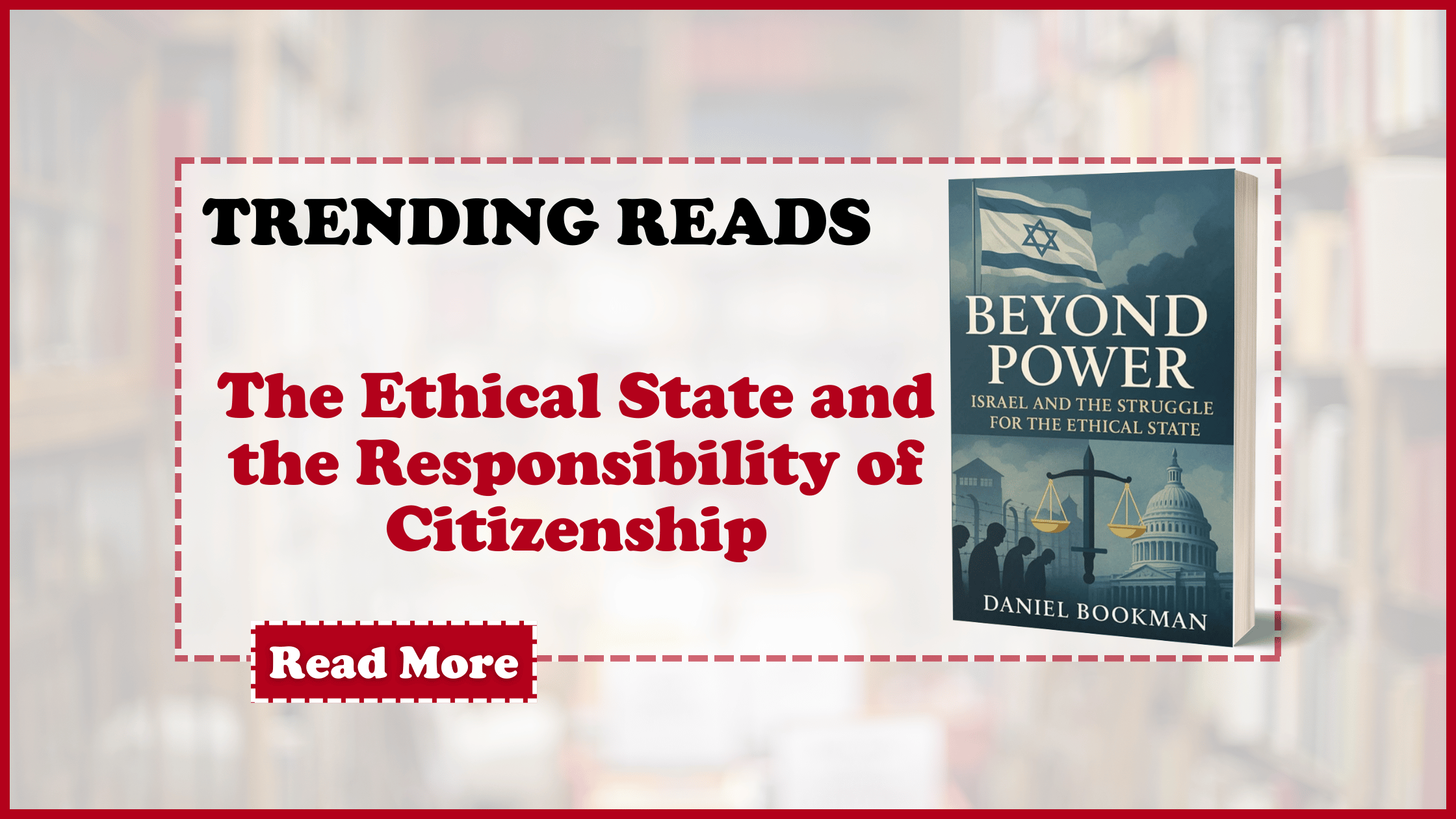
These principles are central to Beyond Power: Israel and the Struggle for the Ethical State, which presents ethical citizenship as the foundation of democratic survival. The survival of democratic societies depends on citizens who understand the cost of moral disengagement. Ethics are not maintained through slogans. They are maintained through consistency.
By tracing the tensions between power and ethics, Beyond Power explores how successful democracies evolved, why politics so often devolves into hostility, why societies fracture, and understanding more deeply the progressive agenda and why Israel in particular stands at the center of so much global controversy. It examines how democracies are corroded from within, how oppressive regimes weaponize ideology, the dynamics of geopolitical tensions, and how Western progressivism redefines compassion. Head to Amazon to purchase your copies: https://www.amazon.com/dp/B0G1D4N83H/
The survival of democratic societies depends on citizens who understand the cost of moral disinterest. Ethics are not maintained through titles. They are maintained through consistency and moral engagement requires effort and patience. It is sustained through everyday accountability rather than public display, which we all need to realize.