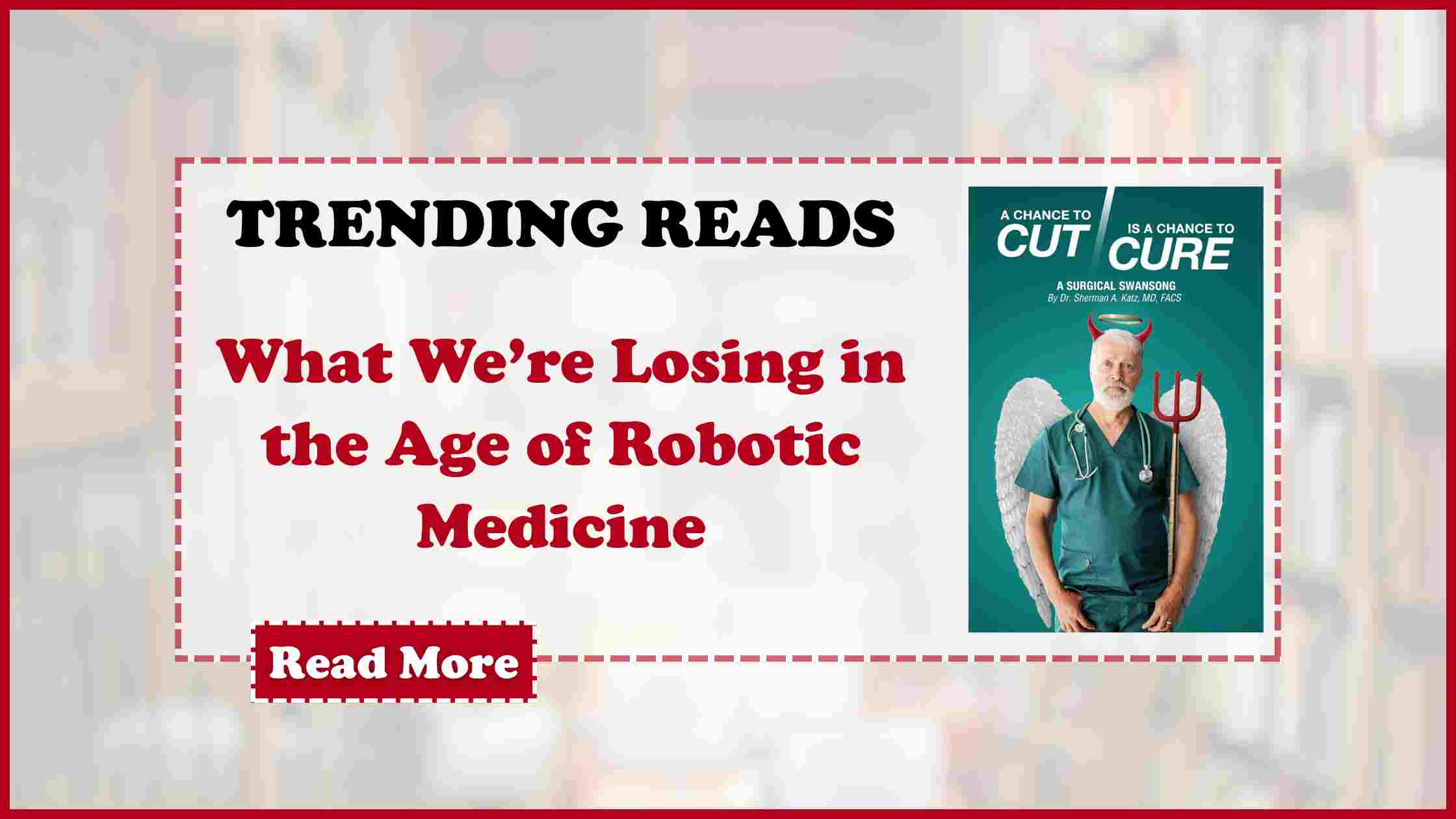
There was a time when surgeons learned their craft by feel as much as by sight. When the surgeon’s hands, guided by experience and instinct, were the sharpest instruments in the operating room. But those days, as Dr. Sherman A. Katz writes in A Chance to Cut Is a Chance to Cure, are slipping away. In their place stands a sleek, efficient, but emotionally hollow version of modern medicine.
Dr. Katz’s memoir captures a surgeon’s life that bridged two worlds. On one side was the gritty, personal, and deeply hands-on practice of old-school surgery. On the other side is the emerging world of robotic arms, digital dashboards, and remote-controlled procedures. While these advancements have brought undeniable improvements in precision and outcomes, they have also carried a quiet cost. That cost, as Katz reminds us, is something less measurable: human connection, artistry, and the soul of the healer’s touch.
Robotic medicine is not a villain. It has allowed surgeons to operate with smaller incisions, fewer complications, and faster recovery times. It has given access to lifesaving procedures that would have been unimaginable decades ago. But Katz argues that this progress has come at a price. Surgeons are now technicians more than artists. Residents train more on screens than on patients. And the skill of reading a wound with your fingertips or trusting your gut instinct is fading fast.
For Katz, the shift is personal. He trained at a time when mistakes taught lessons that lasted a lifetime, when closing a wound with precision was a matter of pride and reputation, and when surgeons stood at the bedside. He laments how these tactile, sensory aspects of surgery are being replaced by mechanical consistency. As he puts it, cutting and sewing were rituals that bonded surgeon and patient in a sacred trust.
What’s missing now? He suggests that it is presence. For example, technology mediates the doctor-patient relationship in a way that can be sterile and distant. Surgeons no longer rely on feel but on feedback from machines. Even diagnoses are becoming algorithmic. This may reduce errors, but it also removes the human layer of healing. The look in a patient’s eye, the subtle change in tone, the instinct to pause—all of it risks being lost in translation.
And what about the next generation of surgeons? Katz expresses deep concern for trainees who may graduate with limited experience in open surgery. With robotic and laparoscopic procedures dominating the field, young doctors may never develop the manual dexterity or emotional resilience once considered essential. The result could be a breed of surgeons highly trained in digital precision but lacking the intuitive confidence built through human practice.
None of this is a call to abandon innovation. Katz is not against progress. Rather, he urges a balance. He believes that while machines can enhance the surgeon’s work, they should not replace the soul of the practice. The surgeon must be more than a programmer. The patient must remain more than a case.
Ultimately, Katz’s memoir is a love letter to a vanishing era and a cautionary tale for what lies ahead. He asks us to consider what kind of medicine we want to inherit. One where the human touch is a memory, or one where technology and compassion move forward together?
As we stand on the brink of fully robotic operating rooms and artificial intelligence guiding clinical decisions, we must not forget what made medicine noble in the first place.
For more information and insight, please read A Chance to Cut Is a Chance to Cure.
Order your copy on Amazon: https://www.amazon.com/dp/1968615334.