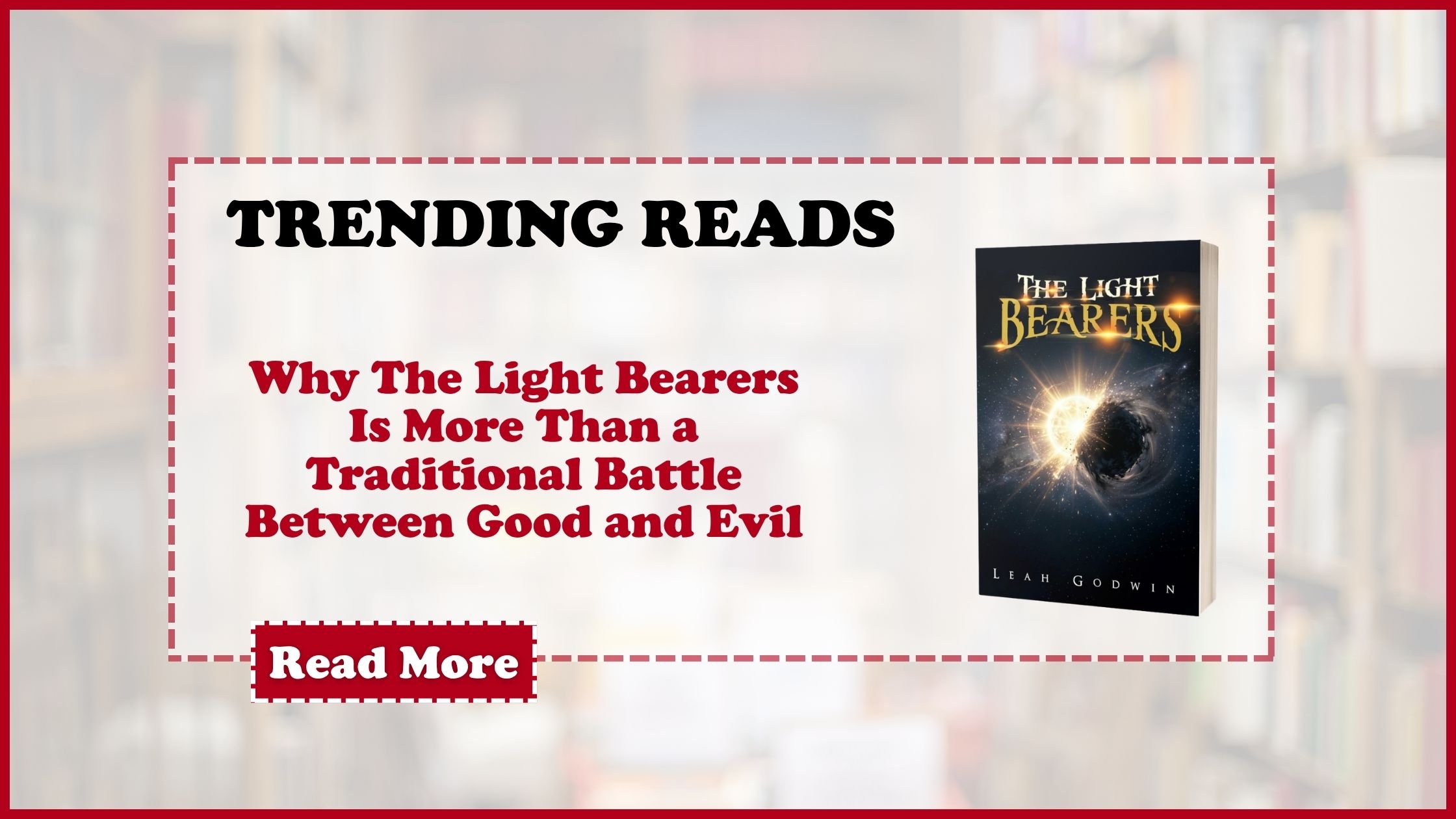
Stories about light and darkness often seem simple at first. Light represents good. Darkness represents evil. The hero stands on one side, the villain on the other and the conflict becomes a clear struggle between right and wrong.
Leah Godwin’s The Light Bearers takes that familiar idea and makes it far more complicated.
In this speculative novel, Light is not merely a symbol. It is a conscious force with its own history, preferences, disappointments and complicated relationship with humanity. Across generations, Light chooses individuals to carry extraordinary abilities, creating a lineage of Light Bearers whose powers can heal, protect, connect people and under certain circumstances, destroy.
That immediately changes the nature of the conflict. The story is not simply about defeating darkness. It is about understanding what people do with power, how fear changes communities and how even something associated with goodness can become dangerous when control, exploitation and resentment enter the picture.
Light Does Not Automatically Make Life Easy
The Light Bearers are extraordinary, but their gifts do not guarantee peace.
Throughout the novel, Bearers are treated in dramatically different ways. Some are protected and celebrated. Others are manipulated, feared, hidden, exploited or pushed toward violence. Stella, one of the earlier Bearers, learns that those who came before her were sometimes used as weapons of war. Her own family tries to protect her from that fate, hoping she can choose a different purpose for her abilities.
That distinction matters.
The danger in The Light Bearers is not always the supernatural power itself. Often, the greater threat comes from the people who want to possess it, monetize it, control it or eliminate it.
Human Darkness Can Be More Frightening
Luciana Ansel’s modern-day story makes this idea even stronger.
As the present Light Bearer, Luciana lives under extraordinary scrutiny. Her private life becomes public entertainment. People gamble on her actions, profit from items she has touched and manipulate situations around her for personal gain.
This gives the novel a darker kind of conflict, one that does not depend on monsters or obvious villains.
Instead, Godwin explores invasion of privacy, exploitation, greed, emotional manipulation, grief, addiction, trauma and the consequences of being treated as something other than fully human.
Luciana may carry immense power, but she also carries deeply personal wounds. Her experiences following the death of her brother Milo, along with her struggles with hospitalization and mental health, reveal how vulnerable a person can remain even when the world sees them as extraordinary.
A More Complicated Question About Power
That is what makes The Light Bearers more than a conventional good-versus-evil story.
The novel repeatedly asks whether power is defined by what someone possesses or by how they choose to use it. It also examines whether communities respond to difference with compassion, fear, greed or control.
Light can heal. Light can protect. Light can also destroy. Darkness, meanwhile, is not always something supernatural waiting in the shadows. Sometimes it appears in exploitation, cruelty, prejudice, secrecy or the decision to treat another person as a means to an end.
For readers who enjoy speculative fiction with moral complexity, emotional intensity, historical scope and supernatural mythology, Leah Godwin’s The Light Bearers offers a story that asks readers to look beyond simple labels.
Read The Light Bearers by Leah Godwin on Amazon: https://www.amazon.com/dp/B0HK8LQ97G/