Being a researcher is a paradox. It demands rigorous thinking, careful planning, and a relentless pursuit of answers. Yet, as any seasoned scientist knows, most of the time those answers do not come easily. Experiments fail. The Projects stall. Progress is rarely linear. The day-to-day experience of research can be deeply frustrating.
But frustration is not the full story. In the long arc of a scientific life, there are also moments of imagination, camaraderie, and surprising joy. These moments, though often overlooked, are vital. They keep the spark alive and remind us why we chose this path to begin with.
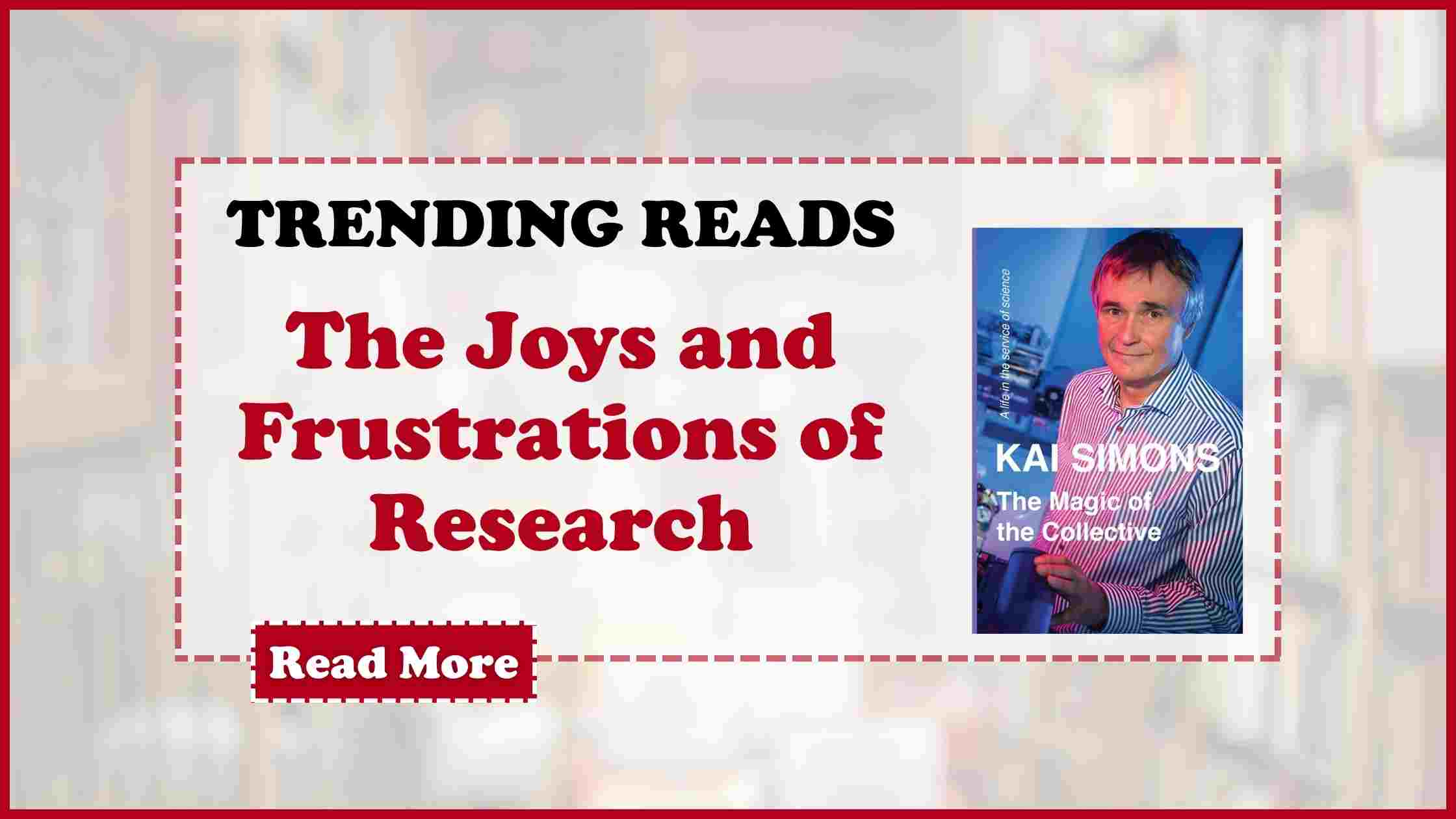
Kai Simons, one of Europe’s most influential cell biologists, captures this dual nature of science with refreshing honesty in his memoir The Magic of the Collective. Reflecting on decades of lab leadership, collaboration, and discovery, Simons paints a portrait of science not as a solitary struggle but as a rich human endeavor filled with tension, creativity, and community.
He writes about how projects sometimes hit a wall. When that happens, the best solution is not to double down in frustration, but to step back and make room for new thoughts. For Simons, playfulness became a surprising ally. In his lab, humour was encouraged. He recalls how Gareth, a brilliant electron microscopist, was also a gifted clown. Together, they arranged parties and performed shows, poking fun at themselves and others. It was a reminder that while research is serious work, a playful mood can unlock creative thinking.
That spirit of openness extended to leadership. Simons adopted a hands-on approach, regularly walking through the lab to talk science with students and staff. He encouraged his group leaders to explore their own ideas, but within a shared framework that fostered synergy rather than fragmentation. He believed in productive tension, where disagreement could fuel better thinking rather than breed conflict.
Not every idea he suggested was taken up, and sometimes his interventions had the opposite effect. But that did not matter. What mattered was the conversation. Simons wanted to spark dialogue, challenge assumptions, and encourage researchers to think beyond their own projects. One of his key collaborators, Graham Warren, helped drive this critical discourse, digging into problems from every angle and ensuring that no idea went unexamined.
At the European Molecular Biology Laboratory (EMBL), where Simons led the Cell Biology Programme, lab meetings were robust affairs. Disagreements were aired freely. When consensus could not be reached, Simons made the final call. And remarkably, the team accepted his decisions. The process was exhausting, often leaving him with a headache by day’s end, but it also left everyone feeling heard.
Beyond leadership, Simons emphasizes the importance of staying intellectually connected to the wider world of science. He recounts how he devoured research papers across disciplines, reading original sources instead of relying on second-hand summaries. This habit, he believed, was essential to developing the ability to make connections and generate new ideas.
Even on vacation, he could not put down the papers. He describes bringing stacks of reprints to the family’s summer cottage in Finland, some still bearing mosquito stains from late-night reading sessions. His obsession reached a point where his family thought he had gone mad. Eventually, he lightened the load—but not the passion.
The ability to connect fields, associate ideas, and spot patterns across disciplines became one of Simons’s greatest strengths. Whether listening to a lecture on an unfamiliar topic or reading a century-old textbook, he remained open to insight from all corners of biology. This broad view helped his lab make major contributions, such as identifying the trans-Golgi network’s role in protein and lipid sorting.
In the end, The Magic of the Collective reminds us that science is more than data and deadlines. It is also about people, personality, and perseverance. It is about learning how to work together, resolve conflicts, stay curious, and never forget the joy that brought us to discovery in the first place.
For researchers feeling stuck or seeking inspiration, Simons’s story offers wisdom from a life. You can purchase the book from Amazon: https://www.amazon.com/dp/1917007027.